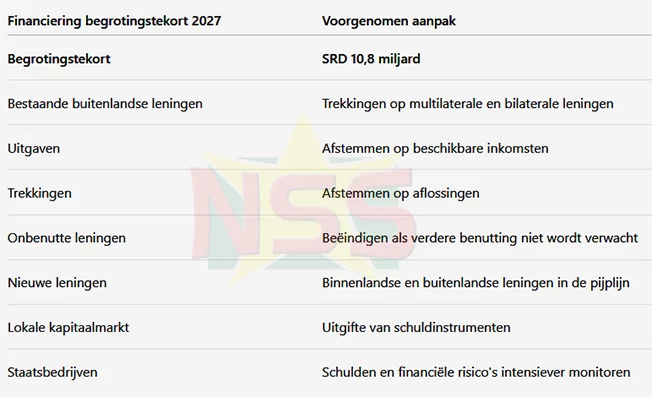
Suriname’s government has laid out a multi-pronged national debt and budget financing strategy in its newly released 2027 State Debt Plan, outlining how it intends to cover an estimated SRD 10.8 billion budget deficit equal to roughly 4 percent of the country’s projected 2027 gross domestic product.
The core financing approach draws on three primary external and domestic credit sources, starting with undisbursed funds from existing foreign loan agreements with multilateral and bilateral creditors. The administration plans to draw down these available funds in a phased manner aligned with the government’s scheduled debt repayment obligations to avoid unnecessary liquidity strains. It also has plans to secure new loans from both domestic and international lenders, though the official debt plan does not break down how much of the total deficit will be covered by existing loans, new borrowing, or other unspecified funding sources.
Rather than relying solely on new borrowing to close the budget gap, the government has coupled its financing plans with fiscal consolidation measures. The strategy requires aligning public sector spending more closely with available government revenue. Additionally, the administration will conduct periodic reviews of undisbursed portions of existing loans, terminating agreements that are no longer expected to be utilized. This step is designed to prevent unused credit lines from being counted as potential future drawdowns that would create unnecessary interest and repayment obligations down the line.
A key long-term policy initiative laid out in the plan is the development of a local sovereign debt market to shift more financing domesticity over time. Starting in 2027, the government will launch an initial issuance of debt instruments with limited volumes and relatively short maturities. Over the next two years, the gradual development of this market is expected to create a sustainable new channel to cover future budget deficits within Suriname’s own borders, which will progressively reduce the sovereign’s foreign exchange risk. Currently, the vast majority of Suriname’s national debt is denominated in foreign currencies, meaning exchange rate fluctuations directly increase the local currency value of outstanding debt obligations. Beyond reducing currency risk, the government projects that a thriving local debt market will help rebuild public and investor confidence in the Surinamese dollar and encourage domestic saving and investment.
The government is also tightening risk monitoring for state-owned enterprises as part of its broader debt management strategy. While the long-term debts of these state companies are already under formal monitoring, the administration will expand oversight to get a clearer picture of potential contingent liabilities that could fall to the public purse if state firms fail to meet their payment obligations. To implement this enhanced monitoring, the government plans to secure targeted technical support and develop formal standardized guidelines, with the ultimate goal of identifying potential financial risks and unexpected funding needs at the earliest possible stage.
Overall, the 2027 State Debt Plan formalizes a four-pronged approach to fiscal and debt management for the year: utilizing existing available credit lines, securing new domestic and external financing, tying public spending more closely to current revenue, and building out a domestic sovereign debt market to support long-term debt sustainability.