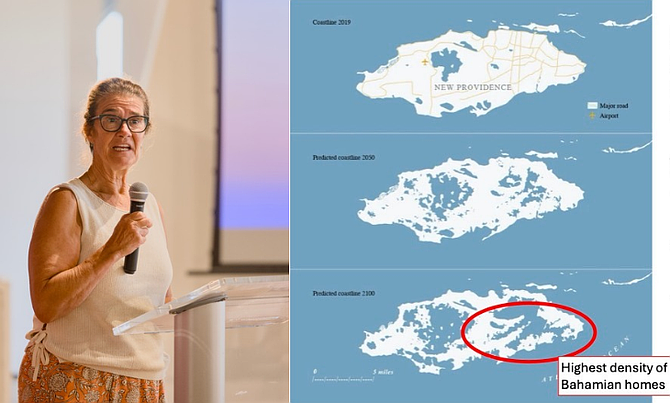
As climate change drives accelerating sea level rise globally, low-lying island nations like The Bahamas are on the front lines of existential risk. During the recent Bahamas Climate Week, hosted by the Baha Mar Resort Foundation, leading marine ecologist Dr. Kathleen Sullivan Sealey delivered a stark warning: many of the most densely populated communities on New Providence, the country’s most populous island, could lose large swathes of liveable land within the next few decades if proactive planning does not begin immediately.
Dr. Sealey, who serves as Professor Emerita at the University of Miami and a board member of the Bahamas Academy of Sciences, based her assessment on long-term climate projections extending to 2050 and 2100. She highlighted a dangerous trend unfolding across New Providence: rapid residential development is concentrated in the island’s southern regions, the very areas projected to face the most severe land inundation. “For New Providence, everybody’s moving south,” she explained. “They’re the highest density Bahamian homes in areas that we’re going to have the greatest loss of liveable areas. So we’re going to need managed retreat from some areas.”
The ecologist emphasized that the country cannot afford to delay discussions about the future of at-risk communities. Planning for managed relocation, she argued, needs to start decades before displacement becomes unavoidable, to give affected families time to adapt and prepare. “We have to introduce that idea in managing those coastlines,” she said. “You may live in this home, but your children and grandchildren may not be able to live there. We need better resources and governance of those resources so they’re more equally distributed.”
Dr. Sealey added that the country’s climate vulnerability has been drastically worsened by decades of unregulated coastal development that eroded the natural ecosystems that once buffered coastlines from storms and rising seas. Mangrove forests have been cleared, coastal wetlands have been filled in to create developable land, construction has been permitted just meters from the shoreline, and other critical natural defenses—including coral reefs, seagrass beds, and coastal dunes—have been severely degraded across the archipelago.
“We collectively have not taken very good care of our islands,” she stated. “We’ve been sold this lie that environmental destruction is necessary for economic development, that jobs require loss of our natural environment, and that is a lie. There have been historic losses from coral reefs, seagrasses, mangroves and dunes.”
These cumulative losses have gutted The Bahamas’ natural resilience to intensifying climate impacts, leaving coastal communities far more exposed to storm surges, chronic flooding, and erosion, Dr. Sealey explained. “Coastal development has already reduced our natural defences,” she said. “It’s far, far, far more expensive to restore or put in new coastal defences like seawalls than it is to protect the original coastline. We have an already weakened coastal ecosystem that is not prepared to take on these changes from the climate.”
Beyond New Providence, Dr. Sealey flagged Grand Bahama as the nation’s most at-risk island from sea level rise, warning that rising ocean waters could split the island into eight separate landmasses, drastically reshaping its geography and requiring major infrastructure overhauls such as new cross-island bridges. Freeport, the island’s economic hub, faces the highest risk of displacement and infrastructure damage, she added.
To address the growing crisis, Dr. Sealey outlined a multi-pronged policy roadmap for The Bahamas. First, the country must begin developing formal managed retreat and community relocation frameworks immediately to prepare for inevitable displacement in high-risk zones. Second, policymakers should prioritize expanded protection and restoration of coastal wetlands, improve national wastewater and stormwater management systems, and implement stricter oversight of new coastal development to stop further erosion of natural defenses. Finally, she called for widespread adoption of nature-based climate solutions to protect existing high-value coastal infrastructure, alongside the development of a comprehensive national climate action plan that unifies these priorities.
“We need to be starting and looking very seriously at nature-based solutions and mitigating high-value, high-risk assets that exist along the coast today,” she said. “We need a national climate action plan. Everybody knows this — to protect and restore coastal wetlands.”