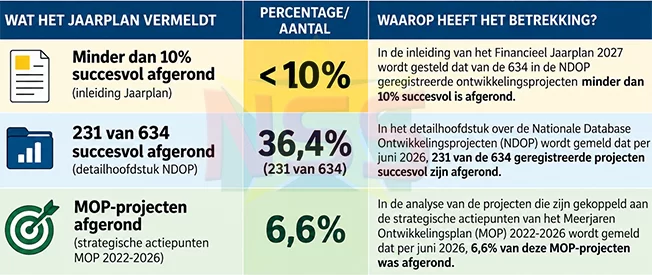
A major discrepancy in public development project completion statistics has emerged in Suriname’s newly released 2027 Financial Annual Plan, raising questions about government data transparency and implementation progress of the country’s current multi-year development strategy. The document, published on October 2, 2026, contains two vastly different success rates for the 634 development projects registered in the National Database for Development Projects (NDOP), creating confusion over how many government-led initiatives have actually been finished. In the opening section of the plan, policymakers state that less than 10% of the 634 registered projects have been successfully completed. The introduction also notes that public resources are not being deployed optimally across initiatives, and that poverty reduction remains one of the government’s most pressing unmet challenges. However, a detailed chapter later in the same official document presents entirely different figures that paint a far more positive (though still uneven) picture of project progress. As of June 2026, when the data for the plan was collected, 145 of the 634 NDOP projects had not yet broken ground, and no progress updates were available for an additional 80 projects. Nine projects were terminated early before reaching their goals. According to this detailed breakdown, 231 projects – equal to 36.4% of all registered initiatives – were marked as successfully completed. A comparison with data from November 2025 puts this slow progress in context: 12 months prior, the NDOP held 623 projects, with 220 successfully completed, equal to a 35.3% success rate. Over seven months, the total number of registered projects rose by 11, while the share of completed projects grew by just 1.1 percentage points, indicating new initiatives are being added far faster than existing ones are being finished. A closer look at the plan offers a potential explanation for the conflicting statistics. The document separately analyzes a subset of projects directly tied to the strategic priorities of the 2022-2026 Multi-Year Development Plan (MOP), the government’s current overarching development framework. For this targeted group of MOP-aligned projects, just 6.6% had been completed as of June 2026. That figure lines up with the “less than 10%” claim in the introduction – but the opening section fails to clarify that the statistic applies only to strategic MOP projects, not all 634 projects in the national database. For the MOP subset, 55.5% of projects remain in active implementation, 20.8% have not started, and no progress data is available for 16.7%. Even with the explanation for the discrepancy, the conflicting data underscores long-running challenges with project tracking in Suriname, a point the government itself acknowledges in the plan. Citing the inconsistencies and the overall slow progress compared to initial forecasts for the 2022-2026 MOP, the plan emphasizes the urgent need for stricter monitoring and evaluation of public development projects. Key reforms outlined include more standardized and accurate data entry, strengthening planning units within individual government ministries, and improving alignment between national policy goals and on-the-ground implementation. The Suriname Planning Bureau’s June 2026 half-year report, which is referenced in the Financial Annual Plan, previously confirmed that MOP goal delivery is lagging behind original expectations. Government officials note they will draw on lessons learned from the current 2022-2026 planning cycle to shape the upcoming 2027-2029 Multi-Year Development Plan, with the goal of addressing implementation bottlenecks and improving project outcomes moving forward.
Financieel Jaarplan spreekt zichzelf tegen over uitvoering ontwikkelingsprojecten