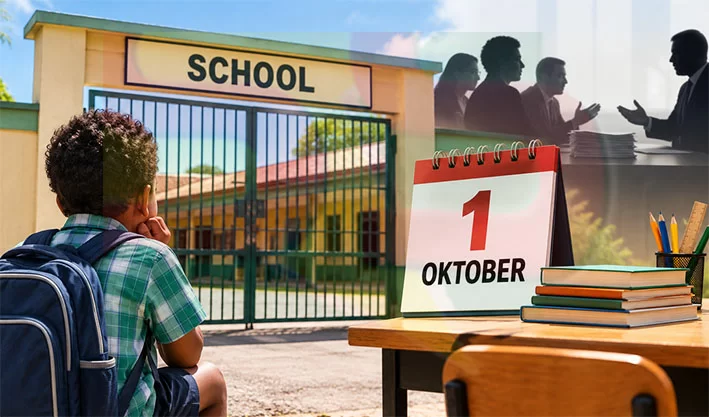
For students across Suriname, the first day of a new school year should mark a fresh, hopeful start. But on October 1 this year, thousands of parents and children were instead plunged into widespread uncertainty, left guessing whether children should report to classes or stay isolated at home.
The chaos erupted after the Joint Education Unions (GOV) issued a last-minute call on the eve of the new school year, urging parents to keep their children home. In a contradictory directive, the union ordered teachers to report to campus as scheduled, so that school leadership could jointly assess whether facilities were sufficiently staffed and prepared to welcome learners.
The Surinamese government did not issue a clear response until the following morning, when officials emphasized that all schools were required to open as normal and stated that the unions lacked the legal authority to urge parents to keep children home. Education Minister Dirk Currie and Minister of the Interior Marinus Bee both expressed surprise at the union’s action, noting that productive negotiations between the government and education unions had been ongoing for weeks, including talks focused on the logistics of the new school year opening. Currie confirmed that those discussions had proceeded smoothly from the government’s perspective.
Yet the on-the-ground reality on October 1 told a different story. Some parents heeded the union’s call and kept children home, while the vast majority of teachers showed up for work as required. The confusion laid bare a core failure: after multiple rounds of negotiations, neither the government nor the unions could deliver a single, clear, consistent message to parents, students, and school staff. If the agreements reached had truly been as clear as the education ministry claims, this widespread disruption and uncertainty would never have occurred.
Beyond questions of school preparedness, an unresolved labor dispute is at the heart of the conflict. The GOV has been negotiating with the government for improved teacher salaries, and had previously stated that the negotiation process needed to conclude before October 1. That deadline passed without a deal, meaning the salary dispute cannot be separated from the action surrounding the school opening. This is not to say that longstanding issues of understaffing, inadequate facilities, and insufficient learning materials do not exist – these problems have been plaguing Suriname’s education sector for years. But that longstanding context makes the union’s argument that an assessment of school readiness could not wait until after the first day of classes far less convincing.
A new school year is never an unexpected event. In Suriname, the summer school break runs from mid-August to late September, giving the education ministry, school leaders, and other relevant stakeholders more than enough time to map out the challenges facing every campus: which campuses face teacher shortages, which classrooms are unfit for use, where learning materials are lacking, and which open positions need to be filled. All of this preparatory work should be completed long before the first day of classes.
It is a common misperception that the entire education system shuts down during school breaks. While students get time off, the administrative and operational side of education cannot grind to a halt for six weeks. Teachers are public employees, and school leaders bear formal responsibility for organizing their campus’ operations. End-of-year evaluations and preparations for the new academic year should therefore be scheduled and completed well in advance of the October 1 start date. If a school is not ready to function properly on the first day of classes, that is a failure of pre-term planning, not an unforeseen emergency.
This does not mean that the teacher salary dispute is any less urgent. On the contrary, teacher compensation has been a simmering pain point in Suriname for decades. Teachers are expected to take on heavy workloads and immense responsibility, but many argue their pay does not align with either their professional duties or rising cost of living. Even many teachers who do not support every industrial action taken by unions agree that their financial standing needs urgent improvement. The government has acknowledged that new salary negotiations are needed and has stated it is working toward improved compensation for educators.
Unions have every legal right to advocate for better working conditions and fair pay for their members. At the same time, the education ministry bears a core responsibility to protect the continuity of learning for students as much as possible. When a labor dispute is a driving factor behind industrial action, that fact should be stated clearly and publicly to all stakeholders. If schools are genuinely unprepared to receive students, officials and unions alike should specify exactly which schools are affected, what shortages are present, and what risks families face. Leaving parents in limbo the night before classes start is not a solution to either longstanding school under-preparedness or unresolved labor issues.
Ultimately, the people who bear the brunt of this conflict are the stakeholders with no seat at the negotiation table. Parents were forced to make last-minute, high-stakes decisions about their children’s education without reliable information. Students lost a day of learning and started their new school year mired in confusion. Teachers were caught in the middle, caught between conflicting directives from unions, school leadership, and the national ministry.
Suriname’s education system has struggled with deep structural problems for years: persistent teacher and learning material shortages, inadequate school infrastructure, and uncompetitive salaries that fail to retain qualified educators in the profession. None of these problems emerged out of the blue on October 1, and they should not have been “discovered” on the first day of the new school year either.
The chaos surrounding this year’s school opening makes one thing abundantly clear: two separate crises have become intertwined, to the detriment of everyone involved. Longstanding inadequate pre-term preparation for many schools, and an unresolved labor dispute over working conditions and pay, have become tangled together with no clear path forward. Both the government and the unions share responsibility for keeping these issues separate and communicating clearly with the public.
No child should have to stay home on the first day of school because adults who spent weeks negotiating still cannot agree on what was agreed. Better teacher pay deserves serious, good-faith negotiations. Persistent school shortages deserve timely, targeted solutions. And every new school year deserves full preparation before the first bell rings.