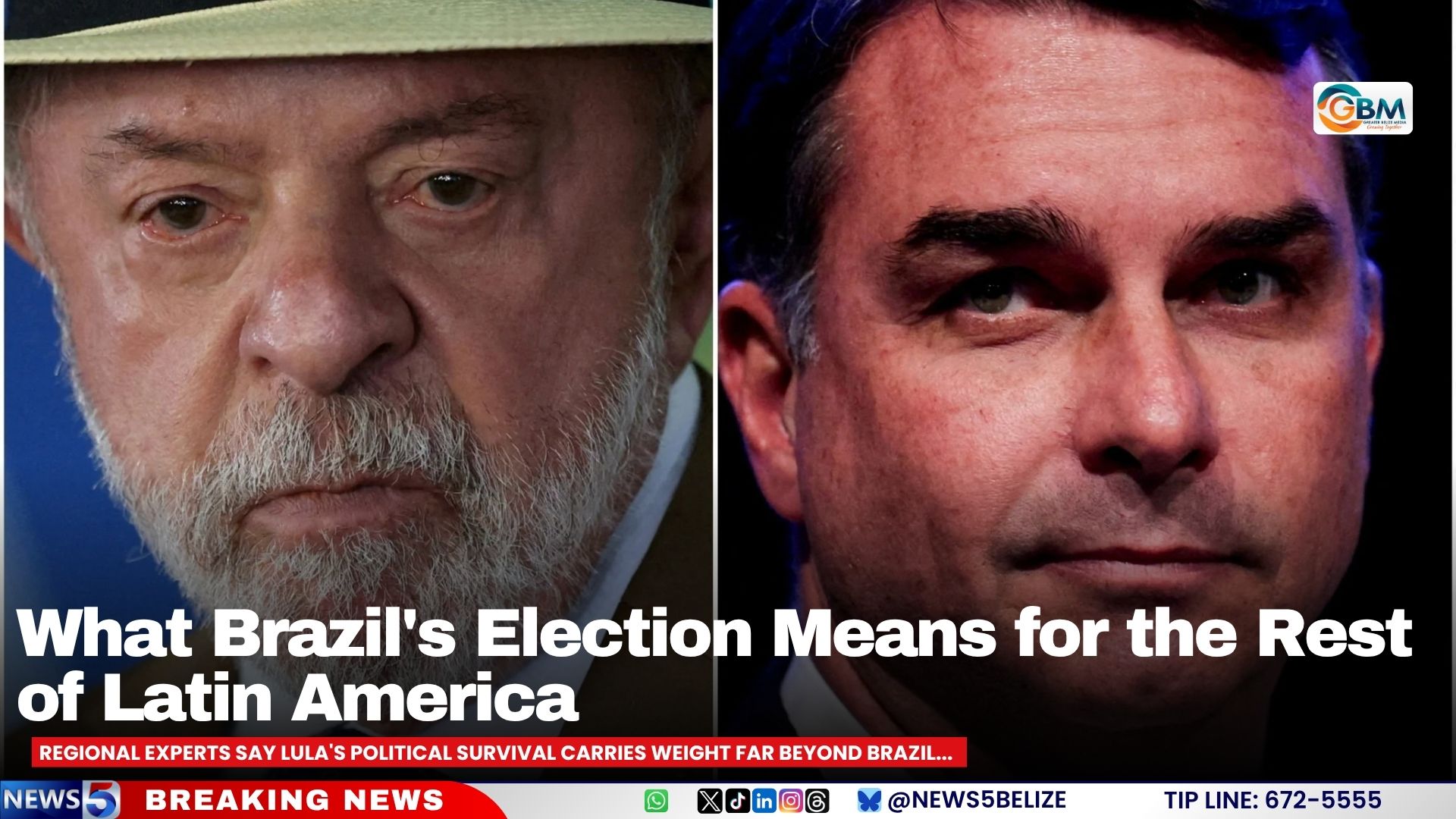
As Latin America’s two-year rightward political shift approaches its most consequential test to date, Brazil’s closely contested 2026 presidential election stands poised to redraw alliance networks across the entire region. With polling indicating a technical deadlock between incumbent 80-year-old President Luiz Inácio Lula da Silva, who is running for a new term, and opposition contender Flávio Bolsonaro – son of former President Jair Bolsonaro, who is barred from the race following a conviction for abuse of power and his role in an attempted coup – most political analysts widely predict the contest will advance to a second-round runoff.
For regional political observers, the outcome of Lula’s reelection bid carries implications that stretch far beyond Brazil’s borders. Renowned Venezuelan academic and former ambassador Alfredo Toro Hardy told CNN that Lula remains the only Latin American statesman with genuine global clout at a time when most new regional leaders lack substantial international influence. “His eventual departure from the presidency would leave a clear void that no other figure is currently positioned to fill,” Hardy explained.
Last week, Lula delivered a widely cited address to the United Nations General Assembly that underscored his independent approach to global diplomacy. Directing his remarks at Washington, Lula declared that “Brazil doesn’t fit in anyone’s backyard” – a line that quickly became one of the summit’s most talked-about statements.
Juan Pablo Scarfi, a political scientist at Argentina’s Universidad de San Andrés, notes that a Lula defeat would rob the region of more than just a single prominent leader, even as he acknowledges that Lula’s influence has waned in recent years amid an increasingly unfavorable international political climate. “If Lula loses, the region would essentially be losing a central figure that has long served as a ideological counterweight to rising right-wing influence,” Scarfi said. “But the current international context is stacked heavily against him.”
The stakes of this election far outpace those of Brazil’s 2018 contest, when the region’s ideological landscape remained far more mixed. Today, Brazil heads to the polls after nearly two years of unbroken victories for right-wing candidates in major regional elections, many of whom have openly received backing from former U.S. President Donald Trump. Argentine President Javier Milei, one of Washington’s closest regional allies, has publicly thrown his support behind Flávio Bolsonaro, joining Trump in endorsing the opposition bid.
Toro Hardy argues that a win for Bolsonaro would expand the so-called “MAGA club” of Trump-aligned leaders across Latin America, with implications that extend to global resource competition. Brazil holds vast reserves of rare earth minerals, a sector where the United States currently trails far behind China. A Lula defeat, Toro Hardy contended, would strengthen China’s strategic position across the region.
Eduardo Gamarra, a political scientist at Florida International University, frames the 2026 election as a potential turning point that could end a 30-year political cycle rooted in trade integration and liberal democracy that began with the 1994 Summit of the Americas. “This makes Lula da Silva, in a way, the last of the presidents who, despite being left-wing, was part of that Latin American vision of cross-regional integration,” Gamarra explained.
Even so, Gamarra warned that the right’s current winning streak has not delivered the stability its backers promised. “Just as this pendulum reaches its highest point, it enters a deep crisis. The Trumpist coalition in Latin America is very fragile,” he noted.
When it comes to filling the regional leadership vacuum that would open if Lula loses power, analysts are skeptical that any existing figure can step into his role. Most doubt Mexican President Claudia Sheinbaum will take on regional leadership, as Mexico’s foreign policy remains tightly aligned with its northern neighbor the United States. Milei has worked aggressively to position himself as the public face of the regional right, but Scarfi notes that even a Bolsonaro victory would not bring the same level of pro-Trump alignment that Milei has embraced in Argentina.
The election’s outcome also threatens to reshape the future of Mercosur, South America’s flagship trade bloc. Scarfi explained that Mercosur was founded during the era of the Washington Consensus but has long served as a counterweight to overly close trade integration with the United States. If Brazil shifts to full alignment with Washington under a Bolsonaro presidency, Scarfi warned that this historic counterweight “could become a thing of the past.”