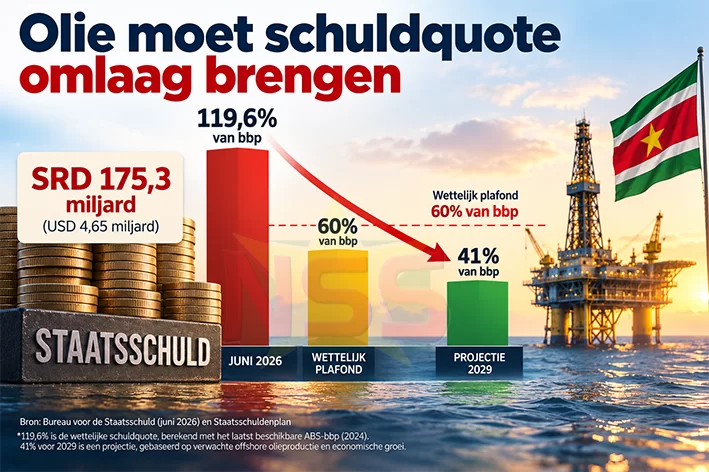
Suriname’s upcoming offshore oil production is projected to push the country’s public debt-to-GDP ratio below the statutory 60% debt ceiling by 2029, according to a new debt sustainability analysis included in the government’s 2027 State Debt Plan.
In the baseline scenario that accounts for revenue from natural resource extraction, the analysis forecasts a steep decline in the debt ratio after 2027, hitting 41% by 2029. This sharp drop is not driven solely by principal repayments on existing obligations; the bulk of the improvement stems from the explosive economic growth expected to accompany the ramp-up of offshore oil output. The 2027-2030 debt plan projects an average annual economic growth rate of 17% over the period, with 22.8% growth estimated for 2028 and a remarkable 35.6% expansion penciled in for 2029. Under these projections, Suriname’s nominal gross domestic product will jump from SRD 252.3 billion in 2026 to SRD 605.9 billion by 2030.
All growth and debt projections are tightly tied to the performance of the nascent oil and gas sector, so the Debt Office ran two separate modeling scenarios: one including natural resource development and one excluding it. The medium-term fiscal strategy targets a debt-to-GDP ratio of 37.7% by 2030, though the Bureau for State Debt has issued a caveat that adverse economic shocks could push the ratio significantly higher than baseline estimates. Suriname’s current State Debt Act mandates that the total public debt ratio must be brought back down to the 60% cap no later than 2029.
Currently, the country’s reported debt ratio varies dramatically depending on which GDP figure is used for calculation. As of the end of June 2026, the State Debt Plan publishes two distinct ratios: 119.6% and 69.5%. The gap between the two figures stems from the base GDP data selected for the calculation. Total central government debt stood at SRD 175.3 billion at the end of June, equal to roughly $4.7 billion USD. The statutory 119.6% ratio is calculated using the General Bureau of Statistics’ official 2024 GDP figure of approximately SRD 146.6 billion. By contrast, when the Suriname Planning Bureau’s estimated 2026 GDP of SRD 252.3 billion is used as the base, the ratio falls to 69.5%. The Debt Office notes that this second calculation paints a more accurate picture of the actual burden public debt places on current domestic income.
The divergence in calculations carries major policy implications because the legal debt cap has been set at 60% of GDP, a threshold Suriname has exceeded every year since 2016. A 2025 amendment to the State Debt Act reaffirmed the requirement to bring the debt ratio back to the original 60% cap by 2029 at the latest. The 2027 debt plan concludes that this target will be achievable largely thanks to the major economic expansion driven by the coming ramp-up of offshore oil production.