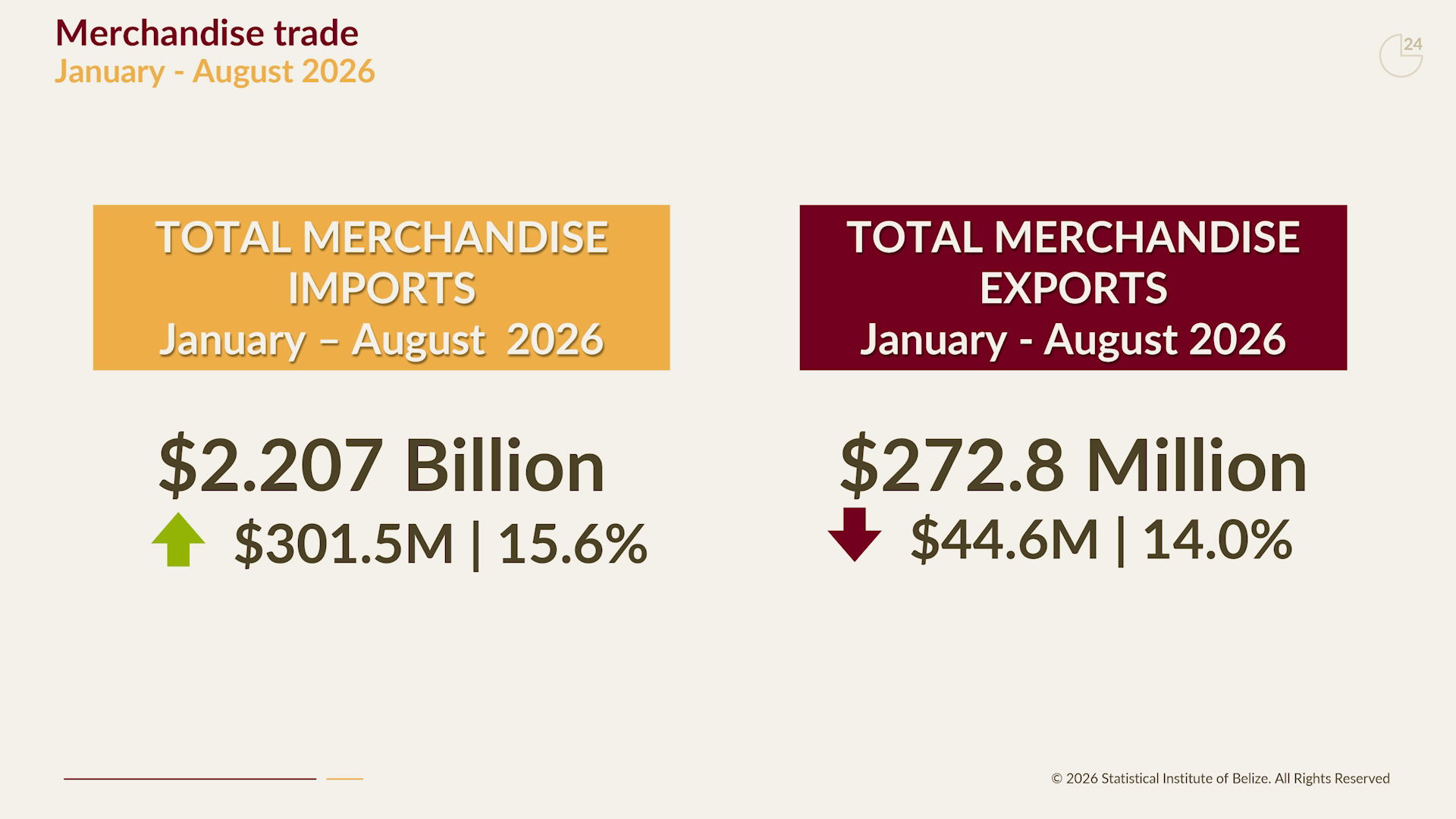
Belize’s trade imbalance has grown significantly worse in the first eight months of 2026, driven by a sharp drop in overall export revenues that leaves the nation importing far more goods than it sells to global markets. New data compiled by the Statistical Institute of Belize (SIB) shows that between January and August, the country imported $2.2 billion in foreign goods, while domestic exports generated just $272 million in revenue. This staggering ratio translates to Belize spending roughly $8 on imports for every $1 it earns from selling goods abroad, marking a substantial 14% year-over-year decline in total export earnings.
While exports to key markets including the United States and European Union posted modest growth over the period, those gains were completely erased by falling shipments to the United Kingdom and member states of the Caribbean Community (CARICOM), the regional trade bloc that has long been a core trading partner for Belize. Alongside the updated trade deficit figures, the SIB announced a major methodological change to how the country tracks merchandise trade: for the first time, it is incorporating data from both formal and informal cattle exports into official national statistics, bringing Belize into alignment with updated international guidelines for trade measurement.
Tiffany Vasquez, a Statistician II at the SIB, explained that long-term trends show a consistent decline in Belize’s domestic exports stretching back years. After a short-lived rebound in export volumes in 2022, the downward trend resumed, with a temporary plateau between 2023 and 2024 doing little to reverse the overall trajectory. “For years, our official trade data missed a critical piece of the picture: informal cross-border exports that were never counted in our official merchandise trade balances,” Vasquez noted. “With updated international statistical recommendations, we are now able to include these unrecorded shipments to give a far more accurate view of Belize’s actual trade activity.”
In the first eight months of 2026 alone, total cattle exports – combining both formal and informal shipments – reached $49.2 million, a figure that would have been largely unreported under the SIB’s old measurement framework. The revised data provides stakeholders with a more complete understanding of Belize’s agricultural trade, a key sector of the country’s economy, while also highlighting the severity of the broader export decline that continues to widen the nation’s trade gap.