Newly released data from the Statistical Institute of Belize (SIB) shows a modest but notable decline in national consumer confidence between July and August 2026, reflecting growing economic anxiety among Belizean households alongside clear divides along gender and regional lines.
The SIB’s monthly Consumer Confidence Index (CCI), a key metric measuring public sentiment around personal finances, spending capacity, and long-term economic outlook, edged down from 42.6% in July to 42.2% in August. This small shift signals that Belizeans are not only navigating unease about current economic conditions but also growing more uncertain about their financial prospects over the coming year.
Breaking down the data reveals stark variations across different demographic and geographic groups, rather than a uniform national trend. In a breakdown of the findings, SIB statistician Juan Blanco highlighted that one district bucked the national downward trend: Stann Creek recorded a significant improvement in consumer sentiment, jumping from 38.4% in July to 48.5% in August. Blanco attributed this uptick to easing pessimism among Stann Creek residents about both current local economic conditions and their own household financial situations.
In sharp contrast, two northern districts — Orange Walk and Corozal — saw marked drops in consumer confidence, leaving their residents with considerably more pessimistic outlooks than other regions of the country.
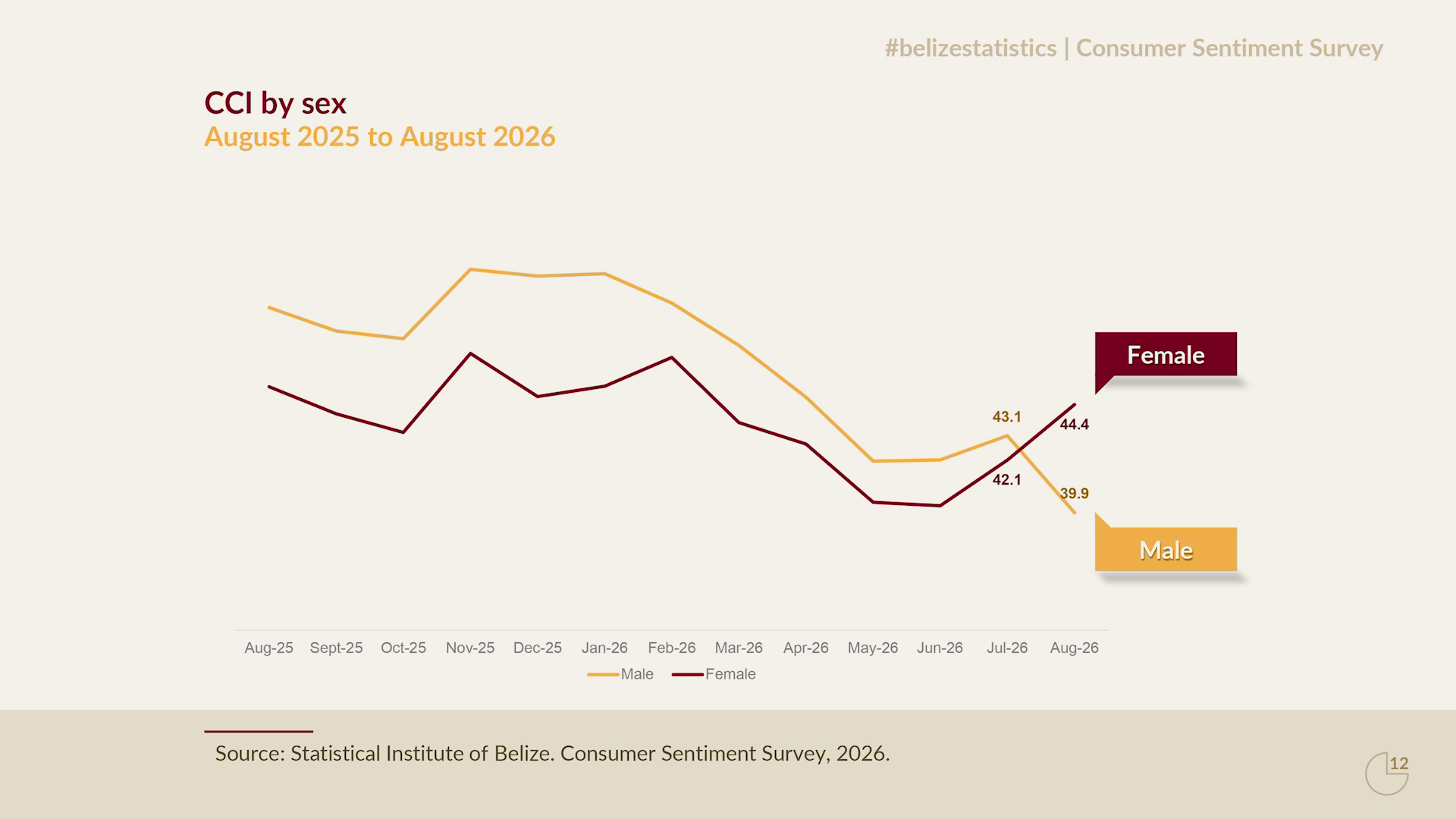
The most striking gap, however, emerged along gender lines. Between July and August, the CCI for male consumers fell by 7.5 percentage points, with Blanco noting that pessimism grew across all three core components of the index. The largest decline was recorded in the expectations component, meaning men have grown far more uncertain about their financial situation 12 months from now. Conversely, the CCI for female consumers rose by 5.5 percentage points over the same period, indicating that women in Belize have become less pessimistic about economic conditions than they were in July.
Overall, the modest national decline in confidence masks deep divides that reflect differing experiences of economic conditions across Belize, with growing uncertainty continuing to shape household attitudes toward spending, saving, and the year ahead. This report is a transcript of an evening television broadcast, with all Kriol-language statements transcribed using a standardized spelling system for accessibility.