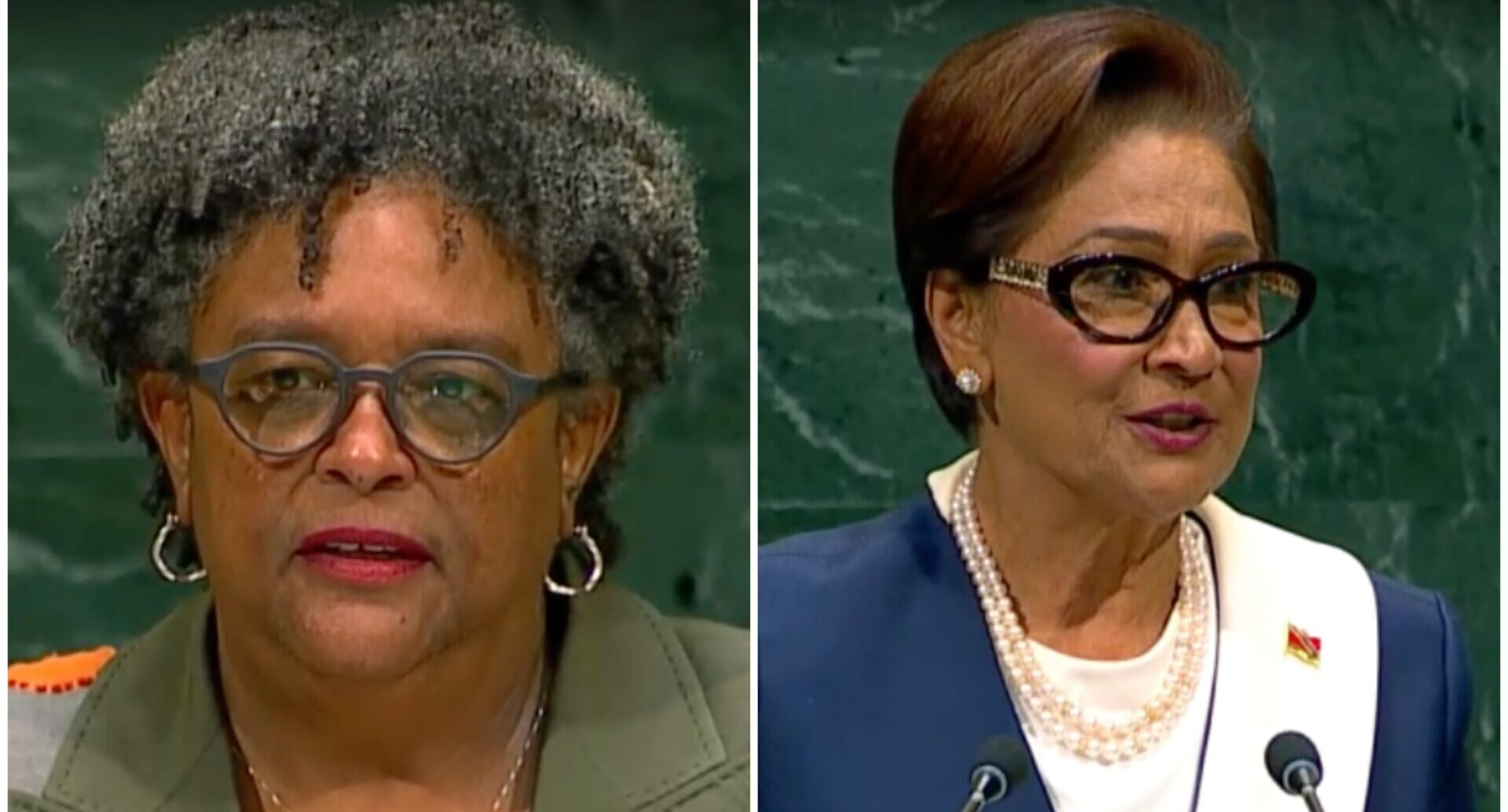
At the 2026 United Nations General Assembly (UNGA) High-level Week, two of the Caribbean Community (CARICOM)’s most influential leaders took the stage just two days apart, delivering addresses that laid bare a growing, fundamental rift over multilateralism, regional alignment, and the role of small island states in global geopolitics. For the second consecutive year, Prime Minister Kamla Persad-Bissessar of Trinidad and Tobago and Prime Minister Mia Mottley of Barbados outlined competing paradigms for international cooperation, reflecting deep divisions that have shaken the foundation of CARICOM’s decades-long tradition of collective foreign policy coordination.
Persad-Bissessar, who spoke first on September 22, framed her foreign policy vision around the existing structure of global power, advancing a transactional approach to international relations aligned with the current geopolitical order. Fresh off securing Trinidad and Tobago’s second ever non-permanent seat on the UN Security Council (UNSC) for the 2027–2028 term, she announced a landmark strategic realignment: a deepening security partnership with the United States centered on countering transnational organized crime and illicit trafficking. Endorsing U.S. military and counter-narcotics operations across the Latin America and Caribbean (LAC) region, Persad-Bissessar aligned Trinidad and Tobago with two key U.S.-led security initiatives: the Shield of the Americas and the Americas Counter Cartel Coalition (ACCC). For Port of Spain, this alignment is driven by domestic law-and-order priorities and what it frames as pragmatic geopolitical positioning, with Persad-Bissessar promising an “independent and practical outlook” during Trinidad and Tobago’s upcoming UNSC tenure that prioritizes finding common ground on global security challenges.
Two days later, Mottley offered a fundamentally contrasting vision that directly challenged the status quo of global governance. Rooting the current crisis of multilateralism in historical inequities and outdated power structures that date back to the post-WWII order, Mottley argued that small island developing states (SIDS) like Barbados are consistently failed by major international institutions that exclude them from critical decision-making. Her address pushed for sweeping UN reform, including restructuring the UNSC, to make global governance more responsive to the needs of vulnerable nations. Expanding on the goals of the Barbados-led Bridgetown Initiative, Mottley called for the World Bank to revise its mandate to prioritize climate adaptation funding, expand concessional finance access for at-risk nations, and introduce natural disaster debt pause clauses. She also reaffirmed Barbados’ commitment to reparatory justice, warned of the risks posed by unregulated artificial intelligence, and pushed back against expanding great power influence in the region, reasserting the Caribbean’s long-standing claim to be a “Zone of Peace” in the face of growing U.S. unilateral military and security expansion.
This divergence at the UNGA is not just a difference in rhetoric—it reflects a growing foreign policy cleavage across CARICOM, a 14-member bloc whose founding treaty enshrines collective foreign policy coordination as a core principle. The rift has widened dramatically since Persad-Bissessar returned to office in May 2025 following her party’s general election victory, as Trinidad and Tobago has openly aligned with the U.S.’s updated Monroe Doctrine (branded the Donroe Doctrine in the 2025 U.S. National Security Strategy and 2026 National Defense Strategy), putting it at odds with most of its CARICOM counterparts. The bloc’s divisions are particularly visible in the debate over U.S. sanctions on Cuba: Trinidad and Tobago has repeatedly refused to back CARICOM statements criticizing the tightening restrictions, while other member states have reaffirmed their long-standing support for Havana amid its worst multi-dimensional crisis in decades.
Already, the U.S.-led security architecture in the region has attracted new members from within CARICOM. Trinidad and Tobago and Guyana were founding members of the Shield of the Americas, and Jamaica, Belize, and The Bahamas have since joined, though only Trinidad and Tobago and Guyana signed the initiative’s 2026 Joint Statement on Defending Hemispheric Sovereignty, which designated 24 transnational criminal groups as foreign terrorist organizations and laid the groundwork for expanded U.S. military operations across the Western Hemisphere. Many analysts suggest that some member states have joined the coalition simply to “go along to get along” with Washington, rather than out of strong ideological alignment.
Even within CARICOM, sub-regional blocs are moving to consolidate their own coordinated positions in response to the growing split. The Organisation of Eastern Caribbean States (OECS), a closely aligned sub-group whose members are also part of CARICOM, reaffirmed its commitment to a unified foreign policy agenda in a September 20 meeting on the margins of UNGA, highlighting the need for collective action to protect small state interests in an increasingly polarized world.
As Caribbean nations navigate this crossroads, deep divisions over geopolitical alignment have left CARICOM fractured. The United States’ growing demand for diplomatic alignment has created a dynamic where some member states see strategic opportunity in closer ties to Washington, while others see the shift as a threat to regional sovereignty and long-standing collective consensus. If the current divergence continues, analysts warn that CARICOM’s decades-long project of regional cooperation could face irreparable harm, with lasting consequences for the voice of small island states in global governance.