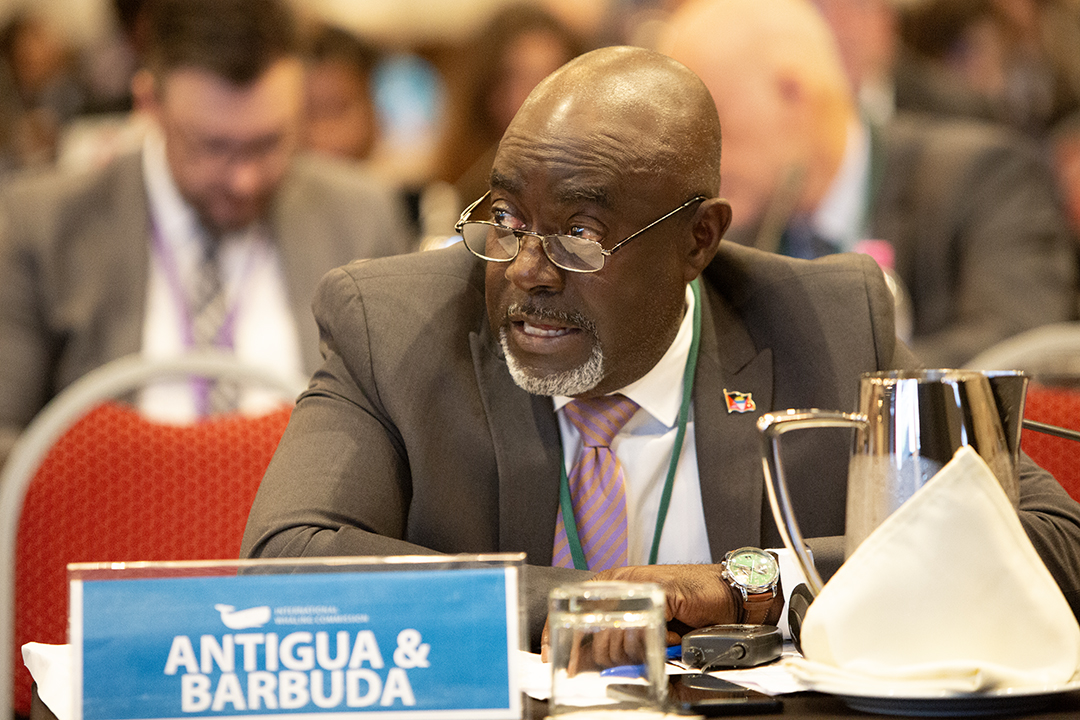
As the International Whaling Commission (IWC) convenes its 70th plenary meeting in Hobart, Tasmania, to mark its 80th anniversary, a fierce debate over proposed changes to core decision-making quorum rules has emerged, with Antigua and Barbuda leading opposition over fears the reforms would marginalize vulnerable Small Island Developing States (SIDS).
The five-day meeting, which kicked off on September 28, brings together member state representatives and observer groups to tackle a wide policy agenda, from whale population surveys to new conservation and management frameworks. On the opening day, IWC leadership tabled two draft proposals to revise the body’s existing quorum requirement, which currently stands at a fixed 45 of the commission’s 88 total member states. Officials formed a cross-state drafting group to explore merging the two options into a unified proposal, but Antigua and Barbuda has already rejected both frameworks in their current forms.
The first option would redefine a quorum as a simple majority of members physically present at a meeting. Antigua and Barbuda’s IWC Commissioner Ambassador Daven Joseph argues this approach is fundamentally flawed, noting that a quorum should be tied to the commission’s full membership, not just the subset of countries that can afford to attend in-person gatherings. In the delegation’s official statement, representatives stressed: “Quorum must reflect 88, not who can afford airfare,” pointing out that SIDS regularly face crippling financial and logistical barriers to sending delegations to international meetings held far from their shores.
To illustrate the risk of this proposal, Joseph’s team laid out a hypothetical scenario: if only 50 of 88 member states attend a meeting, a majority-of-present quorum would drop to just 26 countries — less than one-third of the IWC’s full membership. That would allow a small minority of the commission to advance binding decisions, effectively disenfranchising dozens of states that cannot afford to attend. The delegation also notes that quorum must be maintained for the entire duration of the decision-making process, not just confirmed at the opening of a meeting, a safeguard missing from the first proposal. Antigua and Barbuda further draws a comparison to other global fisheries governance bodies, such as the International Commission for the Conservation of Atlantic Tunas, which ties quorum requirements to total membership rather than meeting attendance.
The second proposal under consideration would set a quorum as a majority of contracting governments that have accredited or registered a delegation ahead of the meeting. While Antigua and Barbuda acknowledges this framework is an improvement over the first option, it still carries significant flaws that make it unacceptable in its current form. Key unresolved questions include whether a country that registers a delegation online but ultimately cannot afford to send representatives in person would count toward the quorum, and whether states facing financial barriers to accreditation would be effectively excluded from quorum calculations entirely. Unlike the current fixed threshold, this proposal would create a fluctuating quorum that changes from meeting to meeting: in a scenario where only 60 member states register for a meeting, the quorum would drop to just 31, 14 members below the current requirement, the delegation calculates.
Instead of advancing either of the two current proposals, Antigua and Barbuda has put forward an alternative path forward: the establishment of a dedicated inclusive working group to re-examine the quorum issue from scratch. The Caribbean nation calls for the working group to include representatives from SIDS, coastal states, and all geographical regions, to build a consensus-backed reform that does not marginalize vulnerable nations. Antigua and Barbuda’s proposal retains the current fixed 45-member quorum threshold as a temporary safeguard, adds requirements for the IWC chair to confirm quorum is maintained before key votes on resolutions, rule changes and schedule amendments, and calls for a higher two-thirds majority threshold specifically for amendments to the IWC’s rules of procedure.
Joseph’s delegation emphasizes that all quorum reform must prioritize broad, inclusive representation rather than enabling narrow decision-making by a small subset of members. “Efficiency at 80 years must be balanced efficiency – not efficiency achieved by excluding members,” the statement reads. Antigua and Barbuda has offered to chair or co-chair the proposed working group, and is calling for the current 45-member rule to remain in place until a broadly supported reform can be agreed upon by the full membership.