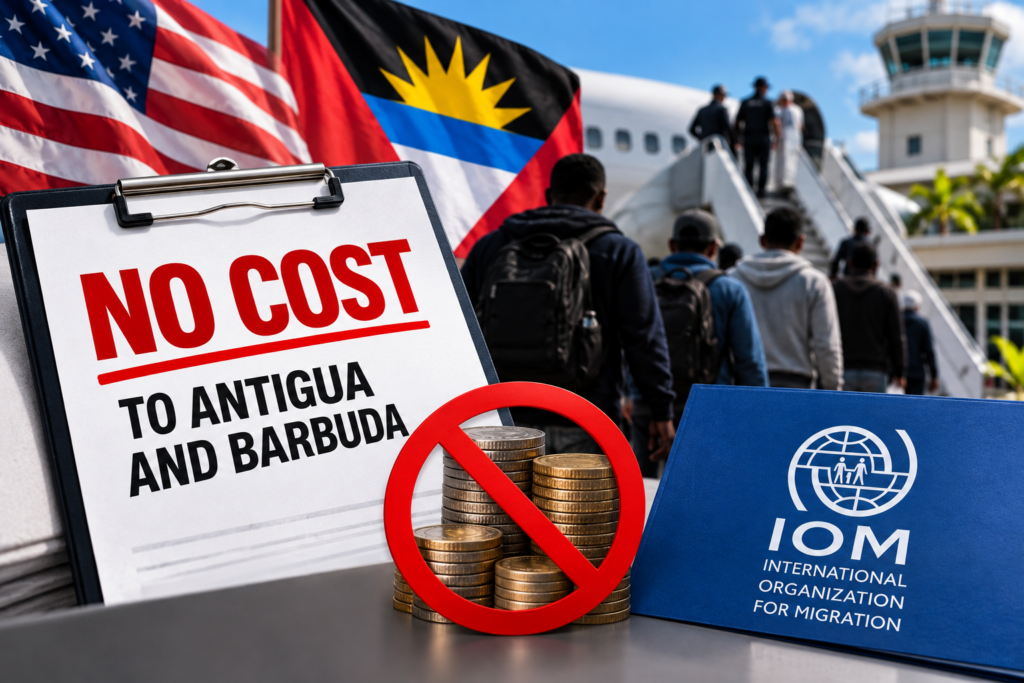
Negotiations between the United States and Antigua and Barbuda over a proposed framework for transferring third-country nationals removed from U.S. territory remain ongoing, with no final deal reached as both sides table differing proposals centered on financial accountability. The discussions trace back to a bilateral memorandum of understanding signed in Washington last December 2025, which laid the groundwork for potential relocation arrangements.
On Sunday, the government of Antigua and Barbuda publicly released Washington’s draft operating procedures alongside its own formal counter-proposal, bringing transparency to the closed-door negotiations. Under the U.S. draft plan, all services delivered to transferred individuals would come at no direct cost to the Antigua and Barbuda government. The U.S. proposal clarifies that the draft framework itself does not obligate financial resources from either signatory government, but notes that Washington will explore existing eligible foreign assistance funding to support the initiative, consistent with U.S. domestic laws and regulatory requirements.
The United States also plans to directly compensate a qualified international organization for delivering core services to relocated people, a structure designed to keep Antigua and Barbuda’s public finances free of associated costs. Under the proposed arrangement, Antigua and Barbuda’s primary role would be to coordinate with the contracted international organization, streamline entry for the organization’s staff, and enable on-the-ground service operations.
Notably, the U.S. draft does not outline a specific dollar amount for potential assistance nor lock in a binding formal financial commitment from the United States. In response, Antigua and Barbuda has put forward a counter-proposal that prioritizes stronger financial protections for the small Caribbean nation. The Antiguan and Barbudan government insists that all financial and operational logistics must be finalized to guarantee that costs stemming from the transfer and ongoing residence of third-country nationals do not fall on local taxpayers.
Antigua and Barbuda’s counter-proposal also suggests the International Organization for Migration could take on a supporting role, contingent on the organization agreeing to terms and negotiating mutually acceptable arrangements with the local government. The proposed arrangement would apply to a narrow subset of third-country nationals: individuals who have received final or expedited removal orders from the U.S. and hold medical clearance to travel. Exclusions from the program are clearly defined, including most individuals with criminal convictions (beyond immigration violations), unaccompanied minors under 18, and any citizens of Antigua and Barbuda.
Antigua and Barbuda’s government has emphasized repeatedly that the documents released Sunday are draft negotiating texts, not a finalized agreement. In the coming days, Attorney General and Minister of Legal Affairs Sir Steadroy Benjamin is expected to table both proposals for review by the country’s House of Representatives.