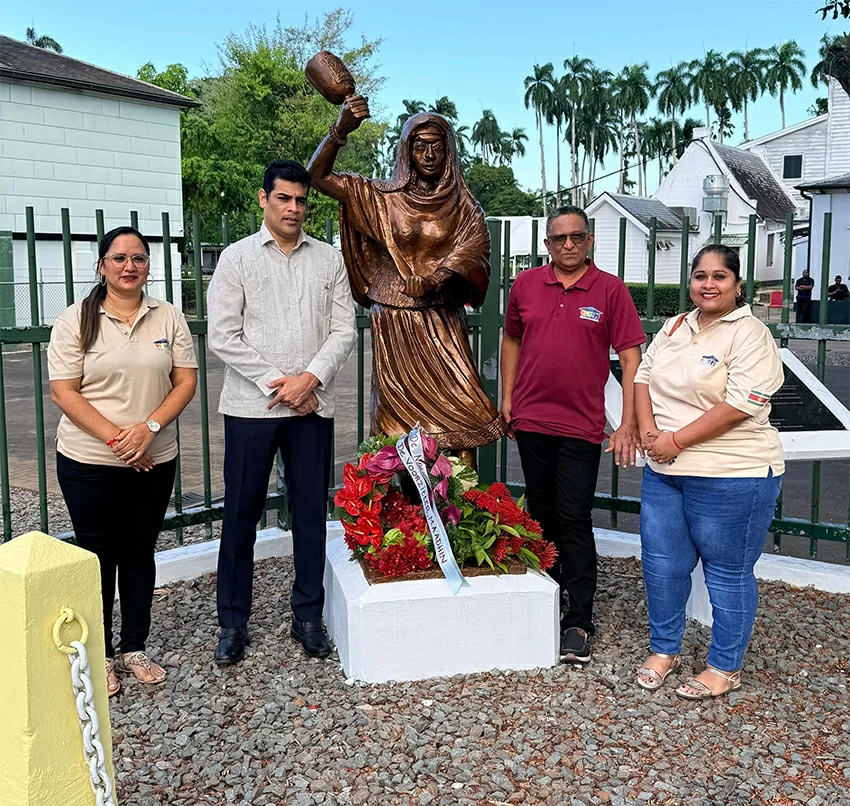
On September 27, 2026, the Cultural Union of Suriname (CUS) held a national commemoration to celebrate the life, lifelong struggle, and enduring legacy of Janey Tetary, a 19th-century contract labor leader and symbol of resistance against colonial exploitation. The event opened with a floral tribute at Tetary’s monument in Paramaribo, followed by a historical documentary screening at the NSHI Ballroom exploring her trailblazing story. Organizers emphasized that the commemoration is not only a moment to reflect on the past, but also an opportunity to connect Tetary’s values of courage and justice to contemporary struggles for equality.
Born around 1856 in Moniar, Patna, in what was then British India (modern-day India), Tetary faced immense hardship from a young age. Divorced in early adulthood, a status that carried severe social and economic stigma for women in that era, she was lured to Suriname by recruiters’ promises of high-wage work abroad. In 1880, she arrived with her 10-year-old son to work as an indentured contract laborer on the Zorg en Hoop plantation along the Commewijne River.
On the plantation, Tetary earned the nickname “Begum,” meaning “noble woman,” for her relentless advocacy for better working and living conditions for fellow indentured workers. She openly challenged the abuse of women by their partners, protected vulnerable workers from exploitation, and prioritized support for pregnant laborers who were forced to complete grueling field work alongside managing household duties and childcare.
By 1884, the brutal conditions on Suriname’s plantages had reached a breaking point. Recruiters had promised workers a daily wage in India, but once they arrived in the colony, pay was restructured to a task-based system that left workers earning far less, with no pay at all if they failed to complete their punishing daily quotas. In September 1884, tensions boiled over into open rebellion. On September 24, a group of workers led by Tetary attacked a white colonial official with canes. When colonial authorities deployed soldiers to arrest the organizers, hundreds of workers armed with canes, bottles, and machetes organized to resist, with women fighting side-by-side with men under Tetary’s leadership.
Colonial commanders ordered a sniper to eliminate the rebellion’s leader. On September 26, 1884, as Tetary prepared to throw a mud-filled bottle at advancing soldiers, she was shot in the back of the head at point-blank range. She died two days later at just 28 years old. Six other indentured workers were also killed in the crackdown, and all seven were buried in an unmarked plot on the Zorg en Hoop plantation. The rebellion was crushed, but Tetary’s legacy as a fighter for justice lived on in oral history.
For more than a century, Tetary’s story was largely erased from official Surinamese history books, part of a broader pattern of colonial historical erasure. That began to shift in 2017, when a bronze statue of Tetary was unveiled on the grounds adjacent to the Presidential Palace in Paramaribo. The monument replaced a bust of Barnet Lyon, the colonial official held responsible for ordering Tetary’s killing.
The unveiling of the statue was widely hailed as a landmark moment in Suriname’s ongoing decolonization process. Then-Vice President Ashwin Adhin called the moment “a milestone in the process of full decolonization, particularly the decolonization of our thinking.” He accused colonial powers of “gross historical falsification” for covering up for 130 years that Tetary was shot dead while leading a peaceful protest for better working and living conditions on Lyon’s explicit orders. Sculpted by artist George Ramjiawansingh, the statue depicts Tetary with a raised hand gripping the neck of a bottle, capturing her defiant spirit and unyielding courage.
In recent years, Tetary’s legacy has gained recognition far beyond Suriname’s borders. In the Netherlands, which controlled Suriname as a colony until 1975, multiple public spaces have been named in her honor, including Janey Tetarypad in Scheveningen, The Hague. City officials in The Hague noted that naming public spaces after figures from former Dutch colonies helps build a more inclusive society and creates a more accurate reflection of shared national history. Streets have also been named for Tetary in Amsterdam and Rotterdam, part of a growing continental movement to confront colonial and enslavement histories, and honor contributions from communities long erased from mainstream historical narratives.
The Cultural Union of Suriname has long played a central role in advancing research on Tetary’s life and preserving her legacy for future generations. In his 2017 annual address, then-Surinamese President Desi Bouterse thanked the CUS and other partner organizations for their research and advocacy to “rectify this important chapter of history and immortalize it with this statue.”
With Sunday’s 2026 commemoration, the CUS continues that mission. CUS leadership noted that the event’s dual focus on reflecting on the past and connecting to the present underscores that the values Tetary fought for – courage, dignity, justice, and the willingness to stand up for marginalized people – remain just as relevant today as they were in 1884.