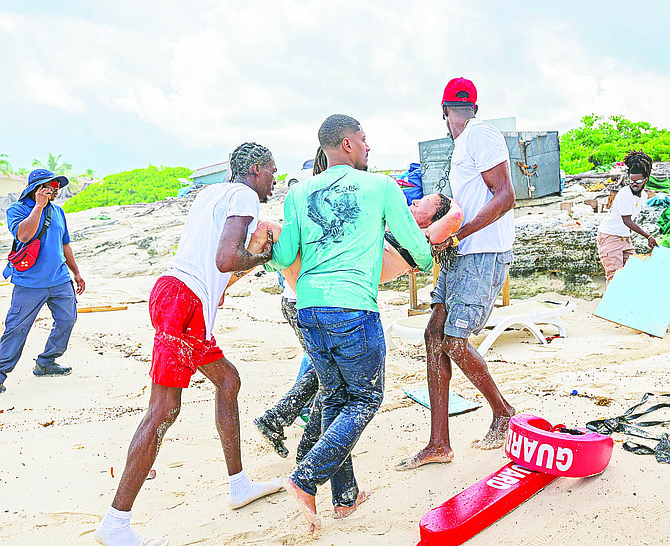
A dramatic high-stakes rescue at Cabbage Beach in the Bahamas has reignited long-simmering tensions over public beach access and unapproved development, prompting swift government action to remove an illegally placed shoreline fence. The incident unfolded yesterday as a 60-year-old American tourist, staying at the nearby Riu resort, was swept into rough Atlantic waters while navigating around the barrier – a structure protesters had warned already forced beachgoers into the surf to pass.
Lincoln Deal, Member of Parliament for Freetown and one of the rescuers who pulled the woman from the waves, described the close call that could have ended in tragedy. “We could’ve lost a life,” Deal said, recalling how powerful currents dragged the woman farther from shore even as lifeguards, protesters, and other bystanders fought to reach her. After the woman was brought back to land, bystanders administered CPR to restore her breathing before an ambulance arrived to transport her for further care. The near-fatal incident comes after weeks of growing unrest over the ongoing construction of the Four Seasons Ocean Club Residences, which has already displaced long-time local vendors and restricted traditional public access to the popular beach.
Footage captured by onlookers shows the woman struggling against churning waves as rescuers worked frantically to pull her to safety. One furious eyewitness called for immediate action, shouting, “Take down the fence before somebody dies. Take down the fence before somebody loses their life.”
Deal emphasized that the fence’s positioning is inherently dangerous, noting that it sits so close to the waterline that walking around it forces pedestrians directly into the surf. “When you’re walking around that fence, you’re basically walking in the water, and so it’s very easy to lose your balance, to fall, to be pulled in, to even be pushed and pressed against the fence,” he explained. Deal added that while the presence of multiple bystanders and lifeguards on scene prevented a fatality this time, there is no guarantee someone will be nearby to intervene in future incidents.
This is not the first controversial fence to spark public outcry at Cabbage Beach. In late August, local vendors discovered a similar barrier being erected near the shore, raising fears that high tides would eliminate the space they have used for decades to operate stalls, rent beach equipment, and run water sports businesses. That first fence was removed on August 30 after government intervention, when officials confirmed the developer had moved forward with construction without required public consultations and inspections.
In the weeks that followed, the government justified new temporary fencing as a necessary safety measure to address severe beach erosion at the site. But Deal and local advocacy group Dis We Beach have pushed back against this explanation, noting that erosion impacts the entire regional coastline, and the development’s own environmental impact assessment acknowledges project-related erosion in the area. The group is also demanding written guarantees that the 27 remaining local vendors, who currently face temporary displacement, will be allowed to return to their traditional spots once construction of the $550 million development is complete.
Last night, the Bahamian government delivered a clear response to the outcry following yesterday’s rescue. Environment Minister Zane Lightbourne announced that the developer will be ordered to remove the fence – and if they refuse, the government will take action to remove it itself. “The Government of The Bahamas has an uncompromising position on Bahamians’ access to their beaches,” Lightbourne stated. “The position applies to every developer operating in our country.” He confirmed that the latest fence was installed without the required advance notice and mandatory public comment period.
Dis We Beach says the core questions about the development’s approval remain unanswered. The group is calling on the government to release the official surveyed fence line, clarify its position relative to the mean high-water mark, and identify who owns the land where the fence was placed. It has also pointed to existing planning law that requires maintaining public beach access as a condition of development approval, and is asking the government to confirm whether such a condition was imposed for the Four Seasons project, and what that condition requires. Beyond that, the group is demanding proof that the government properly assessed the development’s social and economic impact on local vendors, taxi operators, tour providers, and the broader tourism economy that depends on open access to Cabbage Beach.