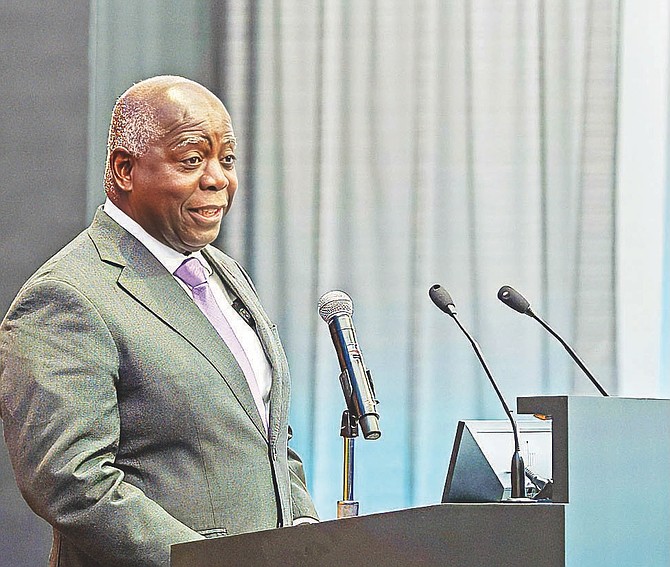
Speaking at the 81st session of the United Nations General Assembly in New York on Friday, Bahamas Prime Minister Philip “Brave” Davis delivered a stark and urgent warning to the global community: the post-WWII international order is sliding toward a hierarchical system where powerful nations can flout rules that small states remain bound by. Davis’s forceful defense of small nation sovereignty comes amid an ongoing, highly public diplomatic dispute between his administration and the United States over unauthorised undercover operations by the US Drug Enforcement Administration (DEA) on Bahamian soil, though he did not directly reference the conflict in his UN address.
The root of the bilateral tension emerged from a three-year US investigation into accused Bahamian drug trafficker Jonathan “Player” Gardiner and his network. US court filings have revealed that DEA operatives, posing as cartel members, conducted undercover activity across The Bahamas, including a 2024 meeting with an unnamed Bahamian politician inside the country’s Parliament to discuss facilitating a cocaine shipment. Last week, Bahamas Ambassador to the US Wendall Jones confirmed that a Bahamian delegation had formally raised complaints with US officials over what the government views as “rogue” DEA operations conducted without explicit local permission, clarifying that the objection relates to investigative conduct, not the prosecution of the suspects.
The dispute quickly escalated: US Ambassador Herschel Walker dismissed the allegations of illegal activity as “fake news”, questioning why Bahamian officials would object to the arrest of a known trafficker. In response, Bahamian Attorney General Wayne Munroe pushed back, noting that US authorities would never accept comparable unauthorised operations by Bahamian law enforcement on American territory.
In his UN address, Davis framed this local dispute as part of a broader, global erosion of the UN’s founding principle of sovereign equality. “International order, where rules apply only to the weak, is not order. It is a hierarchy,” he told the assembled global leaders. He argued that small nations bear no responsibility for the dismantling of the rules-based global system, but will be the first to suffer catastrophic consequences if it collapses.
Davis drew a line from historical colonial exploitation to modern power imbalances, noting “For 500 years, the Caribbean was somebody’s backyard. We did not win our freedom to once again become somebody’s backyard.” He pushed back against the implicit message he says small states receive from major powers: that their sovereignty is only permitted, not inherent. “A sovereignty that must ask permission is not sovereignty. It is a lease. Our ancestors did not break their chains so that their children could become tenants,” he said.
Unlike large powerful nations that can absorb the impact of weakened international frameworks, Davis emphasized that small states like The Bahamas, with a population of just 400,000, rely entirely on multilateralism to stand as equals to nations hundreds of times their size. “When The Bahamas defends multilateralism, we are not defending a bureaucracy. We are defending the only successful arrangement in which a nation of four hundred thousand people can stand at this podium as the sovereign equal of a nation of a billion people,” he said. His proposed solution is not abandoning international rules, but ensuring those rules bind large and small nations equally: “Defending international rules is not a favour to the small; it is an insurance for the strong,” he argued.
Beyond his core argument on sovereignty, Davis laid out a series of key priorities for The Bahamas and the broader Caribbean region. Turning to Haiti, he recalled the nation’s historic legacy as the first country to win independence through a slave revolt, noting that that act of self-liberation led to centuries of punishment, including a 1825 forced compensation payment to former French colonizers that Haiti took more than 150 years to pay off. Davis called on the UN Security Council to renew the mandate for the multinational gang suppression force deployed to Haiti, and ensure the mission receives sufficient resources while upholding Haitian sovereignty.
Davis also reiterated longstanding regional calls for reparatory justice for the transatlantic slave trade, referencing the Caribbean Community (CARICOM) Ten-Point Plan for Reparatory Justice. He urged nations that enriched themselves from slavery to engage in good faith on demands for truth, apology, restorative action and development investment. On Cuba, he repeated The Bahamas’ call for an immediate end to the decades-long US trade embargo, the removal of Cuba from the US list of state sponsors of terrorism, and the lifting of the fuel blockade, calling for the entire Latin America and Caribbean region to be recognized as a zone of peace.
Climate change, an existential threat to low-lying island nations like The Bahamas, also featured heavily in Davis’s address. He warned that The Bahamas cannot confront rising sea levels alone, noting that while the UN’s loss and damage fund for climate-vulnerable nations exists, a fundamental shift in power dynamics is required to make the fund operational and effective. Davis also announced The Bahamas’ formal endorsement of the Declaration on Sea-Level Rise, which enshrines that the country’s statehood, territorial boundaries, and UN membership will never be invalidated by rising ocean waters.
Looking to emerging global challenges, Davis raised alarms about the unequal power dynamics shaping the digital and AI era, warning against a future where small states are reduced to merely supplying raw personal data for systems designed and controlled by wealthy global powers. “The old empires took our lands, plundered them and renamed them. The new ones seek to take our data, and hand us back a picture of ourselves, one we did not paint,” he said. He argued that communities whose data is extracted deserve a voice in how that data is stored, used, and governed, and called for AI systems that respect national laws, understand local languages, and reflect the experiences of people outside wealthy North American and European nations. Davis backed greater small state representation in setting global digital rules, and publicly endorsed Stephen Bereaux’s nomination for Deputy Secretary-General of the International Telecommunication Union.
In a major announcement, Davis confirmed that The Bahamas intends to run for a non-permanent seat on the UN Security Council for the 2032-2033 term, emphasizing that the country seeks to challenge the status quo rather than stay on the sidelines. He called out structural inequities in the UN system, noting that five permanent Security Council members still hold veto power over global peace and security, a framework established decades before most current UN member states gained independence, and one that was never put to a vote of the broader membership. “An institution that cannot reform itself cannot hope to reform the world,” he said.
Davis closed his address by framing the entire debate as a question of legitimate power. “Power without legitimacy is not order. It is control. And a peace kept only by the powerful is not peace. It is permission,” he said.