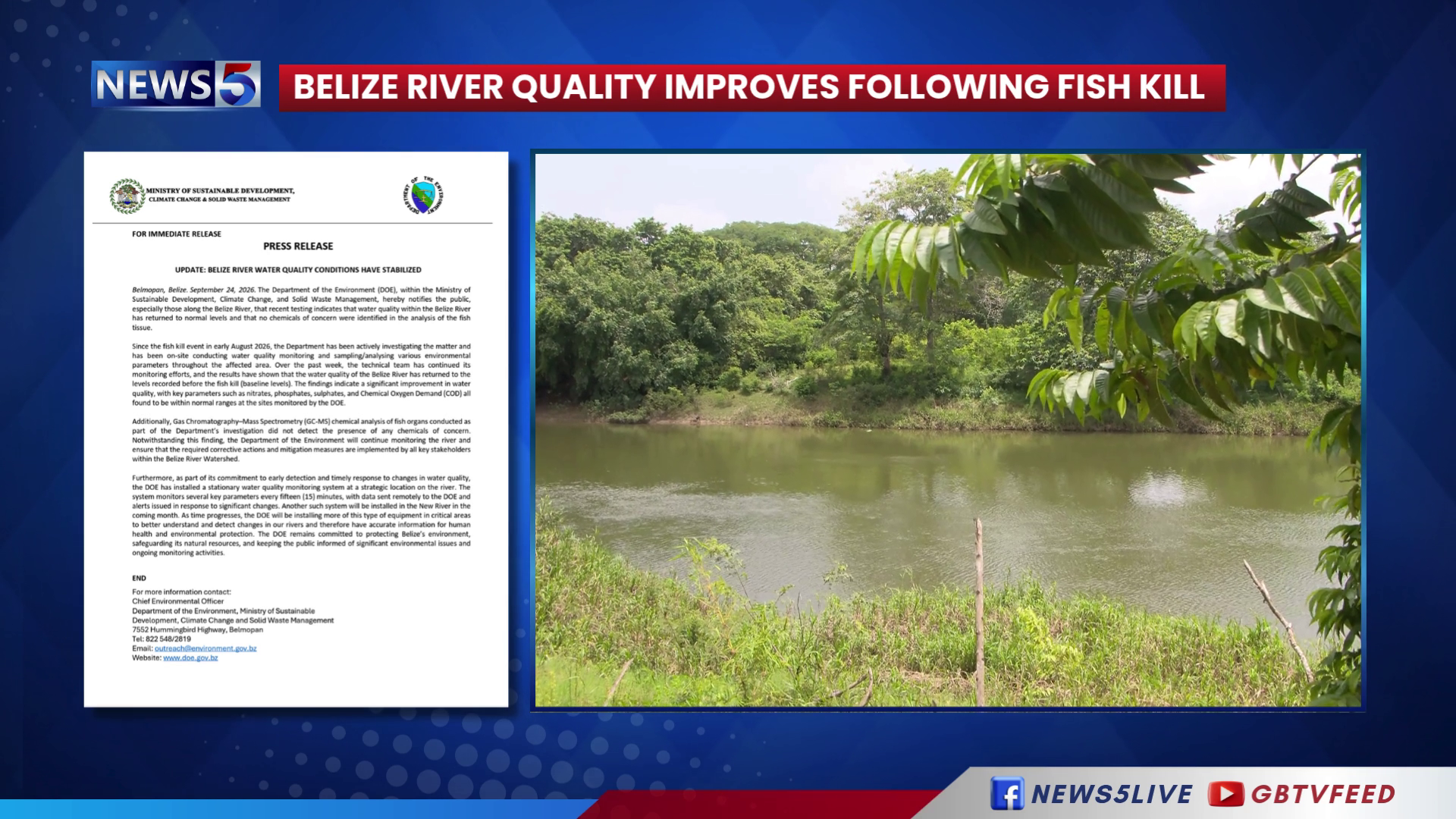
It has been nearly two months since a widespread mass fish death event triggered urgent concern among local populations across the Belize River Valley, and Belize’s Department of the Environment (DOE) has now confirmed that the ecosystem is well on the road to recovery. In a public update released Thursday, the regulatory body announced that key water quality metrics have returned to pre-incident baseline levels, and no hazardous chemical contaminants have been found in tested fish tissue samples.
Back in early August, the unexplained large-scale fish kill sent shockwaves through river-side communities, raising fears of long-term toxic contamination and irreversible damage to one of the country’s key freshwater ecosystems. In response to the public outcry, the DOE launched an extensive, continuous monitoring program to track water conditions and ecosystem health in the wake of the event.
According to the latest monitoring data, all core water quality indicators that spiked to dangerous levels during the incident have now normalized. Testing for common pollutants including nitrates, phosphates, and sulphates, as well as measurements of chemical oxygen demand, all fall within safe, established normal ranges. Complementary laboratory analysis of fish organ tissues carried out to check for lingering harmful substances also returned clear results, with no compounds of concern identified by researchers.
The recovery marks a positive turning point for the Belize River, which supports both local livelihoods and a diverse native aquatic ecosystem. Even so, the DOE has made clear that its oversight work will not end with this confirmation of recovery. The department plans to maintain long-term monitoring of the river and continues to supervise the implementation of targeted corrective measures across the entire Belize River watershed to reduce the risk of similar events in the future.
To strengthen early detection capabilities, officials have already installed a state-of-the-art real-time water quality monitoring system along the Belize River. This system will provide instant alerts for any unexpected shifts in river conditions, allowing regulators to respond rapidly before a small issue escalates into another large-scale ecological event. A identical real-time monitoring system is currently scheduled for deployment on the nearby New River in the coming weeks, extending this early warning protection across more of Belize’s critical freshwater networks.