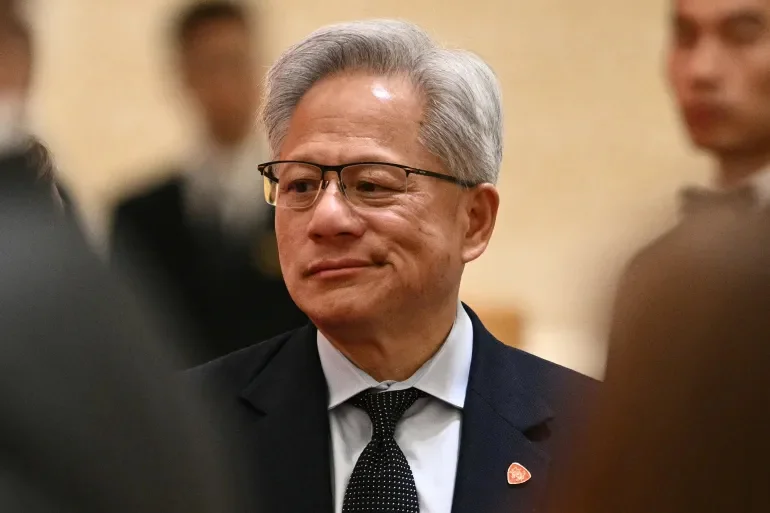
On November 10, developments surrounding a swirling unconfirmed espionage controversy involving Nvidia co-founder and CEO Jensen Huang have rippled across global tech, political, and financial spheres, drawing statements from both U.S. and Chinese officials, triggering internal corporate oversight, and erasing nearly $190 billion from the chip giant’s market valuation.
The controversy first emerged from New York Times reports alleging that Alice Huang, a Singapore-based Chinese businesswoman and former director of data center infrastructure provider Megaspeed International, had established a personal relationship with Jensen Huang to collect information on his activities for Chinese intelligence agencies, a claim that U.S. intelligence agencies had flagged as a potential counterintelligence concern. Footage from Taiwanese CTi News shows the two attending a dinner Huang hosted on May 22, 2025, on the sidelines of Taipei’s Computex tech expo.
Beijing has forcefully dismissed all related allegations as baseless. Chinese Foreign Ministry spokesperson Guo Jiakun stated during a Monday press briefing that the unsubstantiated espionage claims are a deliberate smear campaign designed to discredit China, reiterating the government’s earlier rejection of the narrative. No criminal charges have been filed against Jensen Huang, and no independent verification of the alleged information collection operation has been confirmed to date, with no public details on what data, if any, may have been passed to Chinese authorities.
Nvidia’s board of directors announced on Sunday that it has launched a fully independent investigation into the matter, to be led by a committee of independent board members supported by external specialized legal counsel. The company’s leadership noted that it has found no initial evidence that U.S. national security or Nvidia’s core trade secrets have been compromised, but is committed to a full review of all available facts. Huang has pledged full cooperation with the probe, and will remain in his post as CEO. In a private address to staff, Huang acknowledged that he had been unfaithful to his wife, offered a public apology for the hurt caused to his family, and reaffirmed his commitment to upholding Nvidia’s operational integrity and protecting U.S. national security interests.
U.S. President Donald Trump has publicly expressed his confidence in Huang, disclosing that he spoke directly with the Nvidia CEO over the phone to ask if he had any awareness that Alice Huang could be an intelligence operative. According to Trump, Huang confirmed he had no prior knowledge of such claims, and the president stated he fully believes Huang’s account, adding that the FBI is conducting its own parallel investigation. The U.S. Congress is also weighing in, with Republican lawmakers formally requesting Huang to appear for a hearing on November 18 to address the allegations and their potential national security ramifications, particularly regarding risks of sensitive U.S. advanced semiconductor technology leaking to China.
The controversy has had immediate severe impacts on Nvidia’s market standing: on Monday, the company’s stock fell 4.3% to hit its lowest trading point in seven months, wiping out approximately $190 billion in market capitalization. A proposed class-action shareholder lawsuit was filed in California the same day, naming both Nvidia and Huang as defendants. The suit alleges that the company and its top executive failed to timely disclose information about the alleged personal relationship and associated national security risks, misleading investors and damaging the firm’s long-term business outlook. The claims have not yet been reviewed or validated by a court.
The unfolding scandal is unfolding against the backdrop of intensifying U.S.-China competition for dominance in artificial intelligence development, a space where Nvidia’s high-performance training chips hold a dominant global market share. The U.S. government has imposed strict export restrictions on its most advanced semiconductors bound for China, citing concerns over potential military and strategic misuse. Megaspeed, the firm linked to Alice Huang, has long been under U.S. regulatory scrutiny for alleged efforts to circumvent these export controls to route restricted Nvidia chips to the Chinese market. Huang has previously advocated for partial relaxation of the export bans to preserve Nvidia’s access to the large Chinese consumer and enterprise market, but the current controversy is widely expected to push U.S. policymakers toward even tighter semiconductor export restrictions. As of press time, no conclusive findings from Nvidia’s internal probe or the FBI’s official investigation have been released, and there is no confirmed evidence that Huang knowingly collaborated with any foreign intelligence operation or that any of Nvidia’s critical trade secrets have been transferred to Chinese entities.
China verwerpt spionagebeschuldigingen rond Nvidia-topman Jensen Huang