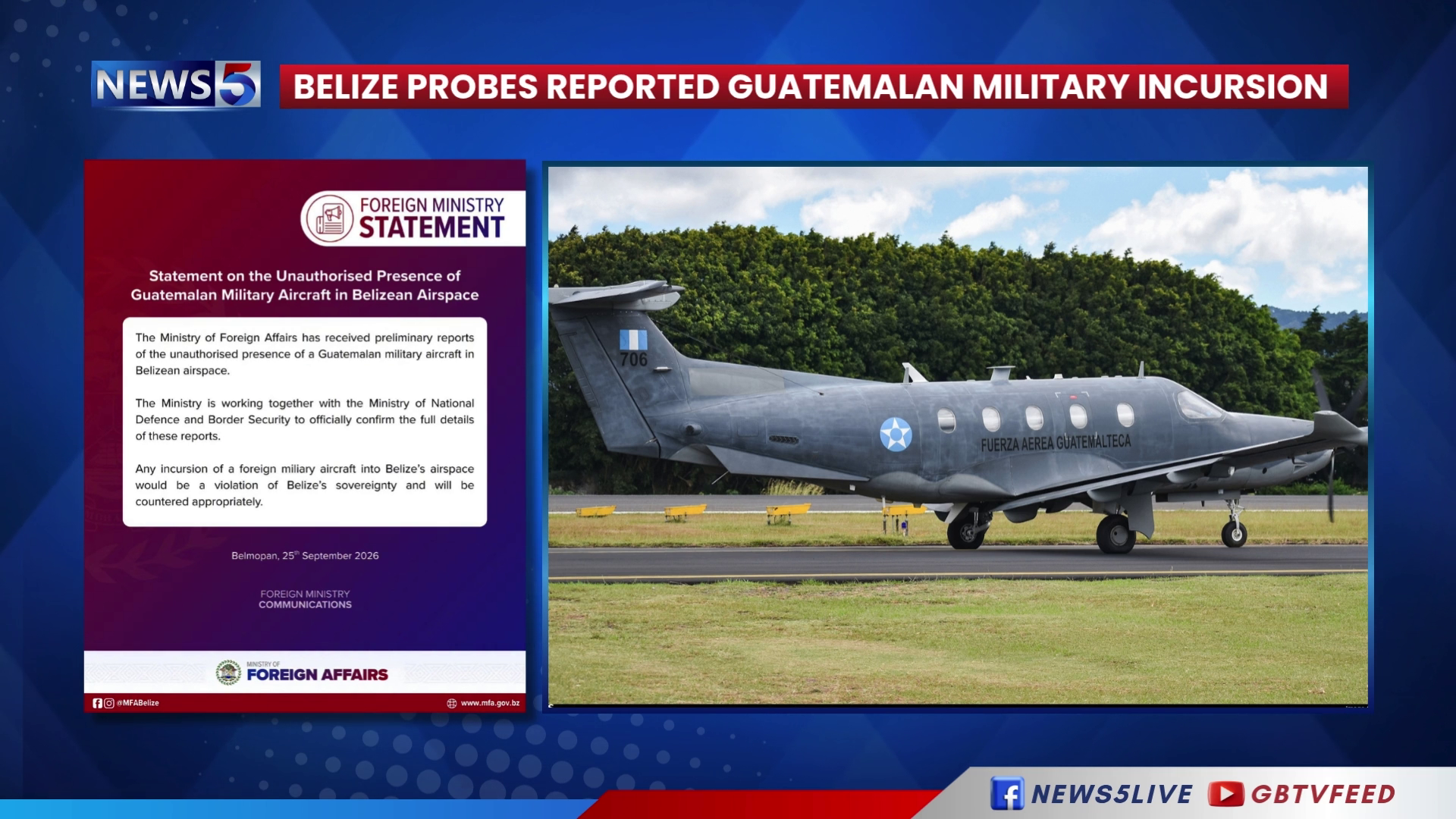
On a Thursday evening in September 2026, an unapproved incursion into Belize’s sovereign airspace by a Guatemalan military plane has sparked escalating diplomatic tensions between the two Central American nations, with Belize moving forward to issue a formal high-level protest.
According to senior defense and foreign affairs officials in Belize, the aircraft—a Pilatus PC-12 NG, a platform commonly used for reconnaissance and surveillance missions—crossed into Belizean airspace from the east at 7:29 p.m. local time. Once inside national boundaries, the plane circled for more than an hour above two popular coastal and island locations: Caye Caulker and Lighthouse Reef.
The most alarming detail of the incident, officials confirmed, came roughly 40 minutes after the plane entered the area. At 8:07 p.m., the aircraft dropped off Belize’s secondary radar system, indicating that its crew had intentionally disabled its transponder. Even with the transponder off, Belize’s primary radar infrastructure maintained continuous tracking of the plane throughout the remainder of its flight, which finally exited Belizean airspace to the south at 8:40 p.m. — a full 70 minutes after the initial unauthorized entry.
Oscar Arnold, Chief Executive Officer of Belize’s Ministry of Foreign Affairs, emphasized that the government never granted any form of clearance for the flight. “We can categorically state now that there was an unauthorized entry by a military aircraft in our airspace, and the Government of Belize emphasizes that we had not given any authorization for this to happen,” Arnold stated in an official briefing.
Beyond the violation of territorial sovereignty, Arnold noted that disabling the transponder creates a major safety hazard for civilian air traffic operating in the region. International civil aviation conventions universally require active transpondonder for all aircraft in controlled airspace, Arnold explained, because the absence of a transponder signal puts civilian planes at severe risk of mid-air collision. “If we can’t find an aircraft on the radar and we direct civilian aircraft to that area, we could potentially have a catastrophic disaster. So that is equally troubling,” he added.
Francis Usher, CEO of Belize’s Ministry of National Defense, confirmed that officials currently have no confirmed information about the flight’s purpose. The aircraft, which lacks offensive combat capabilities, is designed for intelligence gathering, but there has been no indication of what the crew may have been monitoring. Usher added that there was no prior coordination between the two nations for a joint counter-crime or surveillance mission, despite existing bilateral protocols for collaborative operations against transnational organized crime.
Guatemala’s Ministry of Defense has so far declined to provide a concrete explanation for the incursion. In a brief statement, Guatemalan military officials only referred to the incident as an “alleged flyover” and asserted that all of their military operations adhere to international and domestic law. Arnold criticized Guatemala’s response, noting that the statement was released to address circulating social media posts rather than official diplomatic inquiries from Belize, calling the rushed reaction “a little bit uncanny.”
Diplomatic discussions between the two governments are ongoing, but Belize has made clear it will not step back from its demands. The Belizean Ministry of Foreign Affairs is preparing a formal strong protest note to be delivered through official diplomatic channels to Guatemala’s foreign ministry, including a full official account of all tracked movements of the flight. Belize is now demanding a full, transparent explanation from the Guatemalan government for the unapproved incursion and the safety violations that occurred during the flight.