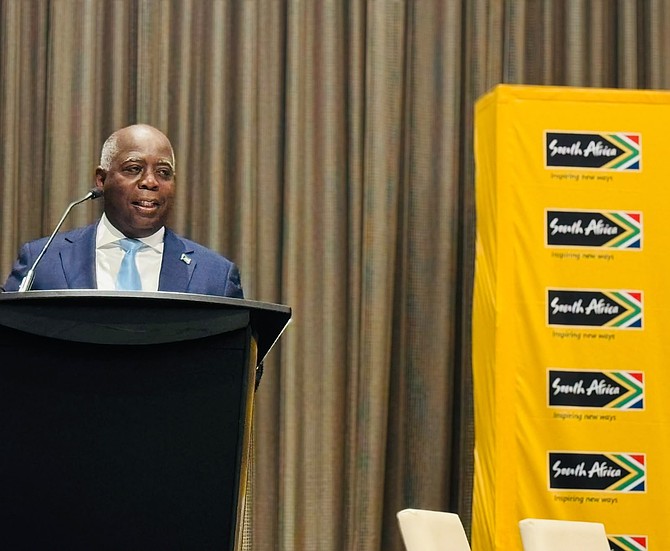
During an address at the Diaspora and Friends of South Africa Roundtable held in New York, Bahamas Prime Minister Philip “Brave” Davis has issued a urgent call for African and Caribbean nations to take ownership of and expand the critical infrastructure that underpins the movement of people, capital, and digital data across the two regions.
Davis outlined a targeted investment agenda focused on closing gaps in key connectivity sectors, pushing for new developments including cross-border data centers, regional digital payment platforms, expanded air travel routes, and integrated trade corridors. These projects would not only boost intra-African connectivity but also create direct, sustainable links between African economies and Caribbean nations. In a memorable framing of the difference between reliance and self-determination, Davis argued: “Remittance is love. Investment is power. Love keeps a family alive. Power keeps a nation free.”
The Prime Minister also positioned The Bahamas as a strategic hub connecting Africa, the Caribbean, and the broader Americas, highlighting untapped investment opportunities across high-priority sectors: food security, renewable energy development, financial technology (fintech), manufacturing, and integrated logistics networks. “Let The Bahamas be your gateway to the Caribbean and the Americas,” he urged attendees.
Davis acknowledged that despite deep, centuries-long historical and cultural bonds between the people of Africa and the Caribbean, practical economic and connectivity ties between the two regions remain underdeveloped. He noted that for most of The Bahamas’ history as an independent state, the country has oriented its trade, tourism, finance, and investment relationships almost exclusively toward North America and Europe. “There were good reasons. But in looking north for so long, we forgot to look east, towards the land our ancestors came from,” he said. Davis also admitted that his own administration faces ongoing work to eliminate barriers to connection, pointing to the significant logistical challenges of direct travel between The Bahamas and South Africa as one prominent example.
Rather than framing existing infrastructure gaps as insurmountable obstacles, Davis reframed them as high-potential economic opportunities for investors. He pointed out that Sub-Saharan Africa is currently the most expensive region globally for remittance transfers, and that most financial transactions between Caribbean and African businesses are currently routed through third-party financial institutions based outside both regions. He also highlighted a stark global imbalance in digital infrastructure: while Africa is home to roughly 18 percent of the world’s total population, the continent holds less than 1 percent of global data center capacity.
Davis emphasized that control over digital infrastructure is inseparable from national sovereignty. “Digital sovereignty means deciding where our data lives, who may use it and on what terms,” he said. “It means sharing in the value it creates. It means entering the digital age as owners, not only as users.”
Turning to The Bahamas’ own investment profile, Davis shared that the country currently imports approximately 90 percent of its food supply, creating major openings for investment in local agricultural production and food security infrastructure. The Bahamas has also set a target of generating 30 percent of its total electricity from renewable energy sources by 2030, another sector Davis marked as ripe for outside and regional investment. He added that the country’s fintech and digital sectors are rapidly expanding, and highlighted the strategic advantages of Grand Bahama’s deep-water port and free trade zone for cross-regional logistics and manufacturing.
Davis pointed to the growing partnership between The Bahamas’ government and the African Export-Import Bank (Afreximbank) as a blueprint for deepening future cooperation. He revealed that in February 2025, The Bahamas signed a $200 million framework agreement with Afreximbank to develop climate-resilient infrastructure across the country. He also noted that Afreximbank has raised its total financing ceiling for Caribbean Community (CARICOM) member states from $3 billion to $5 billion, a sign of growing commitment to regional partnership. “African capital is building Caribbean resilience, and earning a return doing it,” Davis said. “Solidarity is not a speech. Solidarity is a balance sheet.”
To ground his call in shared history, Davis invoked the 1985 Commonwealth Heads of Government Meeting held in Nassau, where global leaders adopted the landmark Nassau Accord that pushed for collective international action to end apartheid in South Africa. He also recalled the historic visit of Nelson Mandela to The Bahamas shortly after his release from prison. Davis argued that the defining challenge for the current generation of leaders in both regions is to secure economic independence and digital sovereignty, building on the anti-apartheid struggle’s fight for political freedom.
“In 1985, The Bahamas chose South Africa’s freedom,” Davis concluded. “In 2026, let Africa and the Caribbean choose each other.”