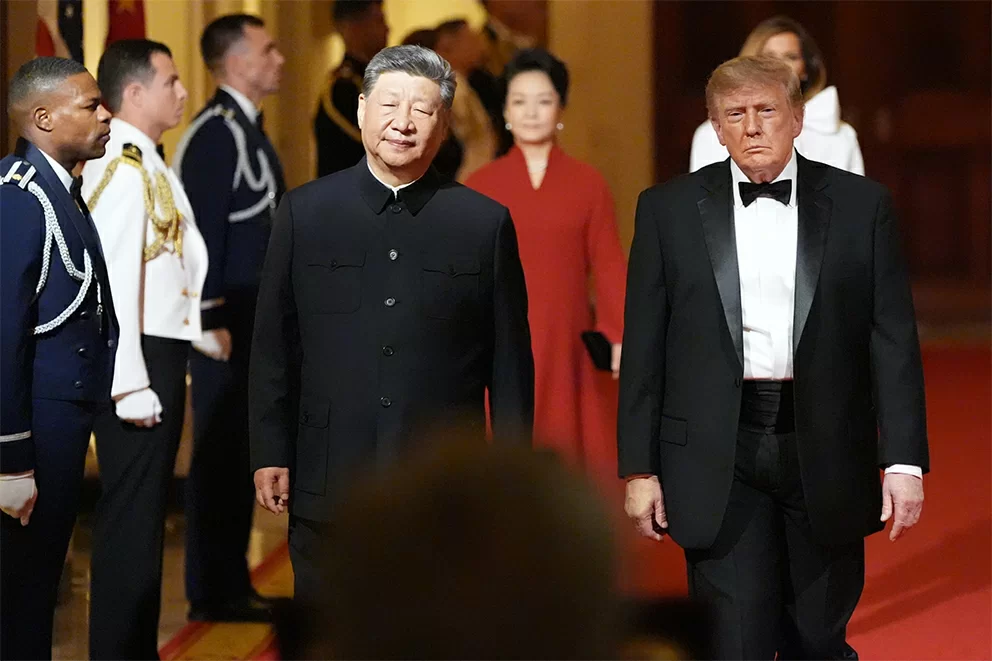
On September 26, 2026, Chinese President Xi Jinping wrapped up his three-day state visit to the United States, the first such high-level official trip to Washington by a Chinese head of state in more than a decade, marking a significant reset in high-level communication between the world’s two largest economies.
The visit opened with a notably warm ceremonial welcome: U.S. President Donald Trump personally greeted Xi at Joint Base Andrews on September 23, before overseeing a full program of official events that culminated in a formal state dinner at the White House East Room on September 24, attended by leading figures from U.S. technology and business sectors including OpenAI CEO Sam Altman, Amazon founder Jeff Bezos, Tesla and SpaceX CEO Elon Musk, and Nvidia CEO Jensen Huang. The dinner gathering underscored the deep interconnected economic and technological ties between the two nations, even as the sector remains a core arena of strategic competition.
Behind the ceremonial pageantry, negotiators from both sides tackled a sprawling agenda of longstanding frictions across trade, artificial intelligence, cross-Strait relations, and the Iran conflict. The most concrete, tangible outcome of the talks is a two-month extension of the existing bilateral trade truce, pushing the original expiration date of November 10 to January 10, 2027. U.S. Trade Representative Jamieson Greer confirmed that the two sides also reached preliminary agreement on components of goods trade, including agricultural products and medical equipment, with additional details to be released at a later date. The extension buys both sides extra time to negotiate a broader, long-term trade framework, and has averted an immediate escalation of the trade conflict for the foreseeable future, though major sticking points including U.S. tariffs on Chinese goods, Chinese purchase commitments for U.S. products, Chinese rare earth export policies, and U.S. restrictions on advanced technology exports to China remain unresolved.
In remarks delivered during the state dinner, Trump emphasized the long-standing personal relationship he has built with Xi since his first presidential term in 2016, noting that “President Xi and I both understand we represent different systems, but the people-to-people ties between our nations endure, and we have never gotten along better than we do right now.” He added that the two nations can continue to collaborate to advance shared economic prosperity and global security, striking a far warmer tone than the sharp rhetoric that has defined U.S.-China exchanges in recent years.
For his part, Xi struck a similarly conciliatory note, framing the dual goals of the U.S. “Make America Great Again” agenda and China’s national renewal as mutually compatible goals that can reinforce one another. He called on both powers to build a new model of coexistence, stressing that healthy competition between the U.S. and China is acceptable, so long as it stays within clear bounds and does not escalate into open conflict.
Artificial intelligence, a critical sector where both nations are global leaders locked in strategic competition for technological dominance, also featured prominently on the agenda. The two governments held discussions on frameworks to mitigate shared AI safety risks, but no major new agreements were reached on advanced chip access or AI technology export rules, leaving the sector as both a potential area for future collaboration and a core pillar of ongoing bilateral strategic competition.
No fundamental breakthrough was achieved on the Taiwan issue, one of the most sensitive core disputes in bilateral ties. China reaffirmed its long-standing position that Taiwan is an inalienable part of its territory and that foreign powers should not interfere in the issue, while Trump made no announcements of major changes to long-standing U.S. policy on the question, leaving it intact as one of the greatest potential sources of bilateral tension. The ongoing conflict around Iran also emerged as another key point of divergence, reflecting differing core national interests for both powers in the region. While the issue was raised during discussions, no major joint diplomatic initiatives were announced, with the meeting primarily focused on preventing disagreements over regional conflicts from further derailing broader bilateral relations.
On the final day of the visit, Trump planned to accompany Xi to the U.S. National Archives in Washington, where the two leaders were set to review historical documents detailing the long history of U.S.-China relations before the official closing of the state visit.
Overall, the Xi visit has reopened sustained high-level dialogue between the two powers, revived personal ties between the two leaders, extended the trade truce, and established a framework for continuing talks on economic and technological issues. However, it failed to resolve the core structural conflicts that have defined bilateral tensions in recent years: disagreements over Taiwan, advanced technology competition, rare earth trade, and the Iran conflict all remain outstanding, and the broader struggle for economic and technological influence between the two nations is unchanged. For now, the primary significance of the summit lies in its role in preventing further escalation of tensions and keeping channels of communication open. Whether the extended trade truce can be turned into a lasting broader agreement will become clear in the coming months, as both sides turn to the harder work of negotiating solutions to the long-standing disputes left unresolved during the historic visit.