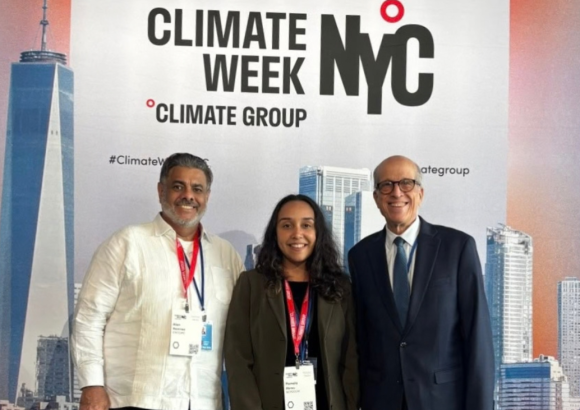
Against the backdrop of the 81st United Nations General Assembly in New York, a pressing call for collective action on climate change has emerged from the Caribbean region. At the 4th Climate Mobility Summit, a parallel event focusing on climate-driven population movement, Max Puig, executive vice president of the Dominican Republic’s National Council for Climate Change and Carbon Market (CNCCMC), delivered a clear appeal for strengthened cross-border collaboration to counter accelerating sea level rise and the climate displacement it triggers.
Puig opened his remarks by stressing that no single Caribbean nation can shoulder the burden of this growing crisis alone. As a small island developing state with over 1,500 kilometers of exposed coastline, the Dominican Republic offers a stark example of the region’s vulnerability. Most of the country’s population, critical infrastructure, and core economic sectors are concentrated along its shorelines, leaving these assets extremely exposed to the gradual advance of rising seas. If current warming trends continue, Puig explained, higher sea levels will exacerbate a cascade of interconnected threats: intensified coastal erosion, saltwater intrusion into freshwater supplies, more frequent and severe flooding, and amplified storm surges that overwhelm coastal defenses. These changes do not only threaten human settlements—they also degrade the natural barriers that protect communities, including mangroves, coral reefs, and sand beaches, all of which underpin the Caribbean’s two largest economic pillars: fishing and tourism.
The human cost of this degradation is already visible, Puig emphasized. More than 9,000 Dominican fishermen and their families rely directly on healthy coral reefs for their livelihoods. As reefs decline, this endangers not just jobs and household incomes, but also local food security and the ability of generations-old coastal communities to remain on their traditional lands. For the Dominican Republic, displacement driven by climate hazards is not a distant threat: national data records show more than 79,000 people were displaced by climate and weather disasters between 2017 and 2022, most from sudden extreme weather events. Unlike these acute events, Puig noted, sea level rise acts as a slow-onset crisis that gradually erodes the habitability and economic viability of coastal areas, creating a hidden, steady flow of displacement that is often overlooked in global climate planning.
The scale of potential displacement across the entire Greater Caribbean region is staggering. Projections from the Climate Mobility Model for the Greater Caribbean estimate that by 2050, roughly 8.2 million people could be permanently displaced by the economic impacts of climate change, with nearly 6 million of those people relocating within their own national borders. Puig was careful to clarify that these figures are not definitive predictions—instead, they serve as an urgent warning to help governments proactively plan for future pressures on communities, housing, critical infrastructure, and public services that will come with widespread displacement.
To address this growing crisis, Puig outlined three non-negotiable priorities for regional and global action. First, he called for greatly expanded, accessible financing for climate adaptation projects, noting that small island developing states lack the capital to fund large-scale coastal protection and planning on their own. Second, he urged regional cooperation frameworks that center the protection of the rights and dignity of displaced communities, rather than treating displacement as a purely administrative problem. Third, he pushed for a just green economic transition that generates new, sustainable employment opportunities for young people in the region, creating alternatives to climate-vulnerable coastal livelihoods.
Currently, the CNCCMC is partnering with the Global Center for Climate Mobility to develop public policies and international cooperation mechanisms designed to shield vulnerable communities and their unique cultural heritage from climate-related harm. This work aligns with the UN Declaration on Sea Level Rise, a global agreement that aims to improve risk mapping and data collection, strengthen adaptation capacity, expand climate financing, and protect at-risk communities. The declaration also prioritizes the preservation and documentation of cultural heritage threatened by sea level rise, including traditional territories, historic cemeteries, sacred indigenous sites, archaeological landmarks, and culturally significant coastal landscapes that define the identity of Caribbean communities.