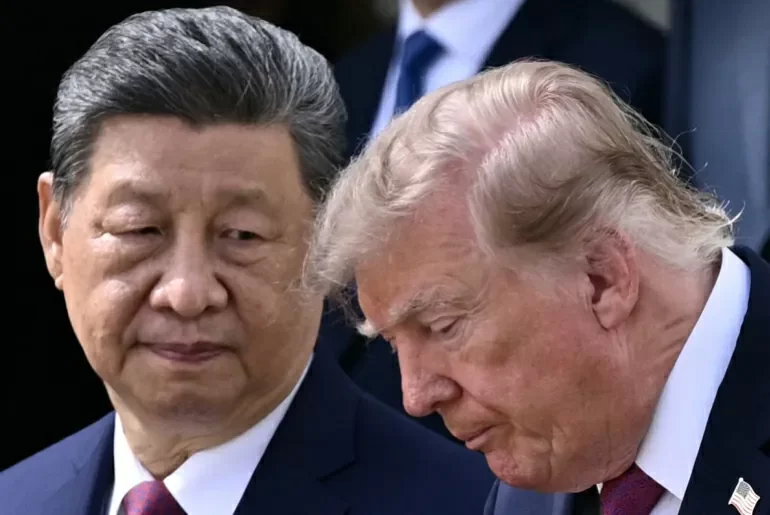
On September 24, 2026, Chinese President Xi Jinping kicked off a high-stakes three-day state visit to Washington D.C., aimed at grounding the growing strategic rivalry between the world’s two largest economies in constructive dialogue and preventing open confrontation.
Xi arrived Wednesday evening at Joint Base Andrews, the U.S. military airbase outside the nation’s capital, where he and his wife, Peng Liyuan, were personally greeted by U.S. President Donald Trump and First Lady Melania Trump. The arrival was marked by full military honors, including an honor guard and ceremonial salute. This personal welcome is considered unusual, as the U.S. president does not typically greet visiting heads of state in person at the military airbase, a choice that underscores the high priority the Trump administration places on this diplomatic engagement. The following day, an official state welcome was held on the White House South Lawn, followed by the opening of formal bilateral talks in the Oval Office. The two first ladies carried out a separate diplomatic schedule, including a visit to the Smithsonian National Museum of Asian Art, which houses over 45,000 works spanning thousands of years of Asian cultural heritage. A state dinner in honor of Xi and Peng was held Thursday evening, with prominent guests from U.S. politics, business, and the technology sector in attendance. An informal meeting between the two leaders and a visit to the U.S. National Archives, which holds key historical documents on U.S.-China relations, was scheduled for Friday.
Trade remains one of the most contentious core issues on the agenda. In recent years, bilateral economic relations have come under growing strain from U.S. import tariffs, Chinese retaliatory measures, and sweeping restrictions on trade in advanced technology. According to senior U.S. officials, negotiators from both sides have agreed to a temporary extension of the existing bilateral trade framework, granting additional time for further substantive negotiations. However, this agreement does not resolve deep-rooted trade disputes. The U.S. continues to raise concerns over Chinese state support for domestic industries, unequal market access, and industrial overcapacity, while China has repeatedly pushed back against U.S. tariffs and export control measures. Rare earth elements, critical raw materials for electronics, electric vehicles, semiconductors, and defense systems, have also emerged as a key point of discussion, with China holding a dominant position in global supply chains for these materials. The influential U.S. agricultural sector is also closely monitoring talks, as American farm groups have pushed for China to increase purchases of U.S. agricultural goods.
Artificial intelligence, a relatively new but rapidly growing area of engagement, highlights the dual nature of modern U.S.-China relations: simultaneous cooperation and competition. Both nations have poured billions of dollars into AI research and development, locked in a race for global technological leadership. At the same time, both countries share a common interest in mitigating the systemic risks posed by unregulated advanced AI systems. Despite shared goals on risk management, core interests still diverge sharply: the U.S. is determined to prevent cutting-edge AI technology from falling into the hands of its strategic competitor, while China seeks to continue growing its own domestic AI and advanced technology industries. This dynamic perfectly encapsulates the current state of bilateral ties: limited cooperation is achievable, but it unfolds alongside increasingly intense technological competition.
Taiwan remains one of the most sensitive geopolitical flashpoints between the two powers. China maintains that Taiwan is an inalienable part of its sovereign territory, and firmly opposes any moves toward formal Taiwanese independence. While the U.S. does not formally recognize Taiwan as an independent sovereign state, it maintains close economic and political ties with the island and provides it with extensive defensive military support. For China, U.S. military and political support for Taiwan is a core violation of its stated sovereignty interests, while the U.S. remains deeply concerned about the risk of military escalation in the Taiwan Strait. No major breakthrough on the Taiwan issue was expected from this visit, with the primary goal instead being to reduce the risk of miscommunication and prevent further escalation of tensions.
The broader regional and global security issue of Iran was also added to the meeting agenda. The ongoing conflict surrounding Iran and its spillover effects on the global economy, energy supplies, and international security have made it a key topic for major power coordination, though it remains unclear whether any concrete agreements will emerge from the leaders’ discussions on this issue.
Analysts emphasize that the blend of elaborate ceremonial diplomacy and substantive working talks during the visit is no accident. Both governments have sought to signal their continued willingness to engage in dialogue, even amid deep, fundamental disagreements on core issues. The visit does not mark an end to the long-running strategic rivalry between the U.S. and China, as the two nations remain locked in competition across economic, technological, and military domains, with fundamental divides over the future of the Taiwan issue and the rules-based international order. At the same time, both nations have clear shared interests in maintaining a stable bilateral relationship: a new full-scale escalation of the trade war would roil global economic growth, while an accidental conflict over Taiwan would carry catastrophic global consequences. For the immediate term, the state visit is primarily focused on managing existing rivalries rather than resolving longstanding disputes. The temporary extension of trade agreements creates space for further negotiations, while ongoing dialogue on AI, technology, and security is designed to prevent competition from sliding into open confrontation. Whether the visit will deliver more than temporary stability will depend on whether both sides can turn tentative agreements into concrete, actionable policy in the coming months.