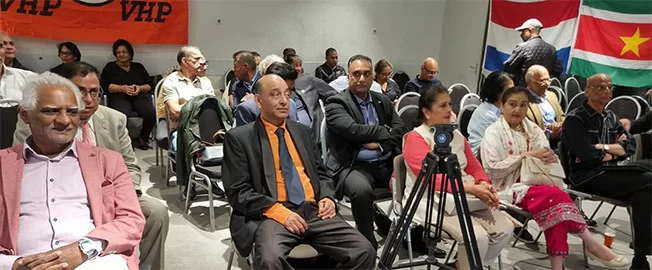
Amsterdam, September 24 – Lachman Soedamah, chair of the VHP (Vooruitstrevende Huispartij) Netherlands chapter, has delivered a bold call for a fundamental, open debate within the broader VHP party focused on realigning its ideological and organizational direction ahead of internal elections scheduled for May 2027. Speaking at the 10th annual Mr. Jagernath Lachmon Lecture, held in Amsterdam under the theme “From Unity to Renewal”, Soedamah argued that upcoming internal votes should center not just on leadership positions and candidate selection, but on the core question of what political path the Suriname-based party should pursue for the future.
In his address, which honors the political legacy of Jagernath Lachmon, covers the future of Suriname’s democratic rule of law, addresses the country’s upcoming oil and gas development, and examines the role of the Surinamese diaspora, Soedamah outlined clear options for the party’s ideological refresh. He highlighted three potential directions: social democracy, social liberalism, and a sustainability-centered approach, and personally advocated for the party to adopt a modern social democratic framework.
Under this model, Soedamah explained, broad economic development would be paired with guaranteed livelihood security, expanded access to high-quality education and universal healthcare, and targeted protection for vulnerable populations unable to support themselves. He emphasized that this approach does not reject entrepreneurship or market dynamics, but requires that both be aligned with the broader public interest.
Beyond ideological reform, Soedamah pushed for sweeping changes to the party’s internal democratic practices. He stressed that the 2027 internal elections must be about more than selecting a new party leader: all leadership candidates must publicly articulate clear policy and governance goals for the party and Suriname. Key reforms he proposed include fairer internal voting procedures, transparent accountability mechanisms, greater decision-making influence for young people and women, and a permanent, structural role for the Surinamese diaspora in party governance. He also called for strict measures to prevent conflicts of interest between public office and party positions.
Contrary to the common view that ideological division weakens broad-based people’s parties, Soedamah argued that open debate over competing ideas can revitalize the VHP, as long as all members are free to speak their minds and have genuine input on final decisions. After internal elections conclude, he added, the party must reunite: losing candidates should feel their views have been heard and respected, while the elected leadership bears the responsibility of uniting different ideological factions under a shared common goal.
Soedamah also offered a balanced assessment of the tenure of former Surinamese president and former VHP chair Chan Santokhi. He credited Santokhi with expanding the VHP into a broad, multi-ethnic national party and guiding the country through a severe economic crisis. At the same time, he pushed back against uncritical praise for Santokhi’s tenure, noting that economic stabilization measures imposed heavy burdens on the Surinamese public. Inflation, rapid price increases, and austerity policies disproportionately harmed low- and middle-income households, Soedamah argued, adding that the Santokhi administration repeatedly fell short on social protection and public communication. He also cited widespread disappointment over slow administrative reform, weak integrity safeguards, poor outreach, and the growing disconnect between politicians and ordinary citizens. The party’s recent electoral losses, he said, serve as a clear reminder that political trust is never permanently guaranteed.
A major portion of Soedamah’s lecture focused on the future of Suriname’s emerging oil and gas sector. He warned that oil and gas revenues cannot act as a standalone development model, stressing that policymakers must first answer what kind of country Suriname wants to build with this temporary windfall, rather than focusing solely on how much revenue the sector will generate. Without strong, independent public institutions, he cautioned, natural resource revenues can lead to waste, economic dependency, corruption, and widening income inequality.
To avoid these pitfalls, Soedamah called for transparent, legally enshrined management of oil and gas revenues. He proposed splitting proceeds into three core allocations: a reserve to buffer against future economic shocks, a savings fund for future generations, and targeted investments in education, healthcare, infrastructure, affordable energy, entrepreneurship, and productive domestic sectors. Crucially, he argued, institutional strengthening must be put in place before large-scale revenues begin to flow.
Soedamah tied his vision for resource governance to his “Diaspora Vision 2050”, which calls for a permanent, structural role for the global Surinamese diaspora in the country’s development. Instead of viewing the diaspora solely as a source of remittances and ad-hoc aid, he argued, Suriname should treat diaspora communities as core development partners. Key proposals include establishing a National Diaspora Council and dedicated diaspora institutions in Suriname and major host countries, expanding the existing Persons of Surinamese Origin program to include knowledge exchanges, internship placements, entrepreneurship support, and cultural programming. He also called for careful, thoughtful debate over dual citizenship rights and formal political representation for diaspora communities.
In closing, Soedamah connected Jagernath Lachmon’s historic legacy of cross-community unity to the VHP’s current mandate for renewal. He argued that Lachmon’s vision of unity should not remain a static historical concept, but must be reimagined for the 21st century to advance good governance, social justice, a stronger rule of law, and a permanent, equal partnership between Suriname and its global diaspora.