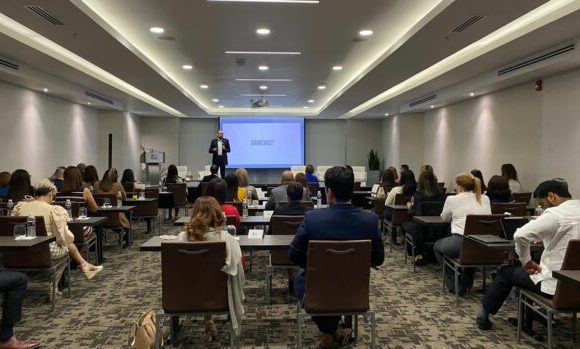
SANTO DOMINGO – Business events travelers visiting the Dominican Republic for conferences, conventions, corporate meetings and other professional gatherings spend nearly three times as much during their stay as traditional leisure tourists, according to a senior industry leader.
Aguie Lendor, executive vice president of the Dominican Association of Hotels and Tourism (Asonahores), told attendees at the opening of SDQ MICE 2026 that this segment of the tourism industry delivers outsized economic benefits to local communities and the national economy.
Lendor explained that visitors traveling for professional events inject far greater revenue into local markets through elevated spending on accommodation, local cuisine, ground transportation, leisure activities and other hospitality services. This dynamic makes the Meetings, Incentives, Conferences and Exhibitions (MICE) sector a particularly critical growth pillar for the capital city of Santo Domingo, he added.
Data from the Dominican Central Bank shows that for the first half of 2026, the average daily spending of all non-resident foreign visitors stood at US$179.48. Applying Lendor’s three-time spending premium for MICE travelers, that puts the average daily spending of business event visitors at roughly US$538 per day.
While exact headcount data for MICE-specific travelers is not yet available, Lendor estimates that this segment makes up approximately 4 percent of total annual tourist arrivals to the country. Between January and August of this year alone, the Dominican Republic recorded 6,610,258 air arrivals, meaning more than 264,000 of those visitors traveled for business events based on Lendor’s estimate.
Lendor emphasized that the expansion of MICE tourism is a core component of the national tourism industry’s strategy to diversify beyond the country’s long-standing sun-and-beach leisure model, opening new revenue streams for businesses across the island.
He added that the MICE sector is already gaining solid traction across multiple key destinations, including the capital Santo Domingo, the second-largest city Santiago, and multiple popular spots in the country’s eastern region. Beyond direct visitor spending, the growth of MICE tourism is creating new small business opportunities across the country and strengthening local supply chains for hospitality and event services.