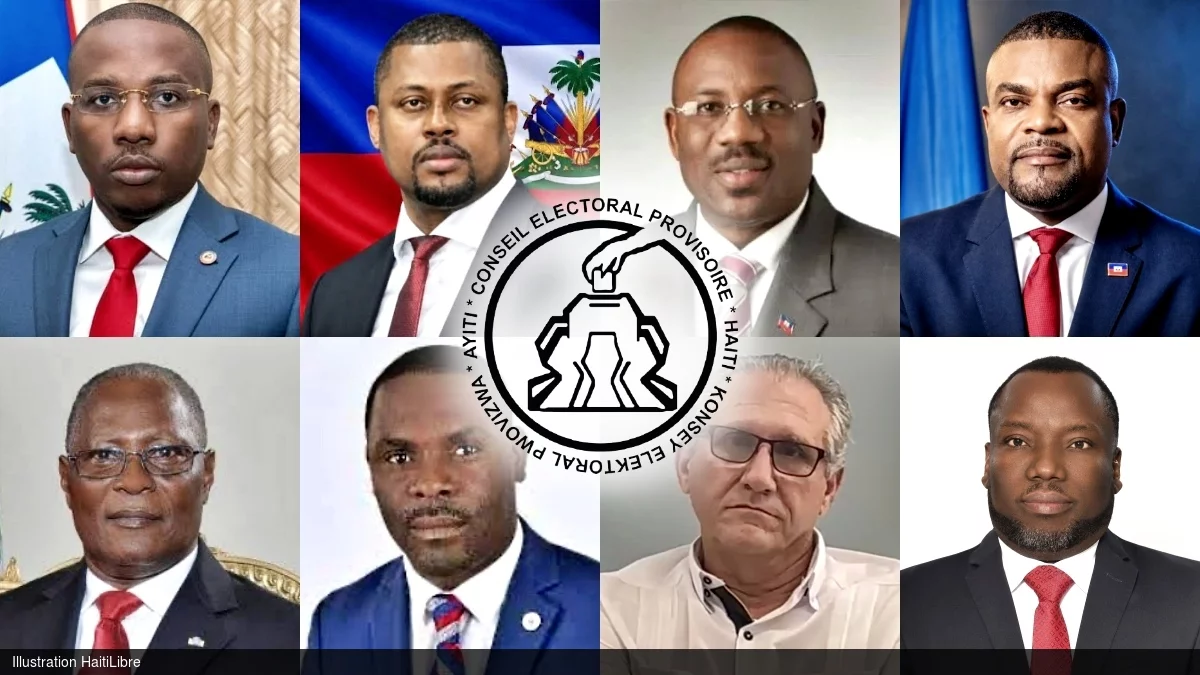
On September 23, 2026, Haiti’s Provisional Electoral Council (CEP) released its first provisional roster of registered candidates for the country’s upcoming December 2026 presidential election, revealing nine names that have completed initial registration — while leaving the much-anticipated candidacy of former Haitian president Michel Martelly in administrative limbo, amid ongoing questions over whether international sanctions will disqualify his bid under new electoral rules.
The nine candidates that appear on the published preliminary list are Claude Joseph of Les engagés pour le Développement, Ricardo Jean-Pierre of Parti Nationaliste Haïtien, Gary Bodeau of PLATFÒM REKONSILYE, Wilson Jeudy of Vision-Action-Réalisation, Wilner Joseph of VIKTWA, Jocelerme Privert of AYITI TRANSFOME, Maxo Joseph of Réveil des Citoyens Haitiens, Munir Joseph Mourra of Mobilisation pour le Progrès d’Haïti, and Gandhy Dorfeuille of Ansanm Nou Fò. All nine have completed initial paperwork to appear on the roster, but CEP officials stress that the entire list remains provisional, with full eligibility still pending completion of rigorous compliance checks.
CEP teams are currently conducting deep dives into the physical documentation submitted by each prospective candidate, with two key eligibility criteria under review: confirmation that each candidate meets constitutional requirements for the presidency, and verification that each candidate’s political party has secured the required 30,000 registered affiliated members. No candidate will receive final official approval until this verification process is concluded.
Martelly, whose candidacy has dominated pre-election speculation, does not yet appear on the published list. CEP confirmed that the former president submitted his registration just one day before the preliminary list was released, and the council’s digital administrative systems require additional time to process, validate, and update the new entry alongside other applications.
The delay in processing Martelly’s registration is not the only barrier his candidacy faces, however. Under a 2026 electoral decree, any individual subject to United Nations Security Council sanctions is barred from qualifying as a candidate. While Martelly is not currently named to the UN Security Council’s sanctions list, he faces sweeping unilateral sanctions from multiple Western governments and major international blocs over allegations of criminal activity and ties to Haitian armed gangs.
The UN Panel of Experts on Haiti first publicly linked Martelly to gang activity in an October 2023 official report, which accused the former president of funding and backing armed gangs to expand his personal political influence. Canada became the first nation to impose direct sanctions on Martelly in November 2022, targeting him over allegations of corruption and gang financing. In August 2024, the United States government added Martelly to its sanctions list, citing his alleged role in transnational cocaine trafficking, money laundering, and continued support for violent gangs. Most recently, in December 2025, the European Union Council added Martelly to its sanctions blacklist, imposing an asset freeze and global travel ban over his proven complicity in organized gang violence.
Haitian legal analysts are now at the center of a growing national debate over whether these international sanctions and expert findings meet the legal threshold to disqualify Martelly under the 2026 electoral decree’s requirements for candidate probity and moral integrity. The CEP’s upcoming ruling on Martelly’s eligibility has emerged as the most contentious and closely watched issue in the lead-up to the December vote, with major implications for the legitimacy of Haiti’s electoral process as the country works to emerge from years of political and security crisis.