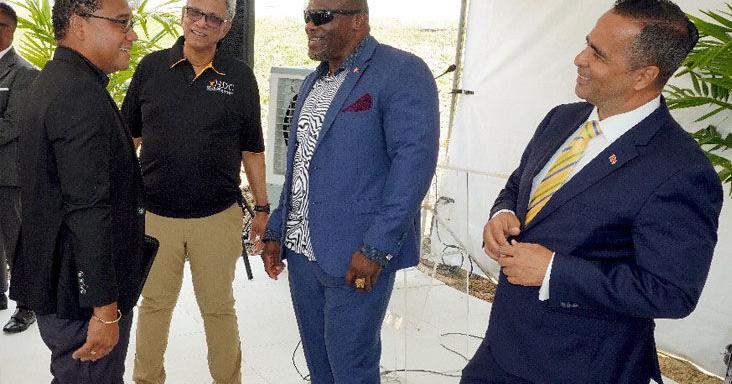
A fierce political confrontation over the controversial Special Operations Bill (SOB) has escalated in Trinidad and Tobago, with senior cabinet minister and ruling party official Roger Alexander calling on residents of opposition-held constituencies to pressure their elected representatives to support full implementation of the legislation across the country. Alexander made his remarks Thursday while speaking to reporters on a site visit of the Canopies at Caura housing development, a new Housing Development Corporation project in his Tunapuna constituency, ahead of the development’s official public launch.
The current clash stems from a decision announced earlier this week by Prime Minister Kamla Persad-Bissessar, leader of the ruling United National Congress (UNC). Facing widespread opposition and threats of mass protest from Members of Parliament belonging to the opposition People’s National Movement (PNM), Persad-Bissessar declared Monday that her administration would limit enforcement of the special operations framework exclusively to constituencies, local government districts, and the autonomous island of Tobago that are controlled by pro-government parties.
In a sharply worded social media statement, the Prime Minister accused PNM representatives of deliberately opposing the anti-crime legislation to protect the violent criminal gangs and local drug trafficking networks that operate in their constituencies. “Therefore, I will only authorise special operations in the 26 UNC-held constituencies, 70 UNC-held local government electoral districts and in the two TPP-held constituencies after consultation with Chief Secretary Farley Augustine,” she confirmed.
Opposition lawmakers have mobilized against the bill on constitutional and civil liberties grounds. During last Friday’s parliamentary debate, senior Opposition MP Stuart Young argued that the broad powers granted by the legislation risked transforming Trinidad and Tobago into an authoritarian police state. That opposition has extended to on-the-ground organizing: Port of Spain South MP Keith Scotland has already publicly pledged to mobilize his constituents to oppose both the bill and the proposed policy of designating high-crime neighborhoods as restricted “closed areas” for law enforcement operations.
Alexander pushed back against the opposition’s position Thursday, framing the government’s limited implementation plan as a defensive barrier that would keep criminal activity contained within opposition-held areas and away from pro-government communities. “We will build it like a fence. So, we will keep them away from good people,” he told reporters. He added that PNM representatives’ opposition to the bill does not reflect the will of ordinary constituents in opposition-held districts, arguing that lawmakers live outside the communities they represent and are out of touch with residents’ demand for stronger anti-crime action.
“He said constituents in those areas needed to stand up against their representatives and say, listen you are speaking for you because you do not live here, we want to speak for ourselves,” Alexander stated, adding that constituent pressure would force opposition MPs to reverse their position on the legislation.
When asked whether the government would open the policy up to broad public consultation before moving forward with implementation, Alexander noted that opposition lawmakers already rejected a consultation process during last week’s parliamentary debate. He confirmed that the administration has no plans to force the policy on constituents whose representatives have actively pushed back against it. When pressed to point to specific language in the legislation that allows for enforcement to be limited along political constituency boundary lines, Alexander stated the scope of implementation would ultimately be shaped by public attitudes toward the policy.