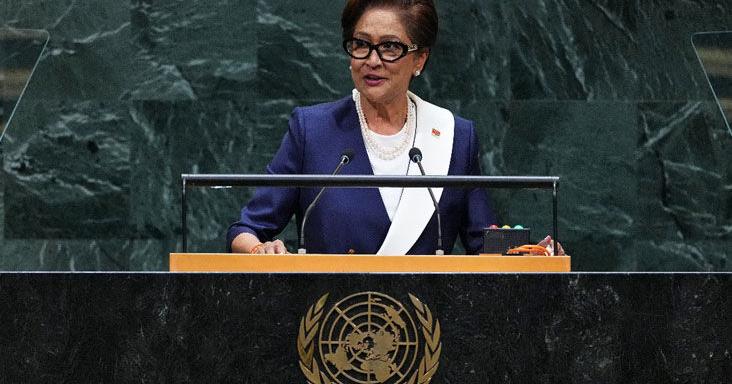
At the 81st United Nations General Assembly session held in New York, Prime Minister Kamla Persad-Bissessar has amplified Trinidad and Tobago’s long-running campaign against illicit firearms, drug trafficking and cross-border organized crime to the global community, issuing a stark warning about the existential risks these networks pose to small island developing states.
In her address to the assembly, Persad-Bissessar stressed that the illegal trade in weapons and narcotics has grown beyond a national crisis for Trinidad and Tobago, emerging as a destabilizing force across the entire Caribbean region. Unlike major global powers, small states like her country face a deeply asymmetric challenge: well-funded, technologically sophisticated criminal networks that directly undermine public safety, weaken state institutions and block long-term socio-economic development. “For Trinidad and Tobago, this is not an abstract threat,” she told delegates. “These networks directly endanger our citizens, our institutions and our development.”
Since her administration took office in 2025, Persad-Bissessar noted, the government has centered its domestic policy agenda on people-centered priorities: building safer communities, attracting productive investment, modernizing public services, and expanding economic opportunity for all citizens. At the core of this agenda is restoring lasting public security, a goal that the country has pursued through deepened collaboration with international partners. She singled out U.S. President Donald Trump for specific praise, extending gratitude for his administration’s commitment to deepening security cooperation and extending an invitation for Trinidad and Tobago to join two key regional anti-crime initiatives: the Shield of the Americas and the Americas Counter-Cartel Coalition.
Trump first launched the Americas Counter-Cartel Coalition during the inaugural Shield of the Americas Summit held in Florida this past March, where Trinidad and Tobago was counted among the founding participating nations. The initiative is designed to coordinate cross-border action to disrupt and dismantle transnational criminal organizations operating across the Western Hemisphere. “We remain confident that this partnership will continue to promote freedom, security and prosperity in our region,” Persad-Bissessar said.
Looking ahead, the prime minister outlined Trinidad and Tobago’s planned priorities for its upcoming two-year term on the UN Security Council, which the country will assume on January 1, 2027. Trinidad and Tobago secured its non-permanent council seat for the 2027-2028 term in a June election, winning support from 181 UN member states—an outcome Persad-Bissessar thanked the global body for. This marks only the second time in Trinidad and Tobago’s history that the country will sit on the Security Council, and the first time in more than 40 years. During its tenure, she said, the country will uphold the mandate it campaigned on: “Building Consensus for the Realisation of Sustainable Peace and Security.”
As a Small Island Developing State, Persad-Bissessar noted, Trinidad and Tobago will bring a unique, on-the-ground perspective to the council’s work, all while remaining fully committed to the principles of the UN Charter, international law, and the peaceful resolution of disputes. Curbing the illicit trafficking of small arms and light weapons will top the country’s list of priorities. She emphasized that while no Caribbean nation manufactures the illegal weapons that fuel widespread violence across the region, Caribbean states bear the devastating human and economic cost of their proliferation. “Although the region does not manufacture these weapons, their availability fuels gang violence, organised crime, drug trafficking and loss of life across our societies,” she said.
During its Security Council term, Trinidad and Tobago will push for expanded global cooperation to map the source countries and trafficking routes of illicit weapons, and block these weapons from being diverted into illegal markets. Key priorities for action include strengthening global firearms tracing mechanisms, expanding cross-border intelligence and information sharing, boosting joint border and maritime security efforts, and deepening collaboration between source, transit and destination countries. These efforts must also target the illegal narcotics trade and the illicit financial flows that fund and sustain transnational criminal syndicates, she added.
Persad-Bissessar emphasized that the crisis in the Caribbean offers a clear lesson for the global community: transnational organized crime can destabilize sovereign states and threaten regional security even in the absence of traditional armed conflict. Through its work on the Security Council, she said, Trinidad and Tobago will bring this firsthand experience to the global stage to rally collective action against a shared global threat.