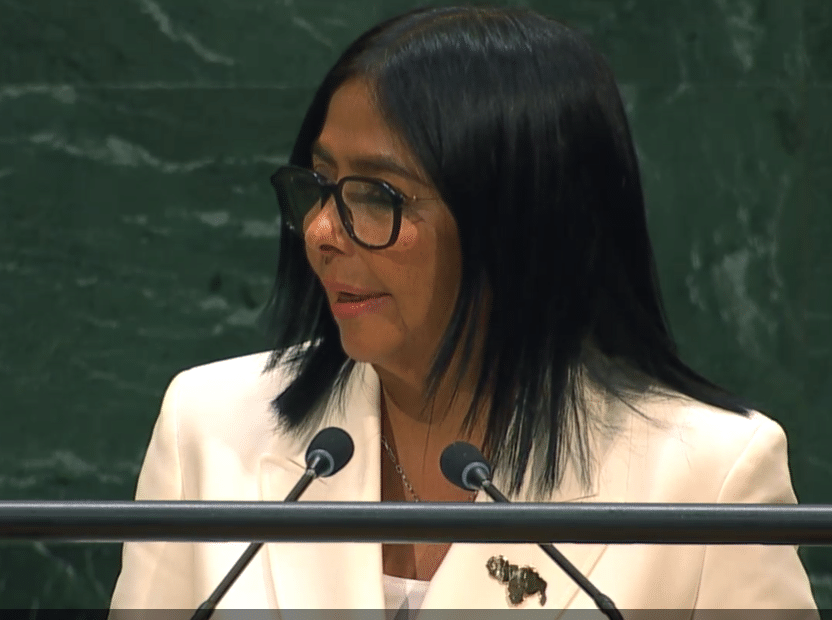
With a landmark International Court of Justice ruling on the decades-long Guyana-Venezuela border dispute just months away, Venezuela’s acting President Delcy Rodriguez used her first address to the United Nations General Assembly (UNGA) on September 23, 2026, to publicly push for a negotiated bilateral settlement of the conflict over the resource-rich Essequibo Region.
Addressing delegates at the 81st UNGA session – what she described as the global headquarters of international law – Rodriguez wore a controversial brooch depicting Venezuela’s territorial map that includes the entire Essequibo Region, a 55,000-square-mile territory that makes up two-thirds of Guyana’s total sovereign land area. In her remarks, Rodriguez reaffirmed Venezuela’s long-stated territorial claim to the region and extended an official appeal to Guyana to return to direct bilateral talks, aligned with the terms of the 1966 Geneva Agreement that governs the dispute.
“Agreements that last the longest are those that emerge from bilateral negotiations,” Rodriguez told the assembly. “They last longer and function better than those imposed by external bodies.”
This public address marks the first time Rodriguez has laid out her administration’s position on the dispute at a major global forum, coming nine months after former Venezuelan President Nicolas Maduro was ousted from power by U.S. military intervention in January 2026. In a notable shift from the rhetoric of the Maduro era, Rodriguez did not launch criticism of the United States or ExxonMobil – the energy giant that has discovered massive oil reserves in Guyana’s offshore waters adjacent to the dispute zone – a departure from her previous speaking appearances alongside Maduro.
Instead, Rodriguez praised a newly signed bilateral cooperation agreement between Washington and Caracas, calling it “one of the most all-encompassing and significant ever signed” between the two nations. She added that the deal will support regional energy balance and strengthen Venezuela’s struggling economy, and publicly thanked U.S. President Donald Trump for his administration’s willingness to restore full diplomatic relations and cooperation with the new Venezuelan government.
Venezuela has long held that the 1966 Geneva Agreement requires a negotiated settlement to the dispute and rejects the ICJ’s authority to rule on the validity of the 1899 Arbitral Tribunal Award that established the current Guyana-Venezuela border. Despite this objection, Caracas has participated fully in all procedural stages of the case that Guyana brought to the ICJ after decades of stalled progress through the UN Good Offices mediation process. The UN Secretary General formally referred the dispute to the ICJ in accordance with the Geneva Agreement, and the court previously ruled it has jurisdiction to hear Guyana’s challenge on the legality of the 1899 border award. A final ruling is expected in early 2027.
The United States has already signaled it stands ready to support both nations in negotiating a final maritime boundary settlement once the ICJ issues its territorial ruling. Venezuela is not a party to the United Nations Convention on the Law of the Sea, meaning any maritime delimitation will require direct bilateral negotiation. For its part, ExxonMobil has indicated it plans to resume oil exploration activities in the Stabroek Block, located in waters closer to the Venezuelan border, once the World Court issues its final ruling.
Notably, Guyana already maintains close strategic ties with the United States and is a participating member of the Trump administration’s Shield of the Americas anti-narcoterrorism initiative, adding an additional layer of geopolitical complexity to the ongoing dispute.