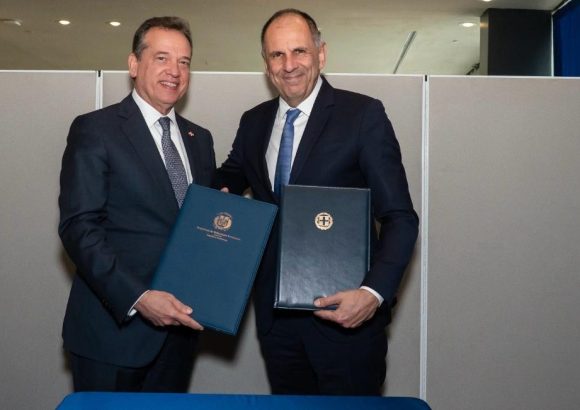
On the margins of the 78th United Nations General Assembly in New York, the Dominican Republic has advanced a slate of key diplomatic engagements, forging new economic partnerships and advancing collaborative education projects with global partners.
In one of the most significant announcements, the Caribbean nation and Greece formalized a new bilateral agreement, signing a Memorandum of Understanding (MOU) aimed at deepening cross-border economic connections, boosting two-way trade and investment flows, and bolstering resilient shared supply chains. The document was officially signed by Dominican Foreign Minister Víctor “Ito” Bisonó and his Greek counterpart Giorgos Gerapetritis, establishing a formal structural foundation for future collaboration between the two governments. As part of the agreement, the two countries will launch a Joint Working Group tasked with identifying new mechanisms to expand economic links, streamline cross-sector information sharing, and exchange policy strategies and stakeholder perspectives across both public and private industries.
Beyond the agreement with Greece, Minister Bisonó packed his New York diplomatic schedule with additional high-level bilateral talks. He held a productive meeting with Italian Foreign Minister Antonio Tajani, where the pair covered a broad range of mutual priorities. These included support and policy coordination for the large Dominican diaspora community residing in Italy, alignment on regional and global energy policy agendas, expansion of bilateral tourism cooperation, and exploration of untapped opportunities to grow trade and economic ties between the two nations.
Another key diplomatic engagement for the Dominican delegation centered on global education cooperation. Minister Bisonó joined Dominican President Luis Abinader for a high-level meeting with UNESCO Director-General Khaled El-Enany. During the discussion, the two sides explored a forward-looking plan to launch a new specialized institute at the Dominican Republic’s Punta Bergantín Innovation Center, with a core mission of expanding access to and quality of STEM (science, technology, engineering, and mathematics) education across the country. If advanced, the proposed initiative will draw on the successful framework of an existing UNESCO model currently under development in Shanghai, China, adapting proven approaches to meet the Caribbean nation’s specific education and development goals.