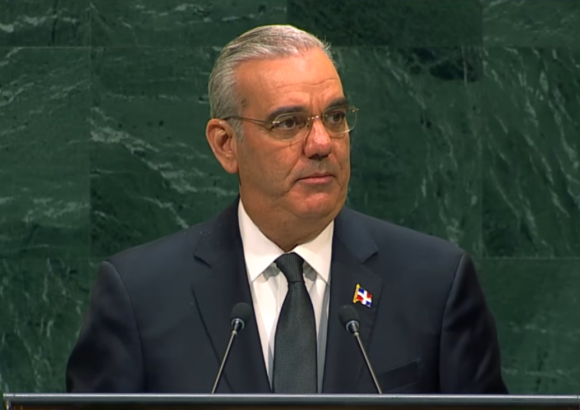
NEW YORK – Speaking on the floor of the 81st session of the United Nations General Assembly Wednesday, Dominican Republic President Luis Abinader laid out the significant social and economic gains his nation has achieved over recent years, while pressing for urgent global collective action to address shared cross-border challenges ranging from climate vulnerability to systemic global inequality.
Leading with domestic achievements, Abinader outlined dramatic progress in advancing the United Nations’ Sustainable Development Goal of Zero Hunger. The country cut monetary poverty nearly in half, dropping from 25.8% in 2019 to just 14.6% in the first half of 2026. Even more notably, the Dominican Republic met its Zero Hunger target two full years ahead of its 2028 deadline, and was removed from the international list of countries grappling with the most severe hunger levels. The Food and Agriculture Organization will formally recognize the nation for this milestone at an October 10 ceremony in Rome, as confirmed by the Dominican government.
Abinader also detailed robust economic momentum across key sectors. For four consecutive years, the country has attracted over $4 billion in annual foreign direct investment, with the 2025 total exceeding $5 billion – a clear signal of international market confidence in the Dominican economy. Exports hit an all-time high of nearly $16 billion, while the nation’s critical tourism sector continues to outpace pre-pandemic performance: visitor arrivals grew from 7.5 million in 2019 and are on track to cross the 12 million mark by the end of 2026, driving job creation and broad-based economic growth.
Beyond reporting on domestic progress, Abinader called for a fundamental shift in how the global community measures national development and access to financing. He argued that relying solely on gross domestic product as the core metric for development is outdated, and that per-capita income alone should not determine whether a country qualifies for low-interest concessional financing. Instead, he urged global leaders to finalize the reform process initiated through the UN’s Pact for the Future, and adopt new common metrics that account for the multidimensional vulnerabilities facing many developing nations. He specifically called on major international financial institutions to integrate the Multidimensional Vulnerability Index into their funding decision-making.
Turning to climate threats, Abinader underscored that climate change and accelerating sea-level rise are not distant future risks for small island developing states like the Dominican Republic, but a daily lived reality. He welcomed the recent UN adoption of a global declaration on sea-level rise, and highlighted the persistent regional challenge of invasive sargassum blooms, which disrupt coastal ecosystems, harm local communities, and threaten the Caribbean’s tourism-dependent economies. Abinader also noted that the Dominican Republic has taken proactive steps to protect global marine resources, having completed ratification of the High Seas Treaty, the landmark agreement governing marine biodiversity in areas outside national jurisdictions.
On broader global conflicts and cooperation, Abinader called for unity, calm, and deliberate diplomacy to address the world’s most pressing crises. He noted that ongoing conflicts in Europe and the Middle East have driven sharp increases in global food and energy prices, a shock that hits small import-dependent nations like the Dominican Republic disproportionately hard. He called for immediate de-escalation of tensions, respect for the principle of freedom of navigation, and a commitment to resolving all international disputes through diplomatic dialogue. Finally, Abinader reiterated his call for a reformed United Nations that is more representative of the global population, more efficient in its operations, and more responsive to the needs of developing nations. Emphasizing the accelerating pace of global change, he noted that “The future is no longer something that is perceived in the long term,” arguing that rapid shifts in technology, economics, and the climate demand urgent, coordinated action from global leaders in the present.