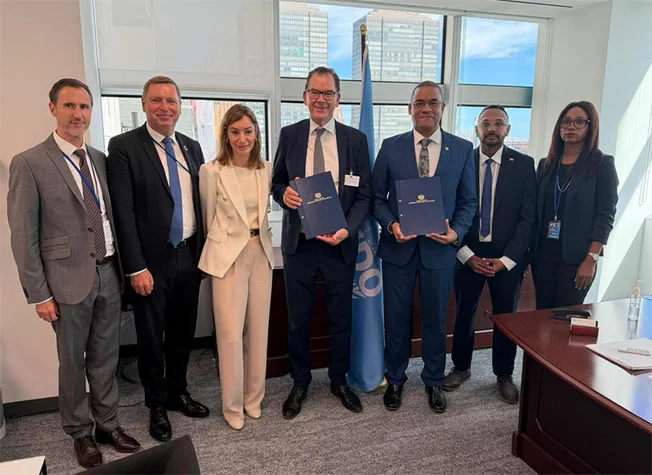
On the sidelines of the United Nations General Assembly in New York on Monday, the government of Suriname and the United Nations Industrial Development Organization (UNIDO) formalized a landmark five-year partnership framework aimed at accelerating the country’s long-term economic transformation. The Programme for Country Partnership (PCP) for 2026-2031 sets out an ambitious agenda to boost local processing of raw materials and agricultural goods, attract targeted foreign and domestic investment, strengthen small and medium enterprise (SME) entrepreneurship, and expand inclusive, quality job creation across the nation.
The agreement was signed by Suriname’s Minister of Economic Affairs, Entrepreneurship and Technological Innovation (EZOTI) Andrew Baasaron and UNIDO Director-General Gerd Müller. Designed as a collaborative strategic framework, the PCP brings together government stakeholders, private sector actors, development partners, and global financing institutions to co-develop projects and mobilize capital for inclusive industrial growth. A core guiding principle of the initiative is retaining greater economic value within Suriname’s borders, moving the country beyond its historical reliance on exporting unprocessed raw materials and agricultural commodities by scaling local production of semi-finished and finished goods. Priority sectors targeted for expansion include agro-industry, light manufacturing, and the strengthening of local end-to-end value chains.
Minister Baasaron emphasized that the new partnership aligns directly with Suriname’s national strategy to build long-term economic growth rooted in sustainable diversification. The initiative places targeted focus on high-priority inclusive development goals: expanding youth employment and entrepreneurship, advancing women’s economic empowerment, accelerating digital adoption across industries, and ensuring meaningful participation of Indigenous and Tribal communities in economic growth. “Suriname has embarked on a path of economic growth, built on the sustainable diversification of our economy,” Baasaron stated during the signing ceremony, noting that teams from EZOTI and UNIDO had spent months refining the program’s details to fit Suriname’s unique national context.
The PCP is structured around four core pillars that guide all planned activities under the framework. The first pillar focuses on improving policy, regulatory frameworks, and institutional capacity to support sustainable industrial development. The second pillar works to boost the competitiveness of domestic enterprises, scale resilient agro-industrial value chains, advance green industrial development, and expand workforce skills training to meet growing industry demand. Third, the initiative prioritizes mobilizing green and blended financing to support productive private and public investment across targeted sectors. The fourth and final pillar centers on developing forest-related value chains and growing Suriname’s emerging bio-economy.
As part of the broader program, stakeholders will also explore the potential development of Special Economic Zones (SEZs) to further attract investment, expand industrial activity, and increase local value addition. UNIDO confirmed that Director-General Müller has committed the organization’s full support to developing a regulatory and operational framework for sustainable SEZs in Suriname if the initiative moves forward. A key cross-cutting requirement baked into the PCP is ensuring industrial expansion does not come at the cost of Suriname’s rich natural ecosystems. The program is designed to pair economic growth with protection of the country’s status as one of the world’s most heavily forested nations with low rates of deforestation. As such, climate resilience, efficient natural resource management, and low-carbon development are integrated into every pillar of the initiative.
For Suriname’s small and medium-sized enterprises (SMEs), the PCP will create new pathways to expand production capacity, boost global competitiveness, and gain improved access to financing and investment opportunities that have historically been out of reach for many smaller domestic businesses. Beyond industrial growth, the program maintains a constant focus on creating quality formal employment, with targeted outreach to increase job opportunities for young people and women across all sectors. It is important to note that the signing of the framework document does not mean all proposed projects and planned investments have already secured full funding. Instead, the PCP acts primarily as a shared strategic roadmap that will guide the government, UNIDO, financing partners, development organizations, and the private sector as they work to develop and fund concrete projects over the coming five years from 2026 through 2031.