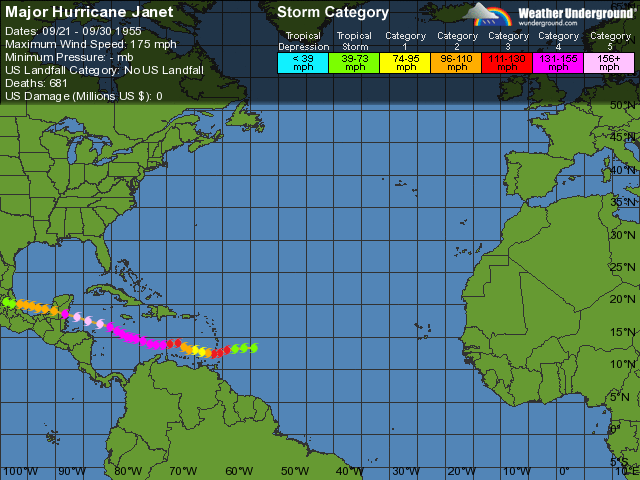
It has been nearly seven decades since one of the most destructive tropical cyclones ever recorded in the Eastern Caribbean descended on the tri-island nation of Grenada, leaving an indelible mark on the country’s history. Between September 22 and 23, 1955, Hurricane Janet, an unusually powerful outlier storm system, tore through the small Caribbean archipelago with a ferocity that defied all prior regional storm expectations.
Local meteorological authorities and broadcasters did issue advance alerts of the approaching danger: the Windwards Island Broadcasting Service (WIBS) began rolling out official hurricane warnings starting at noon on September 22, ramping up the frequency and urgency of broadcasts as the storm drew closer. Despite the repeated alerts, the vast majority of Grenada’s population failed to grasp the imminent threat, adopting a complacent, blasé stance toward the incoming weather event.
That nonchalance evaporated instantly when Hurricane Janet made landfall just after 6:30 p.m. That evening, hurricane-force gusts and torrential downpours slammed into the islands, unleashing 11 and a half hours of unrelenting destruction that stretched all the way to 6 a.m. the following morning. Packing sustained peak winds of 130 miles per hour, the storm scoured the main island of Grenada, as well as the smaller sister islands of Carriacou and Petite Martinique, flattening everything in its path.
When the skies finally cleared and the full scale of the disaster emerged, the human and economic toll was staggering. On the main island of Grenada alone, the storm claimed 120 lives, destroyed half of the country’s entire housing stock, and wiped out 70 percent of the nation’s nutmeg trees – the iconic agricultural commodity that has long been central to Grenada’s local economy. For the smaller northern islands, the devastation was even more complete: 27 additional lives were lost, another 500 people suffered storm-related injuries, and nearly the entire population of Carriacou and Petite Martinique was left homeless.
In total, preliminary damage assessments from the aftermath pegged total economic losses at approximately $20 million U.S. dollars in 1955 valuations. In the immediate response phase, public health officials moved quickly to prevent post-storm disease outbreaks, vaccinating 80 percent of the country’s total population against typhoid fever. As international aid poured into the storm-ravaged nation, prefabricated emergency housing units donated from Suriname arrived to shelter displaced residents. These sturdy, pre-built structures became permanently embedded in Grenada’s built landscape, earning the nickname “Janet Houses” that they still carry to this day, a lasting reminder of the 1955 catastrophe.