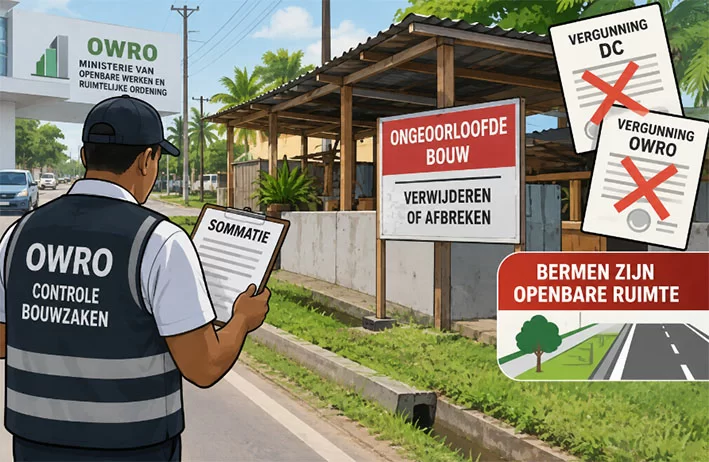
A new government enforcement operation targeting illegal construction on public road verges has kicked off in Suriname, stirring public debate over public land use regulation and conflicting permit rules. The country’s Ministry of Public Works and Spatial Planning (OWRO) has begun issuing formal notices to individuals and private businesses that have erected unapproved structures and outbuildings along roadside verges, ordering these parties to dismantle and remove the unauthorized constructions within an unspecified timeframe.
Minister Stephen Tsang confirmed the details of the operation in an interview with local outlet *Starnieuws*, clarifying that the current round of enforcement specifically targets new construction projects that never received formal approval from either OWRO or local district commissioners (DC). “This action is exclusively for new builds that were put up without getting authorization from either the district commissioner or my ministry,” Tsang stated to reporters.
The crackdown comes after the issue of unauthorized verge construction gained significant public and political attention in recent weeks. Weeks prior, Rabin Parmessar, parliamentary leader of the opposition National Democratic Party (NDP), called for strict enforcement against illegal construction on road verges during a sitting of the National Assembly. Parmessar argued that despite previous agreements to crack down on the practice, unapproved structures were still being allowed to go up, highlighting multiple examples along Jan Steenstraat in the northern district of Paramaribo. He further emphasized that district commissioners should not have the authority to approve any verge construction projects without formal review and approval from OWRO.
Long before the current operation launched, Minister Tsang had already announced a full suspension on new construction permits for road verges, linking the illegal construction to growing stormwater drainage problems across the country. He explained that when structures are built on verges, they block access for OWRO crews to perform regular maintenance on ditches, canals, and other critical drainage infrastructure, worsening flood risks during heavy rainfall.
While the operation is framed as targeting unapproved new builds, it has already sparked confusion and questions surrounding the fate of older structures that were built with previously issued permits. *Starnieuws* has confirmed that at least one business owner on Plutostraat, also in northern Paramaribo, has received a removal order for their verge structure — despite holding a valid construction permit issued in 2025. It remains unclear why this permit-holding structure is targeted, what entity issued the original 2025 permit, and whether OWRO plans to distinguish between permits issued solely by district commissioners and those approved with OWRO’s input, a distinction that could shape the future of hundreds of existing structures.
Suriname’s government has long maintained that road verges are classified as public open space, requiring formal approval from competent government authorities for any private construction or use. With Tsang’s explicit confirmation that the current operation focuses exclusively on unapproved new builds, critical questions remain unanswered: what enforcement action, if any, will be taken against existing legal structures built with previously issued permits, and how will the government resolve conflicting past approval processes?