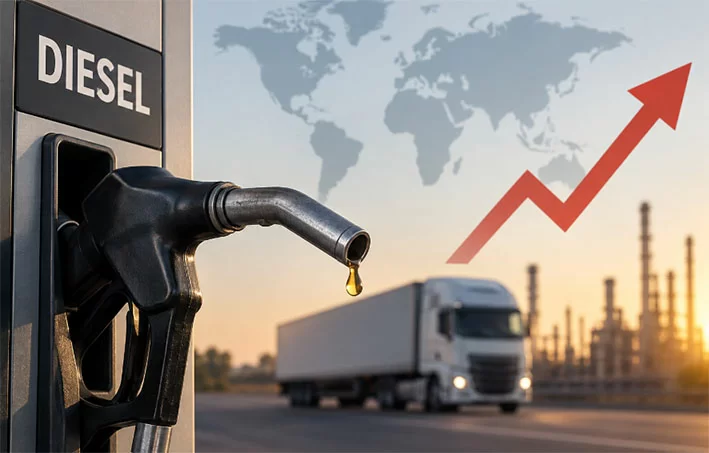
The global diesel market is facing a crippling supply deficit that market analysts warn could remain tight well into 2027, driven by cascading geopolitical conflicts and critical disruptions to key refinery operations in major exporting regions. According to inventory data and industry analysis cited by Reuters on Monday, this shortage is already being felt across three major consumption hubs: North America, Europe, and Asia. As a fuel that underpins global commercial activity – powering long-haul freight trucks, agricultural machinery, and a wide range of industrial equipment – diesel’s scarcity carries far-reaching economic ramifications.
The root of the current crisis lies in the sudden loss of massive volumes of refined fuel exports from two of the world’s largest supply regions: Russia and the Middle East. Tensions around Iran and severe restrictions on commercial shipping transit through the Strait of Hormuz, a critical chokepoint for nearly 20% of global oil trade, have severely curtailed exports from the Persian Gulf region. Parallel to this, repeated attacks on Russian refinery infrastructure and Moscow’s self-imposed export restrictions have further shrunk the pool of diesel available on the global market. Before these cascading disruptions began, the two regions combined made up a substantial share of total global diesel exports.
The United States is currently experiencing the most acute strain of the shortage. U.S. diesel inventories have dropped to their lowest seasonal level since 1982, and the U.S. Energy Information Administration forecasts that stockpiles will remain depressed through most of 2027. Price impacts have already been significant: as of Monday, the average national retail diesel price hit $6.51 per gallon, a 76% jump compared to the same period one year earlier. With U.S. refineries already operating at roughly 97% of their maximum capacity, there is almost no room to quickly ramp up domestic production to offset the global supply gap.
Europe is also grappling with historically low diesel stockpiles, and the crisis is compounded by a parallel shortage of jet fuel. Both diesel and jet fuel fall into the same category of middle distillate refined petroleum products, meaning competition for limited refinery output further tightens supplies. In the key Amsterdam-Rotterdam-Antwerpen storage and trading hub, jet fuel inventories have already fallen to their lowest level in seven years.
The economic impact of the diesel shortage extends far beyond higher prices at fuel pumps for commercial operators. Diesel is an essential input for nearly every sector of the global economy, from moving consumer goods across supply chains to powering farming, mining, construction, and manufacturing operations. Higher fuel costs push up production and distribution expenses across the board, which are ultimately passed through to end consumers, adding renewed upward pressure to global inflation that many central banks have worked aggressively to tame.
Some near-term relief could come from increased production from other major refining centers, including China, where high refining margins are already incentivizing operators to maximize diesel output. However, industry analysts agree that this additional production will not be enough to fully close the global supply gap in the short term. Any new unplanned refinery outages or further escalation of existing geopolitical conflicts could trigger another sharp spike in global diesel prices.
A core structural issue exacerbating the crisis is a global lack of refining capacity, not a shortage of crude oil itself. Damaged or idled refinery capacity cannot be replaced quickly, as new facility construction takes years of planning and investment. This means the diesel market can remain tight even when global crude oil supplies are sufficient to meet demand.
For countries that rely heavily on diesel imports, the crisis marks a shift in how final import prices are determined. No longer is the global crude oil price the only key factor; the availability of refined diesel, its market price, and associated transport costs are now playing an increasingly large role in determining the final cost of imported fuel for import-dependent nations.