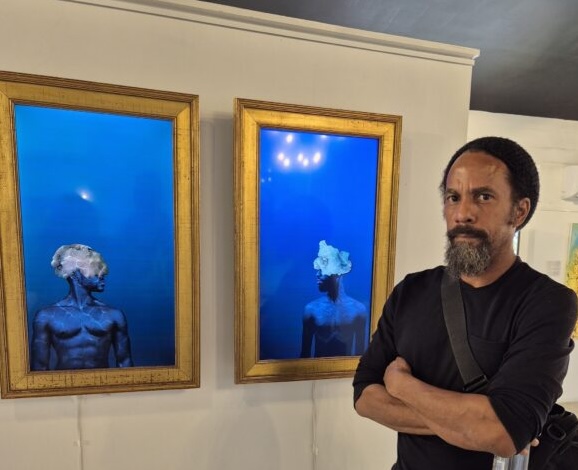
One of the art world’s most anticipated international gatherings, the 2026 Biennale di Venezia, has played host to the Grenada Pavilion for the past five months, with a curatorial mission that bridges divides across the Caribbean region. In a departure from typical national representation, the pavilion has centered the work of a multidisciplinary artist from a neighboring Caribbean island, Barbados, to foster connection and solidarity across the archipelago. Curated by Daniele Radini Tedeschi, the official pavilion program features Russell Watson’s thought-provoking digital installation, titled *BG4202301 1M-A/BG4202301 1M-B*, which builds on the pavilion’s central thematic focus: exploring poetic correspondences between human sensory experience and the natural world that surrounds us. For years, Watson’s practice has centered the interconnected dynamics between the human body, Caribbean ecological systems, and metaphorical transformation. His work consistently creates visual spaces that blur the line between subtle visceral sensation and clear, recognizable representation—a creative approach that finds striking expression in his Venice Biennale presentation. Moving beyond the conventions of literal realistic depiction, Watson’s installation leans into mirroring effects and sensory echoes of the ocean to evoke the quiet, immersive experience of being submerged underwater. Upon entering the installation space, viewers are immediately pulled into the visual interplay between two silent, mirrored figures displayed across separate screens. Far from functioning as simple duplicate reflections of one another, the figures seem to engage in a quiet dialogue across the empty space between their displays. As soft streams of bubbles rising from the figures’ mouths slowly move toward convergence, the work’s meaning emerges not from bold statement, but from symmetry, mutual presence, and quiet internal resonance. Layered visual and auditory elements combine to create an almost tangible sensation of being surrounded by water. Shimmering light that mimics the movement of sun on a sea surface plays across the figures, while the background gradually deepens from pale to rich cerulean, signaling a slow descent into the depths of the Caribbean Sea. Coral formations that cover the figures’ eyes amplify the immersive effect, shifting focus away from visual perception and toward the audience’s other senses. A layered, reconstructed underwater soundscape extends this illusion beyond the visual realm, reinforcing the feeling of submersion even when no physical water is present. Rather than framing the Caribbean Sea as a static subject to be depicted, Watson reconstructs the ocean as a visceral, felt sensation. While the work’s perceptual logic aligns with the traditions of magical realism, it does not introduce supernatural elements to create its unusual effect. Instead, Watson shifts the audience’s familiar expectations of how we perceive art, creating an intermediate space that sits between traditional representation and pure sensory experience. In this space, digital illusion makes the absence of the physical sea feel almost tangible. This delicate interplay of sensory elements is exactly what brings the Grenada Pavilion’s core poetics of correspondence to life. Every formal choice echoes a natural element: blue brings depth to mind, shimmer evokes the constant movement of the ocean surface, coral formations nod to the Caribbean’s fragile marine ecosystems, bubbles signal breath and weightless suspension, and the gradual darkening of the palette mirrors the imagined journey into deeper water. In the dialogue between human figures, color, light, and sound, the sensory presence of the Caribbean Sea becomes almost tangible for visitors, long after they leave the pavilion space. The exhibition will remain open to the public through November 22. This analysis is contributed by Valentina Miniti, an emerging Italian art critic and curator with an interdisciplinary academic background spanning modern literature, literary criticism, communication, and fine arts. From 2022 to 2024, Miniti served as a lecturer in English for Arts and Communication at the Academy of Fine Arts in Reggio Calabria, before shifting her professional focus to independent art criticism and curatorial projects. She currently collaborates with Start Group Srl to support and promote international artistic practice. Disclaimer: NOW Grenada holds no responsibility for the opinions, statements, or third-party media content shared by contributing writers. Users may click to report any content that violates community guidelines.
Russell Watson’s Digital Poetics of Immersion at the 2026 Venice Biennale