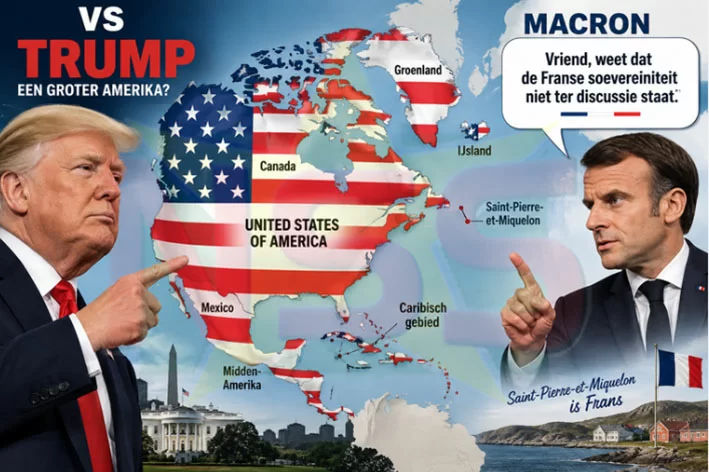
In a striking departure from traditional diplomatic venue choices, French President Emmanuel Macron and Canadian Prime Minister Mark Carney gathered for high-stakes talks this week on Saint-Pierre-et-Miquelon, a tiny French overseas archipelago located just 25 kilometers off the Canadian coast. The location choice carries sharp political weight, coming on the heels of a provocative move by U.S. President Donald Trump, who recently shared an altered image depicting the French territory under an American flag. During his visit, Macron left no room for ambiguity about the islands’ status, forcefully reaffirming French sovereignty over the territory. This historic visit marks the first time a sitting French president has traveled to Saint-Pierre-et-Miquelon since 2014.
The timing of the meeting is no coincidence. Both Paris and Ottawa are currently navigating heightened diplomatic and trade tensions with Washington, and Canada has been actively pursuing deeper economic and strategic ties with Europe to reduce its long-standing overreliance on the United States. Just days before the Saint-Pierre-et-Miquelon talks, Carney addressed the European Parliament to argue for a far closer strategic partnership between Canada and the European Union, identifying energy, defense, artificial intelligence, critical minerals, and digital trade as core areas for expanded collaboration.
Located in the North Atlantic Ocean just off the coast of Canada’s Newfoundland and Labrador region, Saint-Pierre-et-Miquelon is made up of eight small islands and stands as the last remaining French sovereign territory in North America. France and Canada share a maritime border around the archipelago, a geographic fact that infuses the Macron-Carney meeting with unique symbolic meaning. Global news agency Reuters has characterized the visit as an intentional, coordinated signal directed at the Trump administration, a reading widely shared by diplomatic observers following Trump’s provocative social media post.
Beyond the symbolic posture against Trump’s territorial provocation, the two leaders used the meeting to advance concrete discussions on expanding cooperation in areas that are increasingly central to shifting global power dynamics. Energy cooperation topped the bilateral agenda, with additional talks covering aerospace development, critical mineral supply chains, and advanced technologies including quantum computing, satellite infrastructure, and supercomputing research.
For Canada, this meeting is part of a broader, deliberate strategy to diversify its international economic partnerships. Carney has made no secret of his government’s push for closer alignment with Europe at a time when Canada-U.S. trade relations are under growing strain. In a significant policy shift, the European Commission has recently floated the idea of Canada exploring a never-before-used “associate membership” status with the bloc. What this status would entail legally and practically remains unclear, and the proposal has already sparked internal debate among EU member states.
Trump has already issued sharp criticism of Canada’s European overtures and threatened punitive trade measures in response. Carney has pushed back against this pressure, emphasizing that deeper Canada-EU cooperation is not intended to create a new anti-U.S. power bloc. At the same time, Carney has highlighted the mutual benefits of the partnership: Canada holds extensive reserves of strategically important commodities that Europe is eager to access, including energy resources and critical minerals, and Carney has proposed expanding exports of liquefied natural gas (LNG) and clean hydrogen to European markets.
In sum, the meeting on the tiny islands of Saint-Pierre-et-Miquelon carries implications that stretch far beyond the archipelago’s limited geographic footprint. While Trump’s altered map reignited global debates over territorial sovereignty and the projection of American power, Macron and Carney seized the same location to simultaneously reaffirm French sovereignty and demonstrate a shared commitment to deepening strategic cooperation between Canada and Europe at a moment of shifting global alliances.