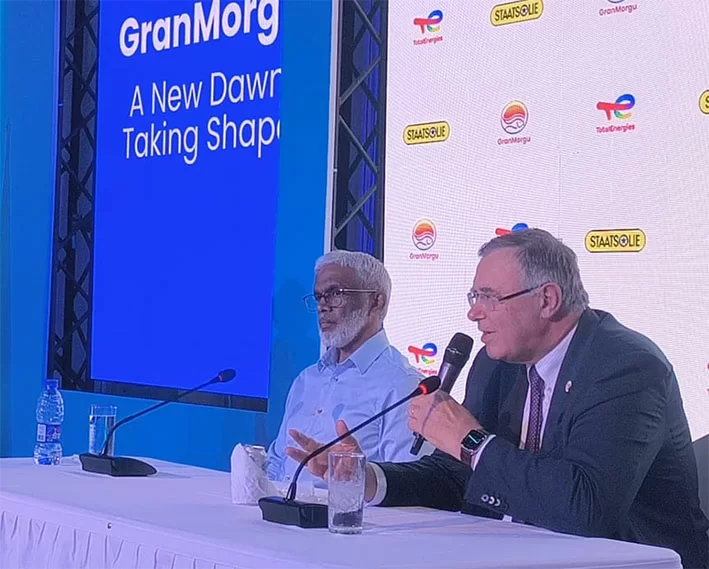
Suriname’s landmark first large-scale offshore oil development, the GranMorgu project, has hit a key milestone, completing half of its planned work and remaining on schedule to deliver its first commercial crude oil by mid-2028, project leaders announced during a joint progress briefing hosted at the Kuldipsingh Port Facility over the weekend. The event, themed “A New Dawn Taking Shape”, brought together executives from lead developer TotalEnergies and Suriname’s national oil company Staatsolie, along with Suriname’s President Jennifer Simons, to outline both the project’s advancement and the critical preparations the South American nation must complete to capitalize on the expected new oil wealth.
The billion-dollar GranMorgu development encompasses the Sapakara and Krabdagu oil fields, located roughly 150 kilometers off Suriname’s northern coast. As the project’s operator, TotalEnergies holds a 40% working stake in the development, alongside APA Corporation which also owns 40%, while Staatsolie retains the remaining 20% interest. To date, around half of the project’s total planned investment has been deployed. At full operational capacity, the project’s floating production, storage and offloading (FPSO) vessel will be capable of processing 220,000 barrels of crude oil per day.
Visitors to the Kuldipsingh Port Facility can already see tangible signs of the massive technical operation taking shape: subsea equipment manufactured in Malaysia, including wellhead components, Christmas tree systems (heavy subsea installations fitted with valves, monitoring sensors and control systems to regulate and secure production from individual oil wells), and other parts of the offshore subsea pipeline network are currently staged on site ahead of their upcoming deployment to the seabed. During a pre-event tour of the facility, President Simons noted that the physical presence of this large-scale equipment makes the project’s progress tangible, confirming how far the development has advanced in recent years.
Beyond the construction and engineering milestones, project stakeholders emphasized that the rapidly developing oil sector presents Suriname with urgent, large-scale challenges that must be addressed to ensure widespread shared economic benefit. The top priority is expanding vocational and technical training programs to build a skilled local workforce capable of supporting the new industry. The project will require trained workers for roles across construction, logistics, maintenance and offshore operations, with a focus on both technical vocational skills and academic training. TotalEnergies estimates that the GranMorgu project will generate between $1 billion and $1.5 billion in local economic activity, and support more than 6,000 direct, indirect and induced jobs across Suriname. President Simons stressed that oil development does not automatically translate to broad-based prosperity: young Surinamese will need to pursue targeted training and certification to access the new job opportunities created by the industry.
Staatsolie CEO Anand Jagesar also warned of the macroeconomic risks that accompany a sudden influx of oil revenue. A rapid flood of foreign capital and foreign workers could drive a sharp increase in domestic demand, pushing up prices for housing, hospitality, and other consumer goods and services, potentially crowding out existing non-oil sectors. To mitigate this risk, Jagesar pointed to Suriname’s Savings and Stabilization Fund, designed to prevent all future oil revenue from flooding into the domestic economy all at once. While legislation establishing the fund was updated and enacted by the end of 2024, the International Monetary Fund confirmed in May 2025 that while Suriname has taken important legislative steps, the full operationalization of the fiscal framework for the fund is still incomplete.
When asked to rate Suriname’s current level of preparation for the launch of offshore oil production, Jagesar gave the country a score of 6.5 out of 10. He noted that there is broad buy-in for the project across government, the private sector and civil society, but the country needs to reach a preparation level of 8.5 out of 10, with significant work still required to expand training programs, upgrade infrastructure, and deepen professionalization across supporting sectors. Even so, Jagesar observed that local Surinamese companies are already investing in upgrades and adapting to meet the strict international standards required by the offshore oil industry.
GranMorgu may also just be the beginning of Suriname’s offshore oil sector. TotalEnergies is continuing its exploration activities in Block 58, where GranMorgu is located, with four new exploration wells scheduled to be drilled in 2026. Jagesar expressed ambition that new discoveries could support the development of a second FPSO in the block, expanding Suriname’s long-term oil production capacity.