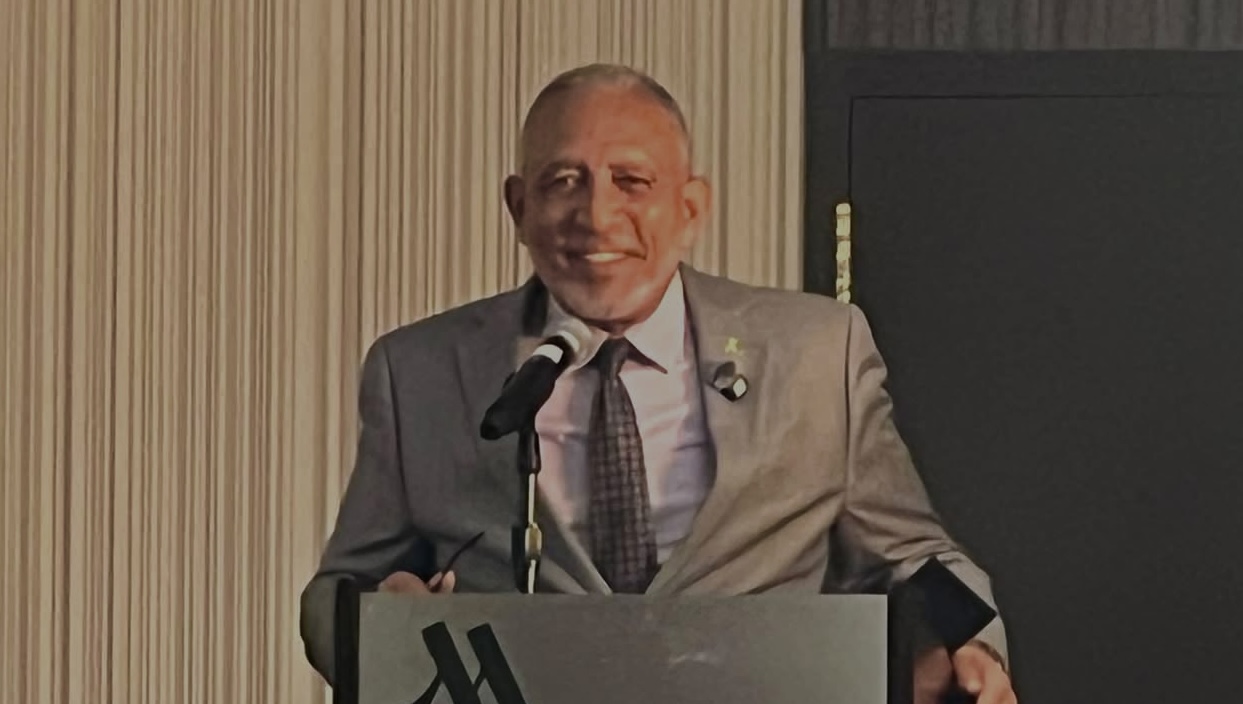
During a diaspora investment gathering held in New York on Saturday, St. Vincent and the Grenadines (SVG) Prime Minister Godwin Friday delivered a landmark call to action, urging the tens of thousands of Vincentians living across the globe to evolve their role in national development from casual supporters to core strategic partners.
Hosted under the theme “Reconnect, Reinvest, Rebuild: Turning Vincentian Global Success into Local Opportunity”, the event marked a turning point in how the newly elected NDP government frames diaspora engagement. Friday, who took office in November following his New Democratic Party’s decisive 14-1 election victory, emphasized that SVG has entered a critical new juncture of national development that demands deeper collaboration between citizens at home and abroad.
For decades, Friday noted, the contribution of the SVG diaspora has largely been measured through the lens of personal remittances — funds sent home to support immediate family, cover household costs, and build local homes. He offered unreserved gratitude for this lifelong support, acknowledging that these hard-earned transfers have long been an invaluable backbone of household and community stability across SVG. But as the country pursues large-scale economic transformation, infrastructure modernization, climate resilience building, and private sector growth, Friday argued that the nation is ready to expand its partnership with the global Vincentian community.
“This is more than a slogan. It is a call to action,” Friday told the assembled audience. “It is an invitation to see ourselves — wherever we live in the world — as one Vincentian family, bound together by a shared history, a shared identity, and a shared responsibility to shape our future.”
Vincentians have built impressive global footprints across nearly every industry, Friday noted. From their island homeland, generations have migrated to North America, Europe, the wider Caribbean and beyond in search of education, opportunity, and improved livelihoods for their families. Today, they hold leading roles in medicine and nursing, finance, technology, hospitality, academia, law, sports, the arts, public service and community leadership. “Your success is not an accident,” he said. “It is born from the same resilience, creativity, and faith that sustain our people at home.”
Despite these shared bonds, Friday warned of growing rifts between the homeland and its diaspora: beyond the obvious geographic separation, emotional and generational distance is expanding as younger generations of Vincentians born and raised abroad build lives far from SVG. Reconnection, he argued, cannot stop at occasional holiday visits or nostalgic cultural ties. It requires intentional, sustained engagement to rebuild bonds of trust, shared purpose, and open communication between all Vincentians, regardless of where they reside.
Positioning himself as both head of government and a fellow citizen invested in national unity, Friday laid out a broad vision for expanded diaspora engagement that goes far beyond remittance flows. The new framework calls for Vincentians abroad to take equity stakes in local businesses and development projects, enter joint ventures with domestic entrepreneurs, share professional expertise through mentorship and training programs, open access to new global markets for SVG exporters, and participate in the country’s capital markets to channel diaspora savings into productive local investment.
As Prime Minister and Minister of Finance and Economic Planning, Friday emphasized that sustained, inclusive growth does not occur by chance. It requires intentional policy, sound governance, and collaborative, long-term partnerships. To that end, he committed his administration to building an enabling environment that welcomes, protects, and incentivizes diaspora investment, pointing to already underway reforms to simplify business registration and operational processes, open targeted investment opportunities in high-priority sectors, and establish trusted intermediary institutions that connect diaspora investors with credible local partners. He also underlined a non-negotiable commitment to good governance, transparency, and accountability in all public-private partnership initiatives.
Friday framed the call for diaspora investment against SVG’s long history of resilience in the face of crisis. The country has endured repeated shocks, including the devastating La Soufrière volcanic eruption, the COVID-19 pandemic, Hurricane Beryl, and the ongoing existential threat of climate change. “Our country knows what it means to rebuild,” he said. “Yet each time we are tested, Vincentians rise again.”
True rebuilding, he argued, extends far beyond repairing damaged roads, bridges, schools, and hospitals. It requires rebuilding investor and community confidence, expanding inclusive economic opportunity, and strengthening the systems that allow all citizens to thrive. In this broader rebuilding effort, diaspora investment serves as a powerful tool to strengthen national resilience, create sustainable jobs and livelihoods, drive innovation in agriculture, fisheries, and food security, and expand authentic, community-led, environmentally responsible tourism offerings. The diaspora also holds unique potential to help SVG expand its digital technology and services ecosystem, connecting local small and medium-sized enterprises — the backbone of the SVG economy — to global markets, he added.
A core focus of Friday’s remarks centered on young Vincentians, many of whom now study, work, and build lives overseas. He emphasized that the government’s goal is not to restrict mobility or dim young people’s global ambitions, but rather to maintain and deepen their ties to SVG’s development. “Our aim is not to limit their horizons, but to ensure that wherever they go, they remain connected to the development of Saint Vincent and the Grenadines,” he said, outlining a vision where a young Vincentian based in New York, Toronto, London, or any other global city can clearly see a pathway to contribute to their homeland — whether through returning home, making an investment, serving as a mentor, or collaborating with local partners.
To turn this vision into action, Friday announced that his administration, through the Ministry of Foreign Affairs, Foreign Trade, Foreign Investment and Diaspora Affairs and the country’s global diplomatic network, is building structured, accessible channels for ongoing diaspora engagement, replacing the ad-hoc, occasional interactions that have defined past outreach. He identified high-impact priority sectors for partnership including sustainable and ecotourism, agriculture and agro-processing, food exports, renewable energy, climate-resilient infrastructure, information and communications technology, digital innovation hubs, education, healthcare, and the creative industries.
Beyond economic partnership, Friday highlighted the symbolic and inspirational value of elevating diaspora achievements, stressing that the success of Vincentians abroad is an inseparable part of the national story. He committed the government to doing more to highlight these contributions, giving young Vincentians both at home and abroad visible role models that encourage them to pursue larger ambitions.
Friday acknowledged that trust is the foundation of any productive investment partnership, noting that capital only flows to markets where investors feel confident in the rule of law and policy stability. “Investment flows where there is trust,” he said, adding that his administration is committed to strengthening that trust through open dialogue, clear, consistent policies, and responsible stewardship of the national interest. “We welcome scrutiny. We welcome collaboration. We welcome your questions, your ideas, and your expectations,” he told the audience.
In closing, Friday returned to the event’s core theme, stressing that the work of building SVG’s future cannot be shouldered by the government alone. “When we say ‘Reconnect, Reinvest, Rebuild,’ we are really saying: let us shape the future of Saint Vincent and the Grenadines together,” he said.
He outlined a shared vision for the nation: a country where all children born to Vincentian parents at home and abroad grow up proud of their identity; a diverse, competitive, and resilient economy that delivers rising living standards, quality education, and accessible high-quality healthcare; and a nation that preserves and amplifies its unique culture, stunning natural beauty, and long-held democratic traditions. “This is not the task of government alone,” he cautioned. “It is the task of a nation — of a global Vincentian family.”
He closed with a personal challenge to every attendee, asking them to leave the event with three guiding questions: How can I reconnect more deeply with my homeland? In what ways can I reinvest — financially, professionally, personally — in the development of Saint Vincent and the Grenadines? How can I help rebuild and renew opportunity for the next generation?
“If each of us leaves this event with one concrete action — one commitment to partner, to mentor, to invest, to advocate — then this gathering will have achieved its purpose,” he said. Thanking the diaspora for their enduring patriotism, perseverance, and love of country, Friday urged the community to bring the benefits of their global success back to the villages, towns, and communities that shaped them.
“Together, let us reconnect. Together, let us reinvest. Together, let us rebuild,” he concluded. “And together, let us turn Vincentian global success into lasting local opportunity.”