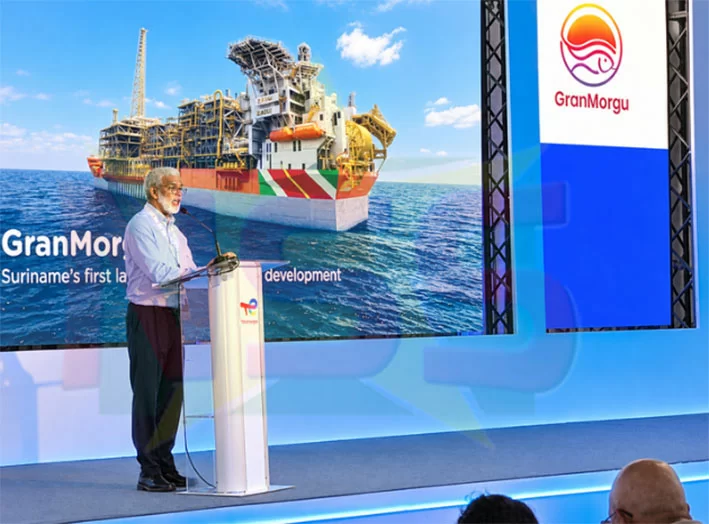
Even though first commercial oil production from Suriname’s landmark GranMorgu offshore oil project is not slated to begin until 2028, the economic ripple effects of the Block 58 development are already being felt across the country, according to Anand Jagesar, chief executive officer of state-owned energy firm Staatsolie.
During a recent site visit to the Kuldipsingh Port Facility, where key subsea infrastructure components for the $X billion project are currently being prepped for deployment, Jagesar noted that roughly 700 local Surinamese workers are already employed in onshore activities tied to the offshore project alone. The large equipment currently staged on land at the port will eventually be installed on the ocean floor, where it will remain as a core part of the project’s production system for decades to come.
Jagesar broke down GranMorgu into three core integrated components: a floating production, storage and offloading (FPSO) vessel currently under construction in China, reservoir wells drilled beneath the seabed, and the subsea infrastructure that connects the producing wells to the FPSO. “This is the last time this equipment will be seen on land. It will operate on the ocean floor for the next 50 years, generating production and revenue for our nation,” Jagesar stated of the components staged at the port facility. Staatsolie holds a 20% stake in the GranMorgu development, and additionally fulfills regulatory and oversight responsibilities for petroleum activities across the country as a state-owned entity.
Beyond the project’s long-term revenue potential, Jagesar emphasized that it is already driving tangible improvements to local livelihoods through job creation. With 700 direct positions already filled by Surinamese workers at the port facility alone, he calculated that approximately 3,000 household members are already benefiting from the project’s early-stage activities. Looking ahead, the company has set an ambition to grow the total number of direct local jobs tied to the development of the country’s offshore energy sector to roughly 2,000 once the project progresses toward full operation.
Jagesar added that the economic spillover from GranMorgu extends far beyond direct project employment. Local service providers and businesses across multiple non-energy sectors are already seeing increased activity tied to the growing oil and gas industry. Hotels, restaurants, and local transport services in particular have benefited from the influx of international energy conferences, foreign corporate delegations, and expert personnel traveling to Suriname to support the project’s development.
At the same time, Jagesar argued that national energy development conversations should not focus exclusively on oil. He pointed to recent major natural gas discoveries in Suriname’s offshore waters, saying these reserves deserve far greater attention in strategic discussions about the future of the country’s energy sector. To advance this agenda, he is considering organizing a dedicated new energy conference. Unlike previous industry gatherings, which centered heavily on offshore oil discoveries and the progress of the GranMorgu development, the next event would place a sharp focus on natural gas and its commercial development opportunities. The country’s strategic focus is gradually shifting away from solely launching its first large-scale offshore oil production toward mapping out the next steps to unlock full value from both its oil and gas reserves, Jagesar noted.