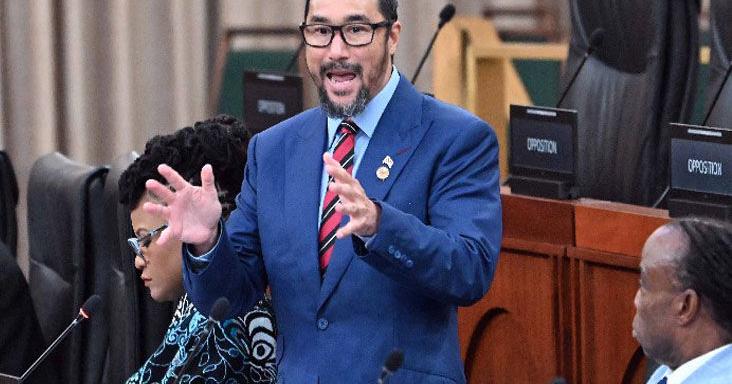
A fiery parliamentary debate over the revised Special Operations Bill 2026 has sparked major constitutional controversy in Trinidad and Tobago, with former National Security Minister Stuart Young launching a scathing attack on the ruling United National Congress (UNC) administration led by Prime Minister Kamla Persad-Bissessar.
Speaking on the floor of parliament Wednesday, Young issued a stark warning that the updated legislation — a revised version of the earlier withdrawn Zones of Special Operations (ZOSO) bill — will effectively reconfigure the twin-island nation into an overt police state, eroding core constitutional protections for all citizens.
Young went further than claiming democratic backsliding is on the horizon, telling legislators that authoritarian rule has already arrived in the country. “It is not creeping. We are in a dictatorship. That is clear,” he said, arguing that the public has gradually become desensitized to repeated encroachments on fundamental rights, allowing authoritarian practices to spread unchecked.
Rejecting Prime Minister Persad-Bissessar’s public reassurance that law-abiding residents have nothing to fear from the new law, Young dismissed the claim as “complete rubbish”. He argued the legislation contains provisions that would enable authorities to detain individuals without sufficient evidentiary justification, echoing harms that he said already played out during the country’s two recent consecutive states of emergency, the second of which concluded on September 17.
According to Young, the past six months of emergency rule already exposed the public to a pattern of rising authoritarianism and systemic rights suppression, with multiple documented cases of innocent citizens having their liberties violated through the use of preventive detention orders. He claimed the UNC administration has already made clear it has no coherent strategy to address violent crime beyond stripping citizens of their constitutionally guaranteed rights, and that the current bill is just the latest step in this deliberate campaign to restrict fundamental freedoms.
Young stressed that while the constitution does allow for limited temporary infringements on rights in extraordinary circumstances, it also explicitly enshrines these protections as inalienable for all citizens. To prevent misuse of the sweeping powers laid out in the bill, he argued the legislation must be required to pass with a special majority vote in the Lower House, rather than a simple majority.
The former minister outlined that the bill frames expanded policing powers through newly established “policing districts”, with wording that would allow every part of Trinidad and Tobago to be designated as such a district. “The UNC is passing legislation here today that makes Trinidad and Tobago nothing less than a police state, with a trampling on constitutional rights here of all citizens, not just those who engage in criminality,” he added.
A core point of contention for Young is the bill’s permit system for movement in so-called “closed areas” — a rebranding of the original ZOSO framework. He raised alarm that the Prime Minister would hold unilateral authority to designate closed areas and deploy law enforcement to enforce movement restrictions, a power he called incompatible with democratic governance.
In one of the most striking comparisons of his speech, Young drew a parallel between the proposed permit system and the segregationist movement control laws of apartheid-era South Africa, saying “This bill mirrors that.” He explained that authorities would be able to cordon off any area based on the presence of a small number of suspected criminals, operating outside the normal safeguards of civilian law, and require every person entering, exiting or residing in the area to hold an official government permit.
Young highlighted the real-world risks this system would create for vulnerable citizens, pointing to the community of Morvant as an example. He questioned how elderly residents would access emergency care, how caregivers would reach people in need of assistance during a crisis, and what would happen to people who are unaware their neighborhood has been designated a closed area — whether they need to reach their home during a fire emergency or access urgent care during a curfew. He reminded law-abiding citizens that violating the closed area rules would carry criminal penalties including fines and imprisonment, meaning ordinary people could face punishment simply for trying to access their own homes during an unannounced closure.