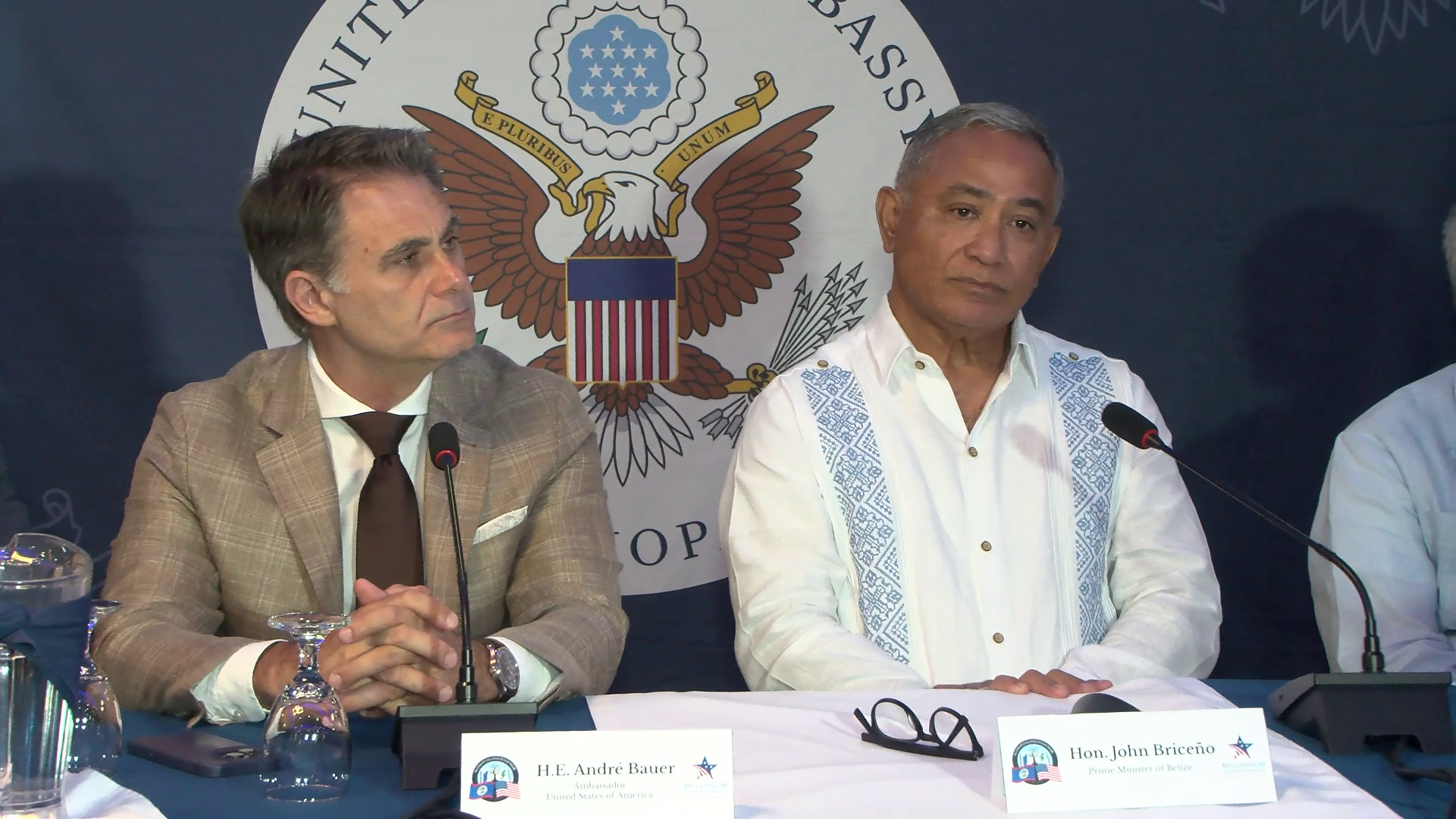
As the five-year Millennium Challenge Compact between the United States and Belize officially gets underway, a $125 million U.S. grant has ignited public and geopolitical debate over whether the substantial investment will force Belize to compromise its long-standing diplomatic balance. Over the past several years, Washington has already pushed Belize to align with U.S. priorities on a range of contentious issues, from regional migration management and cross-border security to Belize’s diplomatic and economic ties with Cuba. Observers warn that shifting U.S. policy priorities over the five-year term of the compact could leave Belize facing untenable pressure to make diplomatic choices that run counter to its own national interests.
Prime Minister John Briceño has moved to reassure the public and international observers that the agreement contains no hidden conditions that would jeopardize Belize’s sovereignty. Speaking to local media, Briceño emphasized that the only requirements attached to the grant are that Belize deliver on the development goals outlined in the compact, maintain full financial accountability for every dollar disbursed, and uphold its long-standing commitments to democratic governance. Briceño noted that democratic norms including freedom of speech and independent media, which the compact references, are already core planks of the country’s national development plans, Plan Belize and Plan Belize 2.0. He added that the opportunity to secure this transformative grant is one that many small developing nations around the world would jump at, saying that the grant comes with no unstated political demands that would force Belize to choose between its relationships.
U.S. Ambassador to Belize H.E. Andre Bauer echoed Briceño’s reassurances, rejecting outright any suggestion that the investment is a quid pro quo for political concessions from Belize. Bauer framed the compact as just the latest chapter in the deep, long-standing bilateral partnership between the two countries, noting that U.S. cooperation with the territory predates Belize’s formal independence. He explained that the compact is part of a broader shift by the Trump administration to re-prioritize development funding for the Western Hemisphere, calling Belize one of the United States’ most reliable regional partners. Bauer added that the United States is already Belize’s largest import partner and the top source of international tourists to the country, noting that “a safer Belize is a safer America.”
To demonstrate its ownership of the development initiative, Belize has committed $55 million of its own funds to the compact program, a contribution that came after additional energy sector projects were added to the original agreement to close a resulting funding gap. Local political commentator Shane Williams has raised ongoing questions about the compact, pointing to past high-pressure requests from Washington that have put Belize in difficult positions, from the rehousing of a convicted terrorist to demands that Belize serve as a safe third country for asylum seekers. Williams questioned whether Belize’s response to future similar requests over the next five years could affect the continued implementation and funding of the compact, leaving the small Caribbean nation in a vulnerable negotiating position.