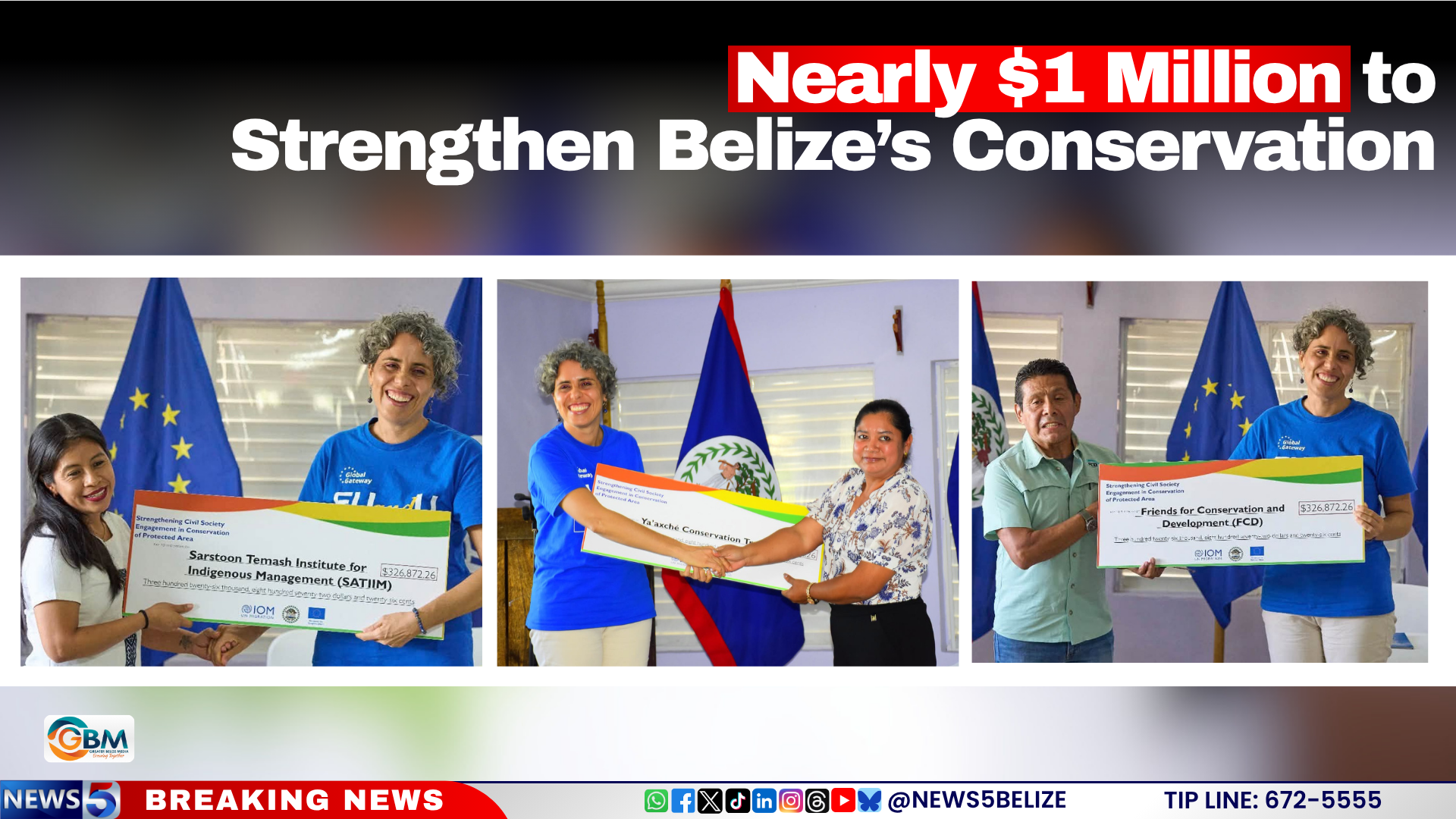
In a major push to safeguard ecologically critical border landscapes, three leading Belizean conservation groups will split a combined $980,617 in grant funding to scale up forest protection, regulatory enforcement, and community-centered conservation work across some of the country’s most at-risk border regions.
The multi-donor initiative draws support from the Government of Belize, the European Union, and the International Organization for Migration, with the full amount allocated directly to the Ya’axché Conservation Trust, Friends for Conservation and Development (FCD), and the Sarstoon Temash Institute for Indigenous Management (SATIIM) – three organizations with long track records of on-the-ground conservation work in Belize.
Each grantee will target a distinct high-priority landscape aligned with its core expertise. For Ya’axché Conservation Trust, the funding will support a targeted transboundary conservation project in the Maya Golden Landscape of southern Belize. The initiative’s key priorities include expanding skills training for park rangers to improve operational effectiveness, streamlining cross-agency coordination for conservation enforcement, and removing barriers to deeper local community engagement in long-term landscape protection.
FCD, meanwhile, will center its work on the ecologically rich Chiquibul National Park, where the grant will enable the organization to strengthen patrol operations, biodiversity monitoring, digital surveillance, and enforcement activity along a 43.5-kilometer section of the park’s western border. In a statement following the grant announcement, FCD Executive Director Rafael Manzanero expressed gratitude for the funding partnership, noting that the targeted program fills a critical gap by supporting civil society-led conservation action. “This unique programme seeks to empower conservation and environmental civil society like FCD. We are grateful for that,” Manzanero said.
The third project, led entirely by SATIIM, takes an Indigenous-centered approach to border conservation and security. The organization will train local community members to serve as biocultural guardians, an innovative model that integrates generations of traditional Indigenous ecological knowledge with modern biodiversity conservation practices to protect both natural ecosystems and cultural heritage along the border.
Beyond the individual projects, this new round of grants fits into a broader regional strategy led by the EU and IOM to boost institutional and community capacity across Belize’s southern and western border zones. Unlike many top-down conservation initiatives, the program channels funding and decision-making power directly to local organizations and community groups that work daily to defend Belize’s irreplaceable forest ecosystems, natural heritage, and Indigenous cultural landscapes against encroachment and environmental degradation.