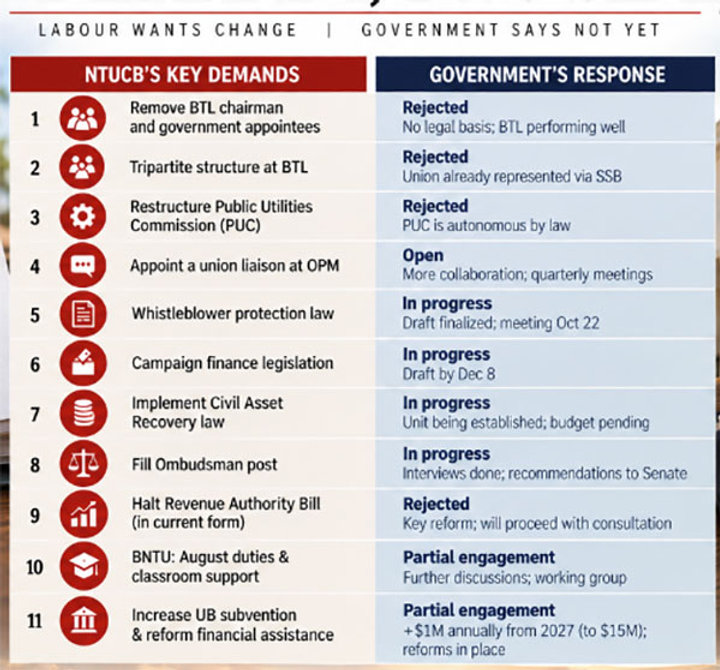
A major standoff has emerged between Belize’s largest umbrella labor organization and the national government after the body of unions confirmed that none of its 11 core policy demands were addressed in full by the Cabinet, setting the stage for further negotiations as consultations are ongoing with industry affiliates and social partners.
The National Trade Union Congress of Belize (NTUCB) issued a preliminary public statement this week reacting to a three-page formal letter from Prime Minister John Briceño, which outlined the Cabinet’s official position on a slate of proposals the union body submitted to the government in August. According to the NTUCB, a number of its demands were entirely omitted from the government’s response, and no proposal was accepted in the exact form it was presented. The union also noted that the Prime Minister’s reply arrived 18 days after the August 28 deadline the organization had set for a government response.
Rather than releasing a full point-by-point rebuttal immediately, the NTUCB announced it is currently holding internal consultations with its governing council, affiliated trade unions, the Joint Social Partners coalition and other key stakeholders. A comprehensive official written response will be published once these consultations are completed.
For its part, the September 15 letter from the government breaks down the Cabinet’s position across all proposed demands, marking some as outright rejected, while leaving space for further talks on others, alongside proposed timelines and alternative policy approaches. Prime Minister Briceño emphasized in the correspondence that while the government cannot agree to every demand put forward by the unions, it remains committed to collaborative engagement through ongoing consultation.
One of the clearest points of contention centers on governance of Belize Telemedia Limited (BTL), the country’s leading telecommunications provider. The NTUCB had formally called for the removal of BTL’s Chairman and all government-appointed board members, a request the Cabinet rejected outright. Government officials argued that there is no legal standing under Belize’s existing company law to force the removal of the board leadership. They also pointed to BTL’s record-breaking profit performance in the most recent financial year, noting that the collapsed attempt to acquire rival provider Speednet Communications did not constitute sufficient justification to dismiss the entire board.
The Cabinet also rejected the NTUCB’s proposal to implement a tripartite governance structure for BTL, arguing that union representation is already secured on the board through the Belize Social Security Board, making further restructuring unnecessary. This reasoning was directly challenged by the NTUCB, which accused the government of misrepresenting both the nature of the existing union-aligned seat and the government’s own authority to restructure the board. The current disagreement follows weeks of rising tension over BTL’s proposed Speednet acquisition, which the Cabinet announced it would not support back in August, prompting the NTUCB’s original demand for board leadership changes.
A second major rejection came on the NTUCB’s call to restructure the Public Utilities Commission (PUC). In his letter, the Prime Minister cited the PUC’s statutory status as an autonomous regulatory body, whose core functions and decision-making powers are designed to operate free from inappropriate external political influence. He added that PUC commissioners are already appointed through a bipartisan process: the Governor General makes appointments on the Prime Minister’s advice, following formal consultation with the Leader of the Opposition. On this basis, the government concluded it could not support the proposed restructuring.
On the demand for a dedicated union liaison position within the Office of the Prime Minister, the government expressed more openness but stopped short of creating a new role. Instead, Briceño proposed deepening collaboration through the existing Joint Unions Negotiating Team and scheduled quarterly formal meetings between union leadership and the government.
On several good governance-focused demands put forward by the NTUCB, the Cabinet did not reject the underlying policy goals, instead outlining that reform work was already in progress with clear timelines for completion. For the Protected Disclosures Bill, the government confirmed it has reviewed feedback from both the NTUCB and the Belize Chamber of Commerce and Industry, and a Cabinet-approved final draft has been sent back to both organizations for a final review. The Minister of Governance has scheduled a stakeholder meeting on the legislation for October 22.
Campaign finance reform legislation is also currently being drafted, with the government confirming that the Minister of Governance plans to submit the finalized bill to Cabinet for approval by December 8. Once approved, the draft will be shared with social partners and other relevant stakeholders for input. For the implementation of the Civil Asset Recovery and Unexplained Wealth Act, the government reported that work is underway to establish a dedicated Civil Recovery Authority Unit within the existing Financial Intelligence Unit (FIU). The FIU and partner agencies are currently assessing infrastructure needs and reviewing Belize’s legislative and operational frameworks to support the new unit, while a final operational budget is being put together.
The government also reaffirmed its commitment to upholding the independence of the Office of the Ombudsman, confirming that the process to fill the long-vacant ombudsman post is moving forward. Interviews for the position have already been completed, and the bipartisan Ombudsman Reports Committee is expected to submit its nomination recommendations before an appointment resolution is tabled for a vote in the Senate.
Another high-stakes disagreement revolves around the proposed Revenue Authority Bill 2026. The NTUCB has called for the legislation to be scrapped in its current form, but the Cabinet refused to halt the process, arguing that the creation of a Semi-Autonomous Revenue Authority is a critical step to improve the effectiveness and transparency of national revenue collection. The Prime Minister’s letter cited a recent sovereign credit rating review from Standard & Poor’s, which criticized Belize for failing to make progress on long-delayed revenue reforms. Cabinet argued that pulling the legislation would be economically counterproductive and could harm Belize’s sovereign credit outlook. That said, the government pledged to work alongside the Public Service Union and Tax Department employees to manage the transition process and address legitimate employee concerns through administrative adjustments.
Cabinet also issued separate responses to demands raised specifically by the Belize National Teachers’ Union (BNTU). On the issue of mandatory August professional development duties, the Ministry of Education said it is open to negotiating the timing and structure of continuing professional development requirements. The Ministry noted that teachers can already apply for up to 10 days of exemption from August duties, and proposed establishing a joint working group with the BNTU to review the policy further. On the BNTU’s demand for a dedicated classroom resource allowance, the Ministry expressed willingness to hold talks but did not commit to a cash payment. It pointed out that the government has rolled out phased classroom material packages to schools over the past three years, and future discussions will determine whether additional support should be delivered in cash or in-kind, as well as the scope of coverage and sustainable financing.
For demands related to the University of Belize (UB), the government confirmed that the institution’s annual government subvention has grown from $7.6 million in 2020 to $10 million in 2026. When student financial assistance is included, the government’s total annual investment in UB currently sits at approximately $14 million, with cumulative investment since 2020 topping $73 million. The administration has also committed to increasing the annual subvention by $1 million per year starting in 2027, until it reaches a total of $15 million annually.
As things stand, the NTUCB has made clear that it does not view the Cabinet’s response as adequate to meet its original demands. The organization’s latest statement reaffirms that multiple proposals were entirely unaddressed, and no demand was approved in the form the unions submitted. In the coming weeks, the NTUCB will continue consultations with its affiliates and social partners before releasing its full, formal response to the government’s position.