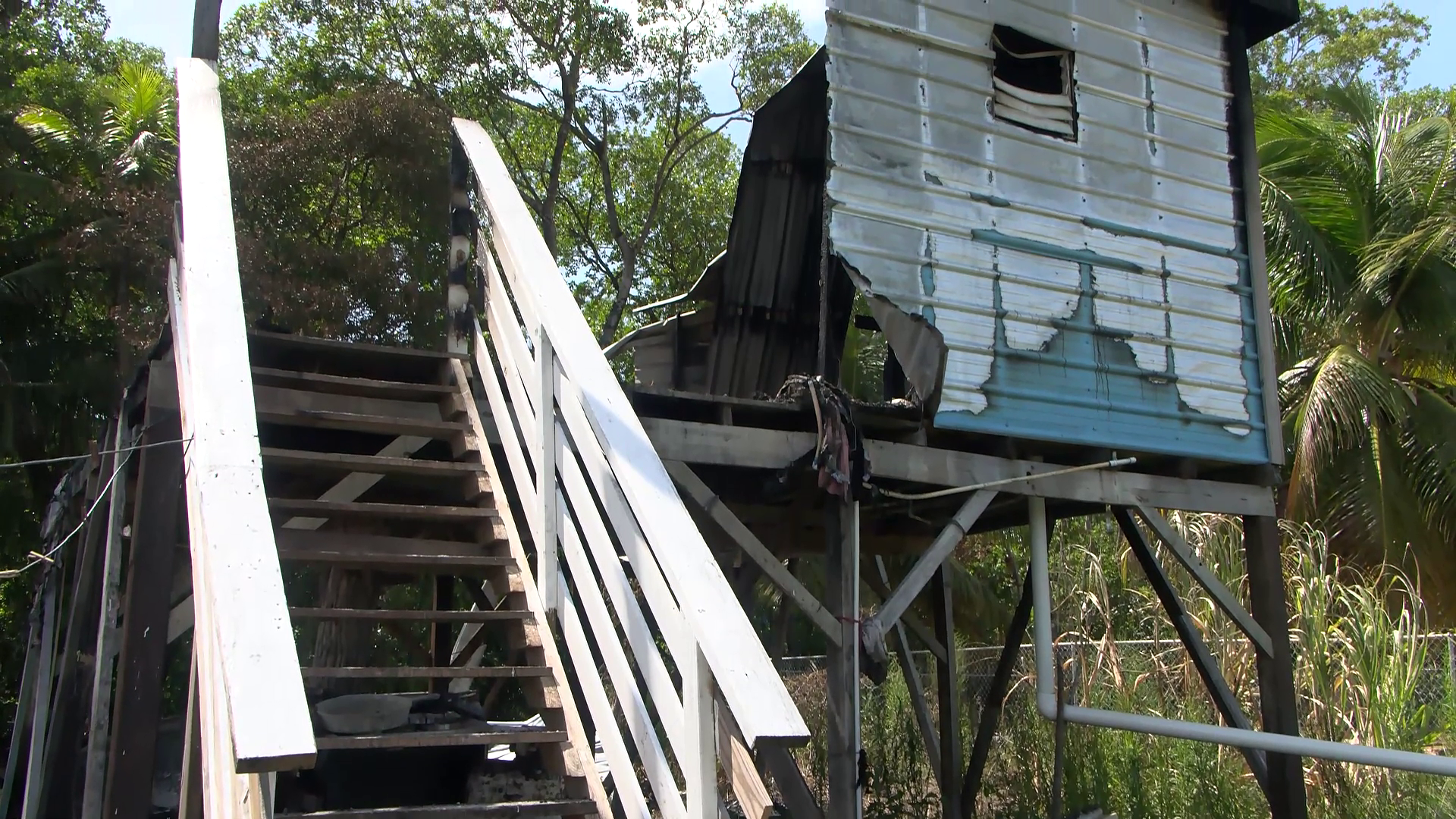
In a devastating turn of events that has sparked public outcry across Belize, a Belama resident who was forcibly evicted from his self-built home just 24 hours earlier has watched his entire life’s work burn to the ground. As of September 17, 2026, 54-year-old Eugene Thompson is now homeless, unemployed, and demanding accountability from authorities, after an intentionally set blaze destroyed the $45,000 property he spent five years constructing with his own hands.
Thompson’s nightmare began one day prior, when a Belize Family Court granted an eviction order that removed him from the property on behalf of Ashema Chang, his former common-law partner of just six months. Chang had filed a petition seeking protection from Thompson, which under Belizean family law allows magistrates to order the accused party to vacate the shared residence to allow the complainant to remain. In an interview with News Five reporter Britney Gordon, Thompson argued the eviction was unjustified, saying the court never attempted to hear his side of the dispute before ordering him out of the home he alone built.
“In family court, they evict me because my common-law gone to court for a summons regarding my house, which doesn’t concern her at all,” Thompson explained, speaking in Belizean Kriol. “They put my common-law into my house for no reason. Just evict me out of my own home that I built. Not even come to me to try figure out what was happening. Just evict me.”
Just 24 hours after Thompson was forced to leave, the property went up in flames. Investigators with the Belize Police Department have since released a wanted poster for Chang, who is being sought for questioning in connection with the suspected arson. Thompson maintains that if he had not been evicted, he would have been on-site to stop the fire before it destroyed everything.
“Yes, because I was trying to avoid this. I went to court. I cried to them. I pleaded to them. Literally shed my tears and nobody tried to help me in the situation. I would still have my house,” he told Gordon.
Over the five years Thompson lived on the property, he poured more than $45,000 of his own earnings into construction materials, furniture, and household appliances. Before the fire, he made a steady living selling homemade street food including patties, conch fritters, and cakes to local residents. His neighbors, who have long relied on his small business, are now standing with him, calling on the government to intervene.
“He’s an old neighbor of mine but I have always known him to be a hard-working person. I know he has his little history, he’s not a perfect person, but for me personally I believe the system failed this young man because they evict him from his own house,” one concerned neighbor told News Five. “I just sincerely sorry for him and I sorry for the loss of his home and I just beg and plead with the government now, please, help this man build back a house even if its just a simple one bedroom one bathroom place.”
Local attorney Dickie Bradley, who specializes in Belizean family law, confirmed that the eviction order granted to Chang falls within the existing powers of the country’s family courts. Protection orders, he explained, are explicitly designed to prioritize the safety of complainants, most often women and children, who report domestic abuse or threats. When a complainant has no alternative housing, Bradley noted, courts routinely order the accused to vacate the shared property immediately.
“A magistrate can try as best he or she can under the law to protect a person who has gone to the court for protection,” Bradley explained in a phone interview. “That protection usually is that the abuser is not to be near to the victim, the complainant. The second order that is usually applied for or would be offered by the court to the victim is that if she has nowhere to go, she can remain in the house and the abuser can be ordered to leave immediately. Get a police and go and get the clothes you need and anything else you need and leave the premises and not to go back there for a certain period.”
Despite the devastating outcome, Thompson has rejected a temporary shelter offer from the Belize Department of Human Services. The fire victim, who describes himself as a self-sufficient, working man who has never relied on public assistance, says temporary housing does not address the root of his loss. He is now calling on the government to fund the full reconstruction of his home to replace what he lost.
“I am not a beggar. I am not a street person. I am a normal human being, civilized,” Thompson said. “If you can’t accommodate me in the situation the way it is, because you made this happen, build back my house for me the way it was. That makes sense.”
The case has reignited public debate across Belize over the balance between protecting vulnerable domestic violence survivors and protecting the property rights of accused parties who own their homes, with many residents questioning whether the eviction order was appropriate given Chang’s six-month relationship with Thompson and his sole ownership of the property. As the investigation into the fire continues, Thompson remains without a permanent home, waiting for authorities to act on his demands.