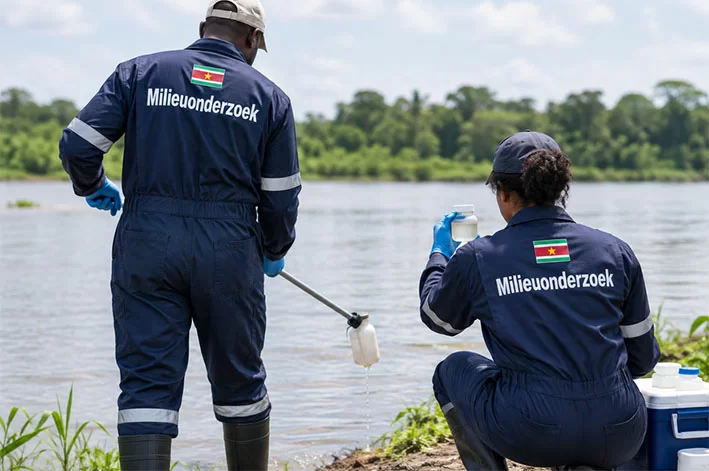
In the wake of a high-profile pollution incident that exposed critical gaps in Suriname’s domestic testing infrastructure, the South American nation’s government has announced an ambitious plan to expand national laboratory capacity, aiming to conduct nearly all required environmental and public health tests within the country by the end of 2027. The catalyst for this policy push came after the contamination of the Saramacca River, when officials were forced to send key analytical samples overseas for testing because no domestic facility could complete the work – a delay that underscored the urgent need for local capability building.
On Wednesday, Suriname’s President Jennifer Simons convened a meeting with leaders from the country’s leading research and testing institutions to map current capabilities and identify unmet needs. Attendees included representatives from the Central Laboratory of the Public Health Bureau (BOG), the Veterinary Laboratory, the Fish Inspection Institute (VKI), the Medical Scientific Institute (MWI), and the Anton de Kom University of Suriname (AdeKUS), each presenting details of their existing analytical workflows and testing limits.
“Our goal is to be able to carry out every test required to guarantee the safety of our people here at home, whether that means analyzing water samples, testing fish for contaminants, or conducting health screenings for exposed communities,” Simons stated during the gathering held at the President’s Cabinet.
According to Patrick Brunings, Minister of Oil, Gas and Environment, the government first will conduct a nationwide inventory of existing equipment, technical expertise, and expansion opportunities across all domestic laboratories. This baseline assessment will clarify which tests currently require international support, and what investments are needed to bring those capabilities to Suriname. Priority areas for expansion include testing for cyanide and mercury contamination in water, animal tissue, and other environmental samples, as well as routine analysis of national air quality. A key focus of air quality testing will be measuring mercury vapor exposure for workers and communities near gold purchasing operations, a common point of risk in Suriname’s active mining sector.
Simons projected that significant expansion of national capacity will be completed as early as 2026, with full deployment of all required testing capabilities targeted for the end of 2027. Beyond strengthening laboratory infrastructure, the government’s broader response to environmental and mining challenges includes a new nationwide survey of gold mining operations led by the National Environment Authority (NMA), designed to create a comprehensive baseline for regulating the sector and mitigating its environmental impacts.