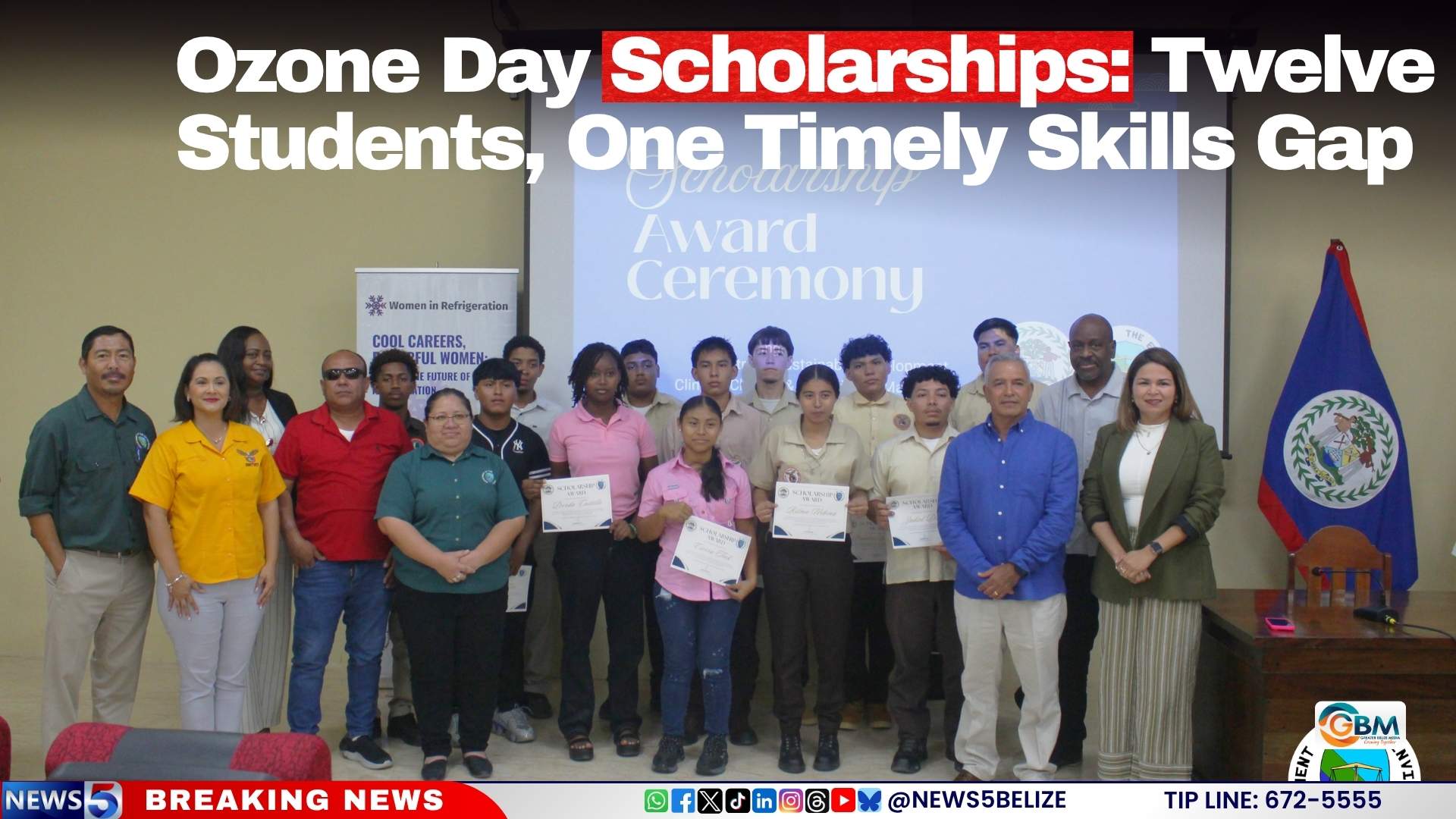
To mark the 2026 International Day for the Preservation of the Ozone Layer, the Government of Belize’s Department of the Environment (DOE) has awarded full scholarships to 12 aspiring refrigeration and air conditioning technicians from three of the country’s districts. Launched through the DOE’s National Ozone Unit on September 16, the scholarship initiative directly supports Belize’s national commitment to phase out ozone-depleting chemicals, aligning with decades of global climate and environmental action.
Recipients of the awards are currently enrolled at ITVET campuses located in Belize City, Orange Walk, and Stann Creek. Each scholarship provides comprehensive coverage for an entire academic year of tuition, and also includes a complete toolkit of routine servicing equipment and full personal protective gear for students entering the field. Notably, three of the 12 selected scholars are women, a milestone in a skilled trade that has historically been overwhelmingly male-dominated, according to DOE data.
The timing of the scholarship announcement is no coincidence. September 16 marks the annual commemoration of the signing of the 1987 Montreal Protocol, the landmark global treaty that established binding commitments to phase out production and use of man-made chemicals proven to damage the Earth’s protective ozone layer. This year’s global theme for Ozone Day, “Global Action for a Cooler Planet,” highlights 10 years of progress under the Kigali Amendment, the 2016 addition to the original protocol that targets the phase-out of hydrofluorocarbons (HFCs), potent greenhouse gases commonly used in cooling systems.
Refrigeration and air conditioning technicians play a critical frontline role in achieving these global and national targets. Safe handling of existing ozone-depleting and high-emission cooling gases, paired with the skilled transition to newer, low-global-warming alternative refrigerants, is essential for Belize to meet its legally binding obligations under the Montreal Protocol and Kigali Amendment. It also addresses a growing skills gap in the country’s sustainable cooling sector, as the nation scales up its phase-out efforts.
“These twelve students represent an investment in the future of Belize’s cooling sector,” said Anthony Mai, Chief Environmental Officer at Belize’s DOE. “By providing training and tools now, we are building a profession that protects both people and the environment.”
The scholarship program is financed through Belize’s national HCFC Phase-out Management Plan, with financial backing from the Multilateral Fund for the Implementation of the Montreal Protocol, an international financial mechanism established to support developing countries in meeting their protocol obligations.