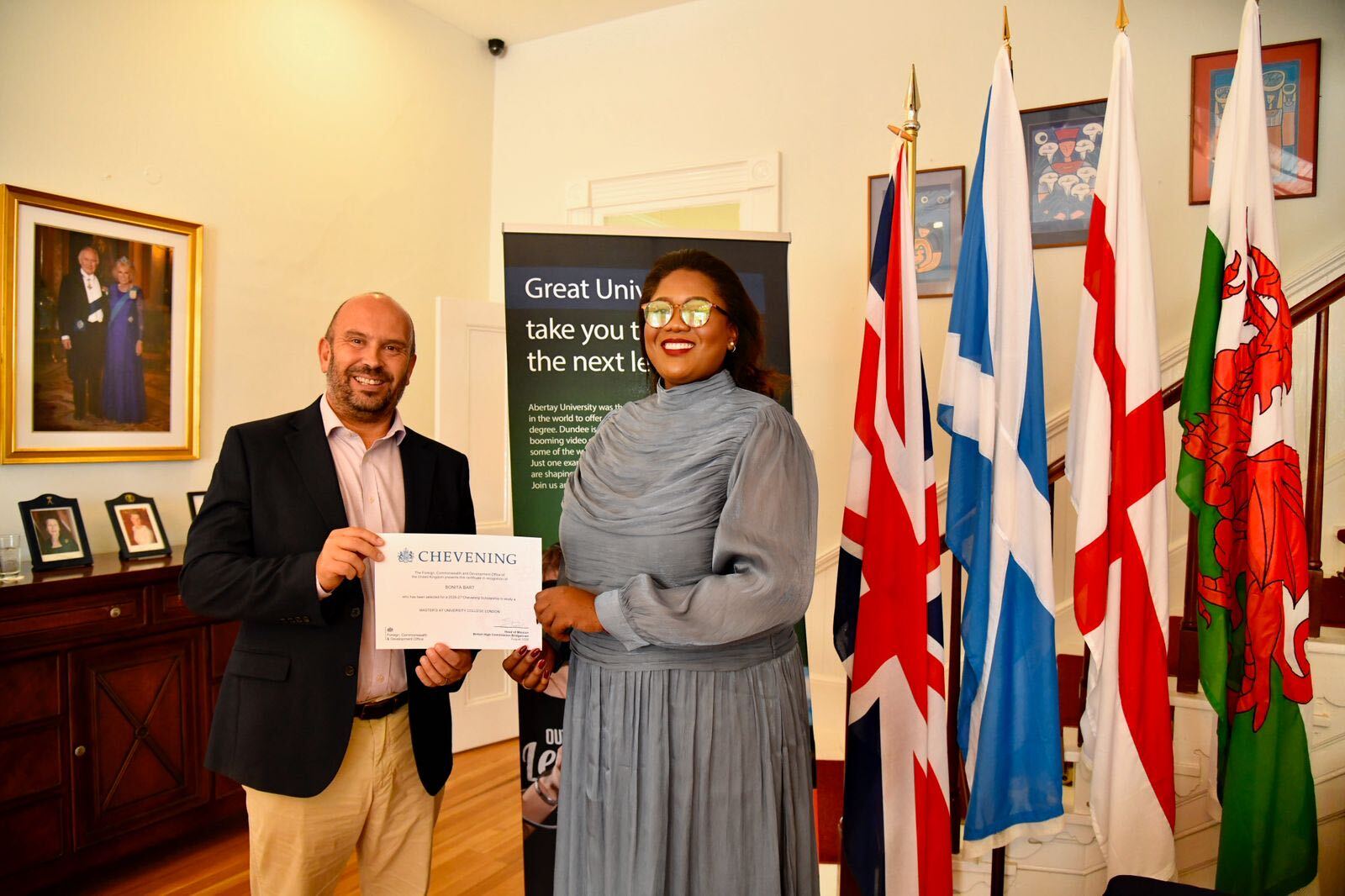
Long before Bonita Alicia Bart could correctly spell the word “architect”, a childhood passion for designing spaces had already cemented her career path. As she recalls, it was her father who first helped her put letters to the dream that would shape her entire academic and professional journey. Today, decades after that childhood conviction, the young Vieux Fort native is preparing to join one of the world’s most prestigious architecture programs, carrying a mission that extends far beyond her own academic success.
On September 20, Bart will depart the Caribbean island of Saint Lucia for the United Kingdom, taking up the country’s sole Chevening Scholarship spot for the 2026/27 academic year. She will pursue a master’s degree in architectural history at University College London’s globally renowned Bartlett School of Architecture, a milestone that still feels surreal to the young scholar. She first received the life-changing news over a routine lunch break, when a congratulatory email popped up on her phone. “I remember putting the phone down and being like, this can’t be real,” she said of her initial reaction.
Instead of jumping into immediate celebrations, Bart confronted a quiet, common struggle for high achievers: imposter syndrome. For a period, she worked through the internal hurdle of accepting that she had earned the prestigious award through her own hard work and merit. “Sometimes we work hard and we don’t accept when good things happen,” she explained. “So, it was a good personal process for me as well.”
Bart’s award makes her Saint Lucia’s only representative among a small cohort of just five Chevening Scholars from the entire Eastern Caribbean region. Initially, the knowledge that she was the sole recipient from her home country left her feeling isolated, especially after learning just how fierce the global competition for Chevening awards is. But the cross-disciplinary group of Eastern Caribbean scholars, whose fields range from medicine and media to logistics and Bartlett’s own architectural history, quickly formed a tight support network. After meeting in Barbados, the group made a commitment to stick together through the challenges of studying abroad, easing much of Bart’s early anxiety. “So, I’m not too scared anymore,” she said.
Bart’s path to the Bartlett grew from a lifelong passion that first emerged in small, childhood moments. She remembers being fascinated by the annual rearrangement of her family home during the Christmas season, eager to weigh in on where every piece of furniture and decor should go. As she grew older, her knack for drawing helped turn that early instinct for spatial planning into a clear professional goal. It was during her undergraduate studies in Jamaica that her focus narrowed to architectural history and theory, sparking a critical observation that would become the core of her work: many Caribbean people do not recognize the unique cultural value of the architecture that exists in their own communities.
“ We think of it as a big capital A of skyscrapers in Dubai and in the US,” she said. “But we’re not thinking about the bioclimatic approach that people have taken with getting houses. And having houses that fit the Caribbean context and the colours and our own cultural history with it.”
Four years ago, Bart turned that observation into action, launching the Caribtecture Research Project to document and analyze the distinct identity of Caribbean architecture through a combination of written research and visual documentation. Within that broader initiative, she created Luciantecture, a focused project centered specifically on recording and examining Saint Lucia’s unique built heritage. For Bart, studying a historic Saint Lucian building means looking far beyond its physical facade: she explores the cultural and social influences that shaped its design, the communities that built and lived in it, and the irreplaceable character that could be lost if the island modernizes without intentional heritage preservation. Among the elements at particular risk are Saint Lucia’s distinctive French colonial architectural legacies, including traditional fretwork and stonework craftsmanship. While some efforts are underway to pass down the trade skills needed to maintain these features, Bart argues that preservation ultimately requires public buy-in: many locals now favor modern glass and luxury cladding over the island’s traditional architectural character.
Her greatest concern is that rapid unplanned modernization will erase Saint Lucia’s unique cultural identity, turning the island into a generic copy of developed nations rather than celebrating its one-of-a-kind heritage. Beyond the cultural loss, she warns this shift could also harm Saint Lucia’s key tourism sector, which relies on the island’s unique natural and cultural identity to attract visitors.
Preservation is not Bart’s only focus. She also points to climate change as an urgent, growing challenge for Caribbean architecture. Much of Saint Lucia’s housing, infrastructure and economic activity is concentrated along vulnerable coastlines, requiring difficult conversations about sustainable development, adaptive infrastructure and even the managed relocation of at-risk coastal communities. For Bart, these decisions cannot be left only to engineers and developers. Relocating entire communities disrupts intergenerational social ties, livelihoods and cultural patterns that are deeply tied to place, and local people deserve a seat at the table in these decisions. “ The social, political and economic aspect of architecture to me is often ignored,” she said. “And I think we don’t bring the public into that conversation as much as they should be a part of that conversation.”
This focus on the interconnectedness of people, place and power is exactly what drew Bart to the Bartlett School of Architecture’s program. The program’s framework examines both rural and urban spaces through social, economic and political lenses, tracing the historical forces that shaped built environments and exploring the impacts of change. That academic training is exactly what she needs to advance her work with Caribtecture and Luciantecture. When she returns to Saint Lucia after her studies, she plans to expand her research in collaboration with local writers, artists and fellow architects to build a comprehensive, accessible public record of Caribbean architectural history.
For now, though, Bart is wrapping up preparations to leave the only home she has ever known for the busy streets of London and the rigors of postgraduate study. When she departs on September 20, she will step into an experience that will almost certainly reshape her understanding of architecture – and ultimately, change how she sees the Caribbean home she plans to preserve.