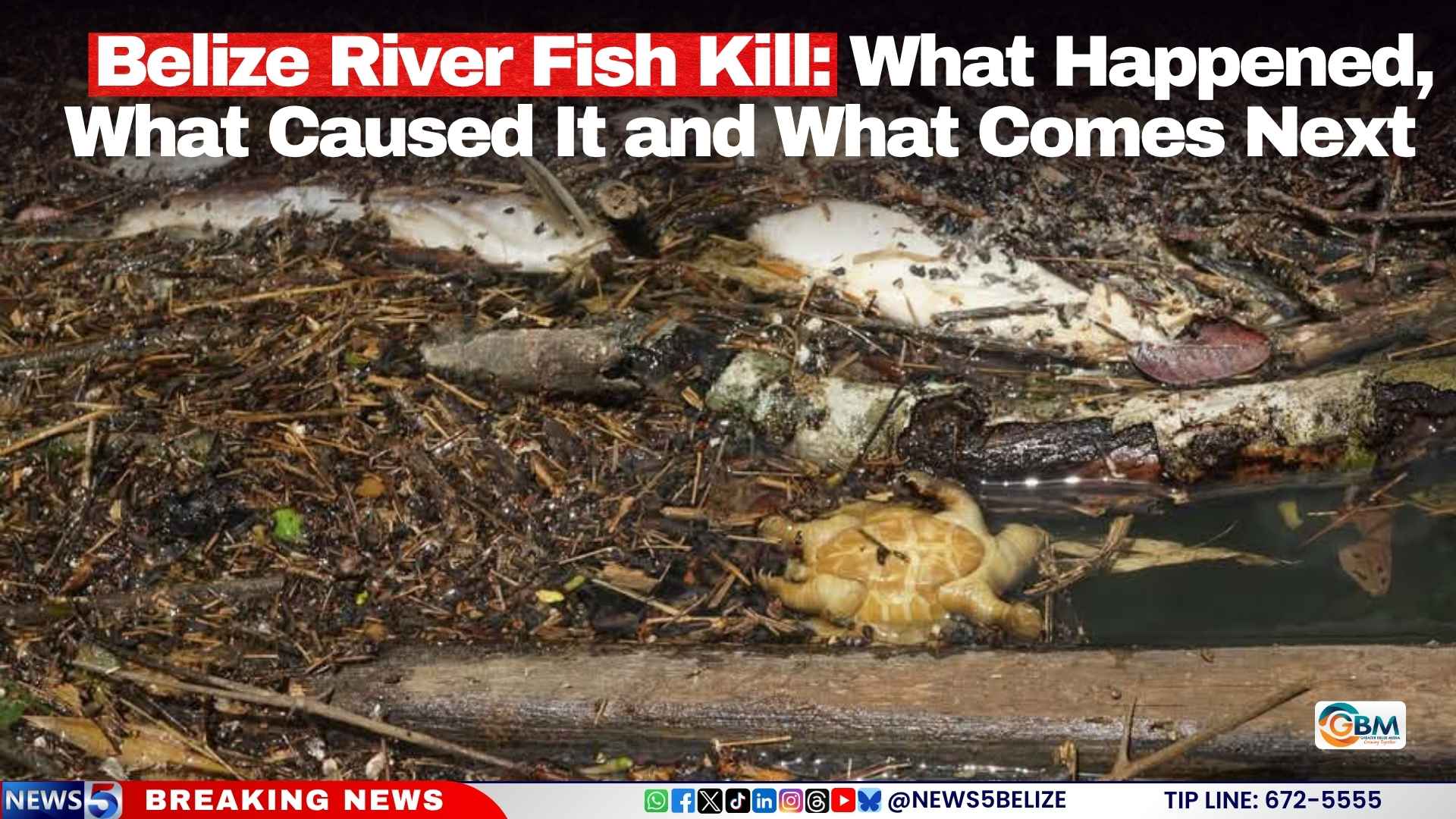
In August 2026, a major fish kill event struck a 17.5-mile stretch of Belize’s most essential waterbody, the Belize River, killing hundreds of fish across multiple species as well as a crocodile and a turtle. Weeks after the event, Belize’s Department of the Environment (DOE) has finalized its investigation into the cause of the disaster and outlined a 10-point corrective action plan to prevent future ecological catastrophes, confirming that the river has now returned to baseline ecological conditions.
At a public information session held in Double Head Cabbage on September 12, Chief Environmental Officer Anthony Mai presented the DOE’s full findings, walking attendees through the step-by-step investigation that ruled out multiple potential causes before reaching a definitive conclusion. Investigators examined every plausible trigger for the mass mortality event, from infectious disease and unregulated agricultural activity to chemical contamination, algal overgrowth and poor water quality, even conducting full postmortem necropsies on collected fish specimens.
The first potential cause to be ruled out was infectious disease. Mai explained that in river ecosystems, disease outbreaks almost exclusively impact a single species, but this event killed multiple fish species alongside reptile species, making disease “highly unlikely” as a root cause. Satellite imagery analysis helped investigators timeline the progression of the event: imagery from May 22 showed the river in normal condition, but by July 23, visible water discoloration was detected near Labouring Creek, aligning with the period when water was released from a nearby rice field. A second discoloration event was spotted near Santander’s discharge outlet on August 2, and just one day later, the first reports of mass fish mortality reached the DOE.
Isabella Bank was identified as the hardest-hit area, though ecological damage was also recorded in sections near Flowers Bank and Scotland Halfmoon. Initial aerial surveys showed three large dark patches on the river that resembled a crude oil spill, but on-the-ground inspections confirmed these patches were dense algal mats, not petroleum contamination.
The investigation ultimately traced the mass mortality to nutrient overload from agricultural fertilizer runoff that triggered severe eutrophication. Mai explained the ecological mechanism in clear terms: fertilizers provide nutrients to help crops grow faster, but when excess fertilizer washes off farm fields and into the Belize River, those same nutrients feed explosive algal growth. As algae spreads across the water surface, it blocks sunlight from reaching submerged aquatic plants, which die off as a result. As algae continue to grow, they consume most of the dissolved oxygen in the water, creating hypoxic (low-oxygen) conditions that cannot support aquatic life.
Necropsies on deceased fish confirmed this conclusion: specimens showed excessive mucus production, anal bleeding, redness on fins, bodies and gill covers, and clouded eyes, all clinical signs of oxygen starvation. While trace amounts of agrochemicals were detected in water samples as far downstream as Flowers Bank, investigators confirmed these were not the direct cause of the kill. The official DOE conclusion is that a high volume of organic nutrients entered the river over a short period, triggering eutrophication that lowered dissolved oxygen levels enough to cause the mass fish kill.
Today, the DOE confirms that the Belize River has returned to its normal ecological state, but officials are still urging caution for river users. While the water is considered safe for recreational activities such as swimming, the department says additional testing is needed before it can confirm that fish caught from the river are safe for human consumption.
To prevent similar events from occurring in the future, the DOE has outlined 10 key corrective actions to protect the Belize River watershed. First, officials will meet with the 24 commercial farms located along or near the affected river sections to establish new environmental protection targets, including restoring the legally mandated 66-foot riparian buffer zone along the waterway. Other near-term actions include restoring riparian forest habitats, improving water, soil and nutrient management practices on nearby farms using climate-smart agricultural techniques, and establishing an early warning detection system to spot water quality changes before they become catastrophic.
Longer-term measures include developing a permanent, comprehensive monitoring plan for the entire Belize River, continuing ongoing data analysis to share with relevant regulatory agencies, updating and strengthening environmental policies and legislation related to watershed protection, assigning a single lead government agency to oversee watershed management, reconvening the Belize River Watershed Committee, updating the official Belize River Watershed Management Plan, and ensuring all relevant agencies fulfill their mandated responsibilities under the updated plan.
Mai emphasized that the 2026 fish kill event should serve as a wake-up call for all Belizeans who rely on the Belize River, which is one of the country’s most ecologically and economically important waterbodies. “This fish kill event is an eye-opener for me, as the chief environmental officer, and I hope that it is an eye opener for everyone, because Belize River is critical; it’s a very essential water body for this country. Collectively, we cannot allow this river to degrade,” Mai said. “The only way we could ensure that the river is protected is if we all play our part.”