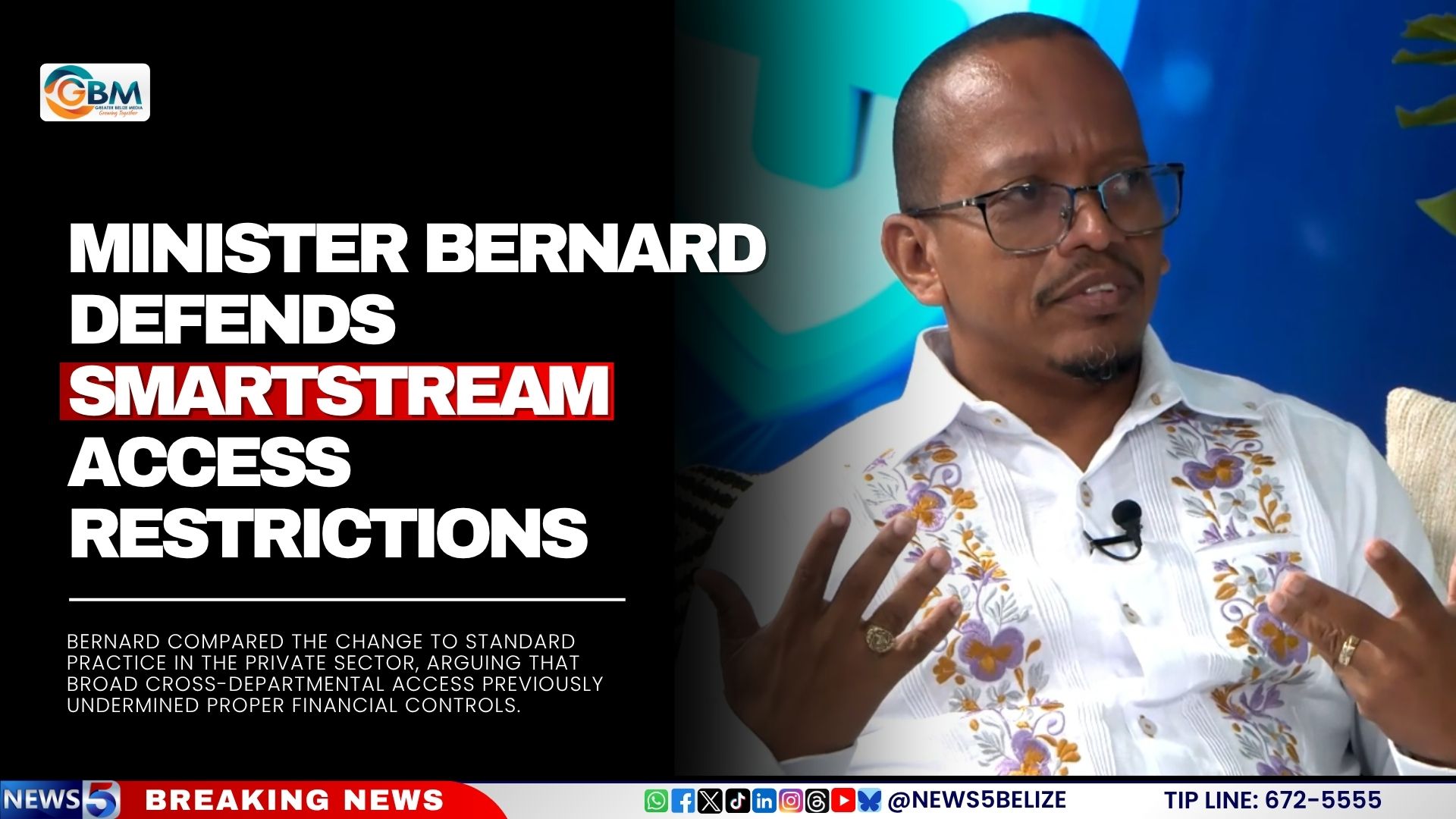
In the face of growing public scrutiny over new financial access rules for government personnel, Belize’s Minister of Health and Wellness Kevin Bernard has publicly defended the administration’s recent policy change that limits individual ministry finance officers’ access to the SmartStream national financial system exclusively to their own department’s data. The policy adjustment comes at a tense moment, as an independent audit and unfolding public scandal continue to rock the Ministry of Defence, leading critics to argue the new restrictions are a deliberate attempt to block access to potentially incriminating records and derail ongoing investigations.
Drawing on his professional background as a former auditor with private sector finance experience, Bernard framed the move as a routine, evidence-based internal control upgrade that aligns with global standard financial governance practices. “Critics have raised concerns that this policy is meant to block transparency around ongoing probes, but I speak from experience as someone who trained in finance and worked in the private sector,” Bernard explained in his press address. “In the private sector, cross-departmental open access to sensitive financial data is virtually unheard of. This is the right call: every ministry has its own dedicated finance officer, whose core responsibility is managing that department’s finances. This restriction does not block Treasury or the central Ministry of Finance, which retains full, unrestricted access to all data across every government department. Limiting individual ministry officers only to their own department’s data is, in my view, entirely appropriate.”
Bernard went on to draw a clear parallel between the new government policy and standard fiduciary practices in private companies, noting that the previous system of unlimited cross-departmental access created unnecessary gaps in financial oversight that put public funds at risk. “If I were a CEO in the private sector, and every accounts clerk had open access to every department’s confidential financial data, that would directly undermine the company’s fiduciary duties to its stakeholders,” he argued. “The decision to restrict access, made by the Ministry of Finance and the Finance Secretary, is simply intended to ensure that each department only manages the data it is responsible for. The only central body with full access to all records is Treasury, which is tasked with conducting all required verification and oversight of public spending.”
When pressed on whether the new rules create an impenetrable “firewall” that blocks officials from accessing cross-departmental transaction data relevant to their own work, Bernard rejected the premise of the question entirely. He questioned why separate departments would need access to unrelated ministries’ financial information in the first place. “I have always asked: why would the Ministry of Agriculture need access to the Ministry of Defence’s internal financial data? A minister’s core responsibility is limited to the portfolio their department oversees,” he said. “The only government body that needs full access to all financial data across every department is the Ministry of Finance, which serves as the final approver for all payments processed through the SmartStream system. I cannot see any valid argument for why my finance officer at the Ministry of Health and Wellness needs to view transactions from Defence, Agriculture, or Climate Change. Her job is exclusively to manage Health Ministry finances.”
Bernard added that the new access restrictions resolve a long-standing structural flaw in the SmartStream system that had never been addressed by previous administrations. “This gap in the system has been there for years, and no one prioritized fixing it until now,” he noted. “If you ask me whether this is a restrictive policy meant to strengthen procurement processes and tighten oversight, I fully support this change. It is long overdue.”
The Health Minister also used the address to highlight the government’s broader anti-corruption reform agenda, which Belize has advanced in alignment with the United Nations Convention Against Corruption (UNCAC). Current completed and ongoing reforms include the establishment of a centralized national procurement unit, draft whistleblower protection legislation currently open for public consultation, new civil asset recovery legislation, and mandatory annual financial disclosure requirements for all politically exposed persons.