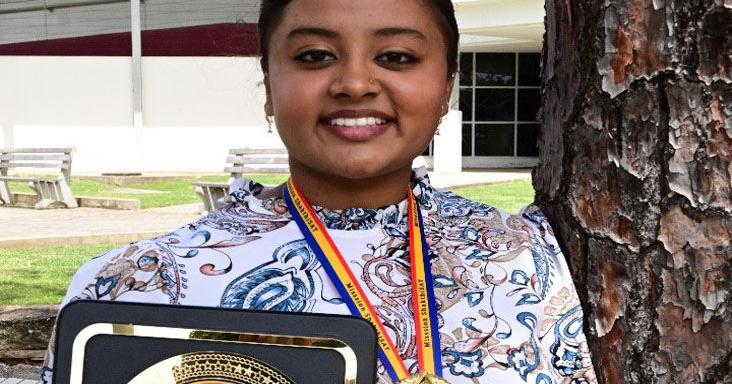
A 19-year-old medical student from Trinidad and Tobago is poised to see her small twin-island nation make global aerospace history, after she returned home from a groundbreaking all-female international space initiative in India that will send the country’s flag to the surface of the Moon.
Kaitlyn Sahatoo, one of Trinidad and Tobago’s official representatives to the ShakthiSAT Mission 2026, recently shared details of her week-long experience hosted by the Indian Space Research Organisation (ISRO) at Gautam Buddha University in Greater Noida, Uttar Pradesh. Held from August 23 to 30, the program brought together 12,000 young women from 108 nations to collaborate alongside leading ISRO scientists and international aerospace developers on cutting-edge satellite and lunar mission projects. Participants gained hands-on training in core aerospace fields ranging from satellite engineering and payload development to leadership and transnational space diplomacy.
According to Sahatoo, the program’s culminating mission — which includes a satellite deployment and lunar payload carrying the flags of all participating nations — is scheduled to launch on October 11, coinciding with the International Day of the Girl Child. While the young student has maintained her core career focus on medicine, the unprecedented opportunity has kept her deeply engaged with the project even after returning home. Sahatoo says she hopes to earn a chance to return to India to witness the launch in person, noting that even if that dream does not come to fruition, she remains intensely proud to have represented her nation on a global aerospace stage.
“It has been a wonderful experience knowing that I went there, represented our small twin-island Republic of Trinidad and Tobago on a mission of that level and scale, and that our country’s flag, I believe, is now going to be on the moon,” Sahatoo shared during a recent interview.
During the program, Sahatoo gained direct practical experience working on 12U low Earth orbit satellite technology, helped assemble and reassemble the engineering model of the ShakthiSAT satellite alongside veteran aerospace experts, and contributed to pre-launch preparations for the upcoming lunar mission. The experience deepened her understanding of core aerospace engineering challenges, particularly the systems that allow satellites to generate and store solar power. She explained that satellite solar panels harvest energy from the sun to recharge on-board batteries, which sustain operations during eclipse periods or when orbital debris blocks sunlight from reaching panels — a technical challenge she says she found particularly fascinating to explore.
Beyond space exploration, the experience has opened new professional avenues that align with Sahatoo’s medical career goals. She now is considering exploring the emerging field of space medicine, a specialty that remains largely untapped in Trinidad and Tobago. She also points to tangible opportunities for satellite technology to transform local healthcare, from remote patient monitoring to large-scale disease surveillance, and says she hopes to play a role in advancing that integration to strengthen the nation’s healthcare system.
As launch day approaches, Sahatoo says her primary hope is that the satellite will operate as planned and deliver the valuable scientific data it is designed to collect. She also hopes her participation will open doors for other young Trinidadians to access similar global opportunities, and has called on the Trinidad and Tobago government to expand investment in youth STEM initiatives, including supporting more young people to travel abroad for hands-on training alongside international scientific experts.
Laura Rambaran-Seepersad, one of two Trinidad and Tobago ShakthiSAT ambassadors who accompanied Sahatoo on the trip, echoed that commitment to expanding local opportunities. In a message shared after the team’s return, Rambaran-Seepersad noted that she and co-ambassador Donna Scoon-Moses returned from the initiative not just with new technical knowledge, but with a global network of professional connections that they plan to leverage to create new local opportunities in space science, satellite technology and STEM education.
Beyond technical work, the program included a Women’s Leadership Summit that brought participants together to discuss pressing global issues including climate change, sustainable development, women’s economic and professional empowerment, and cross-border scientific cooperation. Rambaran-Seepersad emphasized that the next critical step is translating the knowledge and connections gained through the program into tangible, accessible opportunities for young Trinidadians, including structured training, mentorship programs, international research collaborations, and greater exposure to the fast-growing global space sector.
The long-term goal of this work, she says, is to build a clear, accessible pathway for Trinidad and Tobago to play a more active role in the global aerospace industry. “For me, that is the real value of the mission: taking one extraordinary international experience and using it to help create a pathway for the generation that comes next,” Rambaran-Seepersad said.
ShakthiSAT’s core mission, she added, is to ensure small developing nations like Trinidad and Tobago have both a voice and a visible presence in the global movement to prepare young women for leadership in the future of science and space exploration. “Our young people should not only dream about space—they should know that they have a place in it,” she said.