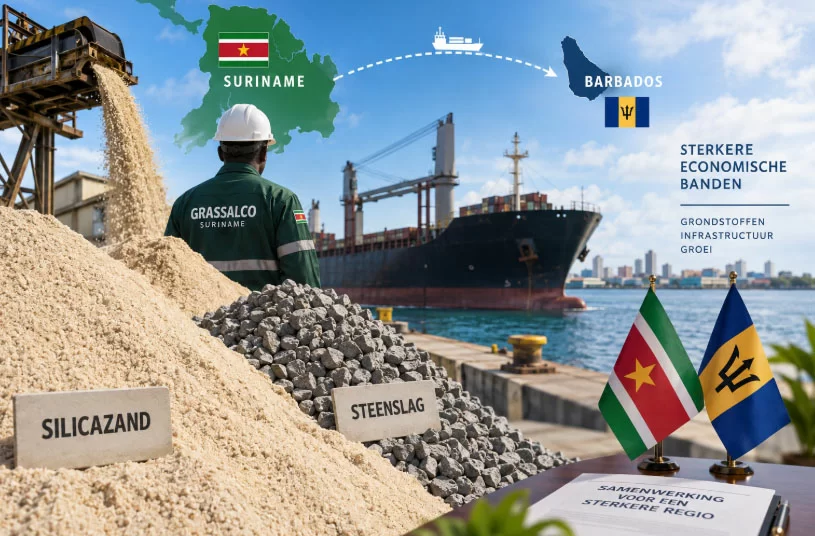
As the Caribbean nation of Barbados ramps up its push for large-scale infrastructure development, it is actively exploring opportunities to import key construction materials – silica sand and crushed stone aggregate – from neighboring CARICOM member Suriname, according to recent high-level diplomatic talks held this week. The push for imports comes as Barbados’ own domestic reserves of these critical building materials have declined significantly, creating a supply gap that needs to be filled to support the government’s accelerated infrastructure agenda.
Senior Minister Kerrie Symmonds of Barbados confirmed the country’s interest in Friday’s discussions, which were held at the Lloyd Erskine Sandiford Centre with Surinamese officials and a delegation from N.V. Grassalco, Suriname’s state-owned mining enterprise. “Historically, we have relied heavily on our domestic deposits to meet our needs for silica sand and aggregate, but those reserves have dropped off dramatically in recent years,” Symmonds explained during the talks. “That means we now have to source a large share of our required construction materials from international suppliers, and Suriname stands out as a natural, strategic partner.”
As a fellow member of the Caribbean Community (CARICOM), Suriname, located on the South American mainland, holds abundant untapped natural resources that can deliver tangible economic benefits to Barbados at a competitive advantage over non-regional suppliers. The ongoing discussions with Grassalco are also part of a broader initiative to revitalize bilateral economic cooperation between the two nations, which was disrupted by the COVID-19 pandemic after the signing of the landmark Brokopondo Agreement in 2018.
The Brokopondo Agreement outlines cooperation frameworks across multiple key sectors, including maritime and air connectivity, tourism development, agriculture and food security, trade and investment, natural resource development, and renewable energy. “Now that the worst of the COVID-19 pandemic is behind us, we are working to restart implementation of the critical commitments laid out in the Brokopondo Agreement,” Symmonds noted. Beyond construction materials, Barbados has also signaled interest in exploring collaborative opportunities in Suriname’s growing oil and gas sector, as well as joint renewable energy projects.
Symmonds emphasized that the longstanding positive political and diplomatic ties between the two CARICOM nations should now be translated into concrete, mutually beneficial economic outcomes. For Grassalco, which was founded in 1971 and specializes in the exploration and extraction of mineral resources including gold and natural stone, a new trade agreement with Barbados could open the door to expanded regional market access for Suriname’s mineral products. If negotiations progress successfully, this partnership could mark the first step for Suriname to establish itself as a leading regional supplier of construction raw materials across the Caribbean bloc.